- Saturday, 6 June 2026

Kirati Folk Stories In English
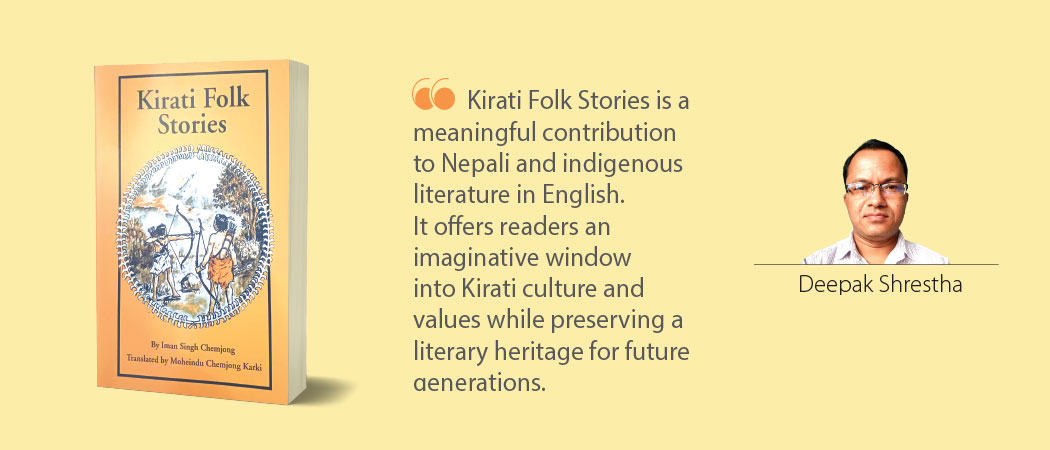

Kirati Folk Stories is a significant literary work that brings the rich oral tradition of the Kirati community to contemporary readers in English. Written by the late historian and scholar Iman Singh Chemjong and translated by his granddaughter Moheindu Chemjong Karki, the book is an English version of Kirati Dantya Katha, first published in 1965. The translated edition was officially released on January 1, 2026, coinciding with the 122nd birth anniversary of late Chemjong, adding both symbolic and cultural value to the publication.
The book consists of 19 folk stories that reflect the beliefs, traditions, worldview, and close connection of the Kirati people with nature. These stories are not historical narratives or scholarly interpretations but imaginative folktales that have been passed down through generations. Set in a time long past, they present a world where humans, animals, birds, plants, rivers, mountains, and flowers coexist and interact meaningfully. Nature is not merely a background in these stories; it is an active participant with voice, character, and purpose.
One of the notable strengths of the book is its structure. Each story appears as an independent chapter, preserving the traditional style of oral storytelling. Most of the stories are brief and engaging, while the longest extends to about 17 pages. Despite their simplicity, the stories are layered with cultural meaning and moral insight. Titles such as The Story of Kalchunda, The Story of Mount Tandong, The Story of Koirala, The Story of the Dog, and The Story of the Nettle immediately suggest their connection to everyday life and the natural world.
These particular stories are especially relatable even today, as they explain the origins of birds, mountains, trees, animals, and plants that continue to exist in Kirati society and households. For instance, The Story of Kalchunda narrates how a bird was rewarded for fulfilling a king’s wish, resulting in the golden beak and feet still seen today. Similarly, stories about Mount Tandong, the faithful dog, the koirala tree, and the nettle plant link ancient imagination with present-day belief and practice. Such narratives effectively bridge the past and the present, making the stories both familiar and meaningful.
Beyond these, several other stories explore broader themes related to ancient spiritual beliefs, the role of gods and priests, and the origin of the Himalayan landscape and medicinal flowers. Figures central to Kirati cultural and spiritual tradition—such as Sumnima and Paruhang—appear in multiple stories, reinforcing their importance in Kirati literature. The book also includes references to the Yuma religion and Yuma Sammang, the revered goddess, offering readers insight into indigenous belief systems. The personification
of animals such as crows, wrens, vultures, snakes, monkeys, and mice adds imagination and vitality, making the stories lively and memorable.
The translation by Moheindu Chemjong Karki deserves special appreciation. She has carefully preserved the originality, cultural depth, and linguistic flavour of the source text while making it accessible to English readers. Although some Kirati names and terms may be unfamiliar and challenging to pronounce, they enhance the authenticity of the work and reflect the translator’s commitment to cultural preservation rather than simplification. The translation clearly aims not only to reach a wider audience but also to safeguard the Kirati language, tradition, and worldview.
Illustrations by renowned artist Tek Bir Mukhiya further enrich the book. Placed throughout the text, the illustrations vividly capture key moments, characters, and emotions from the stories, adding visual appeal and helping readers—especially younger ones—engage more deeply with the narratives. Published by Ekta Books Distributors Pvt. Ltd., the book is attractively designed, reflecting the publisher’s long-standing experience in producing quality books for young readers.
Overall, Kirati Folk Stories is a meaningful contribution to Nepali and indigenous literature in English. It offers readers an imaginative window into Kirati culture and values while preserving a literary heritage for future generations. The book will be especially valuable for students, young readers, researchers, and anyone interested in folk literature, cultural studies, and indigenous traditions.
(Shrestha is a freelance writer.)