- Friday, 29 May 2026

Beautiful Butterflies Of Sankhuwasabha

Sankhuwasabha, also called the Arun Valley, is known for its exceptionally rich natural heritage and biodiversity. In this region, there are various species of mammals, butterflies, rhododendrons, orchids, and rare plants and herbs. Due to the rich diversity of rhododendrons in this region, it is also called the “Rhododendron Capital of Nepal”. Makalu Barun National Park and Conservation Area is also located in the district, which is designated as a biosphere reserve by UNESCO. This reserve has ecosystems such as tropical forests and alpine meadows.
As per the scientific studies, this region is famous for butterfly diversity. Around 31 species of butterflies from nine families are found in the southern part of the district. The Nymphalidae and Satyridae variants of the butterfly family are dominant here. Another scientific study conducted in this region in October 2020 identified the Pale Green Awlet (Burara gomata) in the buffer zone of Makalu Barun National Park. This butterfly species was first identified in the eastern region of Nepal in 1990 during the Japanese Expedition. The specimen of this butterfly was brought to Japan and examined.
The varied geography of Nepal, ranging from the Terai plains to the towering Himalayas, harbours a high variety of butterfly species. As per the recent update in 2024 by Dutch butterfly expert Piet van der Poel, there are 695 recorded butterfly species in Nepal, making up about 3.72 per cent of the total butterfly diversity in the world. This variety of butterfly species in Nepal has caught the attention of some of the most renowned experts in the field of butterfly research, such as British butterfly researcher Colin Philip Smith, fondly known in Nepal as "Putali Bajey". Smith spent more than five decades researching butterfly species in Nepal, documenting hundreds of species, contributing to the curriculum of school education in Nepal, and facilitating the establishment of a butterfly museum in the country. Smith left us in November 2023 in Pokhara at the old age of 88 years.
Butterflies are one of the most studied insect species in the world and are also considered to be one of the most important indicators of environmental health. Of the total butterfly species in Nepal, about 51 per cent are found in the Terai/Shivalik region, 88 per cent in the mid-hills, and 13 per cent in the highlands of Nepal. About 18 per cent of butterfly species in the central hills of Nepal are threatened due to increased human-induced pressures on the environment. Butterfly populations are directly related to climatic conditions.
From a biological point of view, species of butterflies are also considered to be some of the most interesting creatures. They are known to eat only fluids, and for this, they have a long proboscis with which they drink fluids like nectar, water, and minerals. Some species of butterflies are known to "mud puddle" to obtain sodium and other nutrients necessary for reproduction. They are also known to land on humans to obtain sodium and other nutrients from sweat droplets containing salt. They have six legs, four wings, and one pair of antennae, with the antennae used to smell and feel the air around them and taste receptors on their legs to recognise food and host plants.
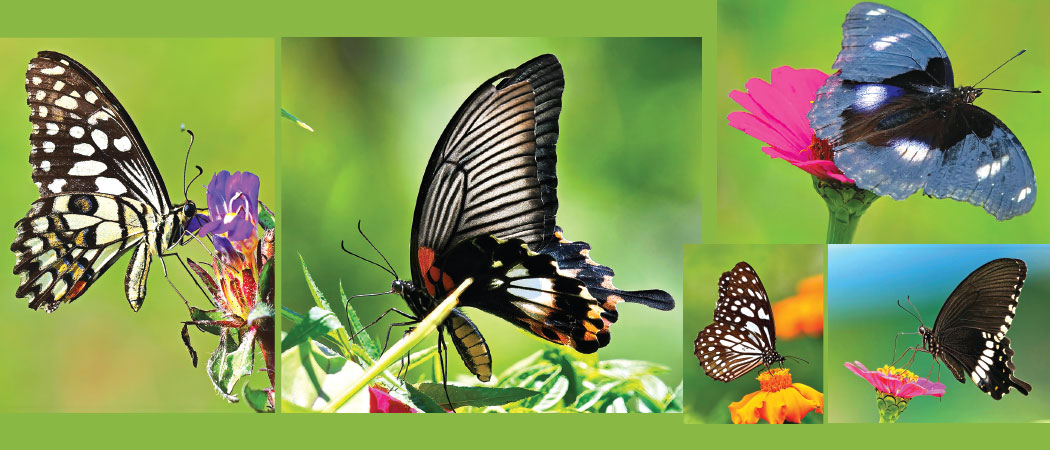
During my 17-day stay in Sankhuwasabha in August 2025, I was able to click pictures of 21 different species of butterflies found at different locations of the district. This experience proved that the district has a tremendous potential for biodiversity studies and research. It is unfortunate to note, however, that many species of butterflies are facing severe threats to their existence. According to the NRDB Biodiversity Profile Project (1995), out of a total of 142 species of butterflies facing severe threats to their existence in Nepal, 12 species are in dire need of strict protection.
(The author is a wildlife photographer. Photos used in this article are by the author.)