- Monday, 8 June 2026

PM Karki's Test Of Statesmanship

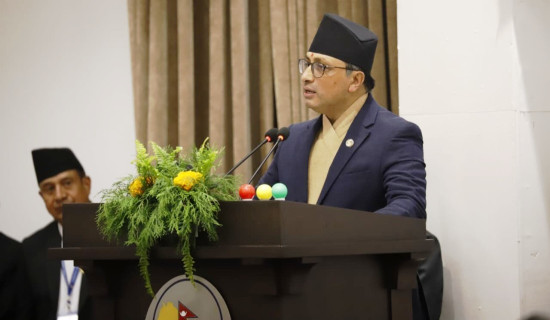
Prime Minister Sushila Karki’s first address to the National Assembly (NA) on 2 February 2026 was an address of a kind that no other Nepali premier has delivered before. It was, however, very characteristic of PM Karki. She addressed the 19th session of the National Assembly from her heart. She sequentially presented facts and stressed the most important issue facing Nepal today—the need to hold elections in a free and fair manner on the date fixed for 5 March 2026. Karki repeatedly mentioned that Nepal is in a state of peril and that the only way to save it is to hold elections on the scheduled time and hand over the Cabinet to the people’s elected representatives.
After the restoration of democracy in Nepal and the transformation into a republic, a series of prime ministers have ascended to the highest executive position. While all were deeply involved in party politics, once in office — except for KP Bhattarai and Man Mohan Adhikari — most tried to retain the premiership despite repeated accusations of corruption and nepotism. Karki represents a fresh breath of political change. She has demonstrated that her love and passion for the country have kept her free from greed for power and corruption of the kind that some of her predecessors have been accused of. Her technical expertise as a lawyer has helped her not only during her tenure as the first female Chief Justice of the country, but also as the first female Prime Minister.
Principled leadership
Karki is an example of principled leadership. She is educated, has excelled in her profession, and, most importantly, leads a simple lifestyle that distances her from greed and corruption. South Asia has had exemplary leaders in the past, including Mahatma Gandhi, Indira Gandhi, Benazir Bhutto, and Sirimavo Bandaranaike, yet leadership in the region has often succumbed to nepotism and corruption for the sake of power rather than national development. In recent times, Bangladesh is a clear example, where former Prime Minister Sheikh Hasina was ousted by the youth. However, Nobel Laureate Professor Yunus, who took charge of conducting elections, has not been able to do so even after more than a year.
After the Gen Z revolution of 8–9 September last year, Karki took oath as the Prime Minister of Nepal. She had been the first choice of the Gen Z youths. Since then, Karki has faced a series of challenges that have come her way, some unprecedented and some expected. But no matter what, Karki must be given credit for the fact that she has not been shattered or shaken by the hurdles she has encountered. While accepting the premiership, she made it clear that her main mandate would be to hold elections scheduled for 5 March 2026 and to start investigations into the deaths and destruction during the Gen Z revolution, together with corruption in the country.
From the day she took the oath until now, she has stuck to her commitments and is heading closer to the election date. She openly admitted to the NA that Gen Z had pressured her into appointing certain individuals as ministers of different portfolios. None of them belonged to any political party when they joined her Cabinet, and some had mentioned that they might have to leave if they later decided to contest the elections.
Her candid confession included folding her hands before individuals such as Kulman Ghising, Mahabir Pun, and Jagdish Kharel to join her Cabinet under pressure from the Gen Z revolutionaries. She also frankly mentioned during her address to the NA that former minister Pun left very angrily, as the Cabinet was unable to pass a few laws he proposed. While those proposals may have been good, there was a process to be followed before amending or passing laws, which could not be completed within the given time frame.
If one scrutinises what PM Karki has achieved during her tenure, it can be said without hesitation that within the past four months, she has established a system of good governance by adhering to her promise of placing the country above everything else. She formed a Cabinet with individuals she did not previously know, listened to pressure from different factions of the Gen Z—including protests demanding her resignation — and eventually accepted resignations from key Cabinet members who were meant to see her through her term to the elections, but instead chose to contest themselves.
A lone missionary
Despite this, she marched on as a lone missionary to accomplish her mission of holding elections on time and save the country “from peril,” as she says. Her determination has also been key in sending a message to both old and new political parties, whom she met regularly, requesting their participation in the elections. This was no easy task, as many leaders of mainstream parties struggled to accept her as the Prime Minister. There were attempts to oust her and reinstate the former Cabinet.
Prime Minister Karki has demonstrated leadership that places the nation above all else and remains determined to conduct the elections. All Nepalis must now support her. It is equally important to cast votes responsibly so that the handover by PM Karki is to elected representatives capable of upholding her determination to keep the country above party and personal ambitions.
(Sharma is a senior journalist and women rights advocate namrata1964@yahoo.com X handle: @NamrataSharmaP)