- Tuesday, 9 June 2026

Improve Capital Expenditure

Nepal is a country struggling with economic development. Budget allocations are made every year for recurrent and development expenditures. In order not to impede development works, the national budget is endorsed by mid-Jestha. However, budget releases are not made in time. Procrastination of the budget releases affects the timely execution of development projects on the one hand and, on the other, the quality of such projects also gets compromised. Moreover, the issue of cost overruns may also arise. Last-minute spending of budgets, i.e., in the last month of a fiscal year, may be attributed to delayed budget releases or apathy on the part of the concerned towards spending budgets promptly.
What is surprising is that the government is compelled to freeze a large chunk of the budget on the one hand, while on the other, several development projects cannot move ahead due to a lack of budget allocations. This shows that there is something amiss in the implementation of budgetary arrangements. Nepal has three tiers of government: federal, provincial and local. Local governments are powerful under the federal setup. Local governments are legally required to announce their budgets by Asar 10 every year in accordance with the Intergovernmental Fiscal Arrangement Act, 2017. Failure on the part of local governments to announce their budgets by the deadline hampers the execution of development works.
No political interference
Non-announcement of budgets on time may be due to internal wrangling or political interference. The concept of local government in the federal structure is such that local governments are autonomous and party politics should not interfere in their affairs. According to the Constitution of Nepal, there are no ruling and opposition parties in local governments. Further, the Local Government Operation Act, 2017, envisions a system whereby all political parties work together to run local governments smoothly. But in practice, such inter-party cooperation is hardly seen. As most of the officials of local governments are affiliated with one political party or the other, they are always influenced by their respective political parties.
Unfortunately, political interference, frequent changes in government or internal wrangling affect development works at local levels. This fiscal year, several local governments, including the Kathmandu Metropolitan City (KMC) and the Dharan Sub-Metropolitan City, failed to present their budgets by Asar 10, 2082. At the time, the KMC was embroiled in wrangling over the administrative officer of the metropolis. The Mayor wanted to have the administrative officer removed, which the federal government flatly refused. Likewise, the Dharan Sub-Metropolitan City could not announce its budget on time owing to its internal conflict.
There is a tendency to approve development projects without studying their feasibility or proper planning. Fragmented projects are approved for the benefit of certain leaders or ministers. Such projects are not for the good of the general public. Some time ago, the interim government scrapped some of such fragmented projects, arguing that these projects were a waste of government funding. The procurement policy is also flawed. As per this, the lowest bidder is selected for any development project regardless of its execution capacity or experience with similar jobs. This may lead to delays in project completion. The quality of work may also be compromised.
Even work may not proceed as per the criteria laid down in the tendering process. So there should be a robust monitoring mechanism. The bridge over the Bishnumat River connecting Teku and Kalimati is a case in point. The bridge was constructed by Pappu Construction, a construction company with a bad track record. The bridge was completed and handed over to the Department of Roads in 2018. Soon afterwards, the bridge was declared risky. The bridge has remained unused since, resulting in a waste of money and depriving the public of using the facility.
There are bureaucratic hassles and red tape in the tendering process. The tendering process is long and complicated. The same company may receive multiple tenders. Disbursement of funds is also sluggish, as it has several processes to be fulfilled. This is one of the reasons some contractors abandon project works mid-stream. Despite adequate budget allocations, spending capacity is low. This could be because of a lack of proper planning for development projects or apathy towards development. People’s representatives may think that they are there for five years only, after which their responsibilities may be assumed by others.
The structure of local bodies is such that no mayor or chairperson of a local body can be removed once elected, unlike in the case of provincial or federal governments. Local bodies cannot be reshuffled, either. Local bodies are, therefore, permanent bodies that complete a full term. There is no provision for penalising such local bodies that do not present their budgets on time. Experts suggest amending the Local Government Operation Act, 2017, to include punitive clauses for local bodies that fail to announce their budgets on time. Federal and provincial governments continue giving budgets to local bodies, violating this legal provision.
Leeway
However, the National Natural Resources and Fiscal Commission has the leeway to slash budgets for errant local bodies. Since 2019, the federal government has implemented the Provincial and Local Governance Support Programme for policy support, institutional building and capacity building at provincial and local levels. The programme aims at streamlining local bodies with robust administrative systems and accountable public financial management so that elected people’s representatives are empowered and enabled to deliver quality service to the public.
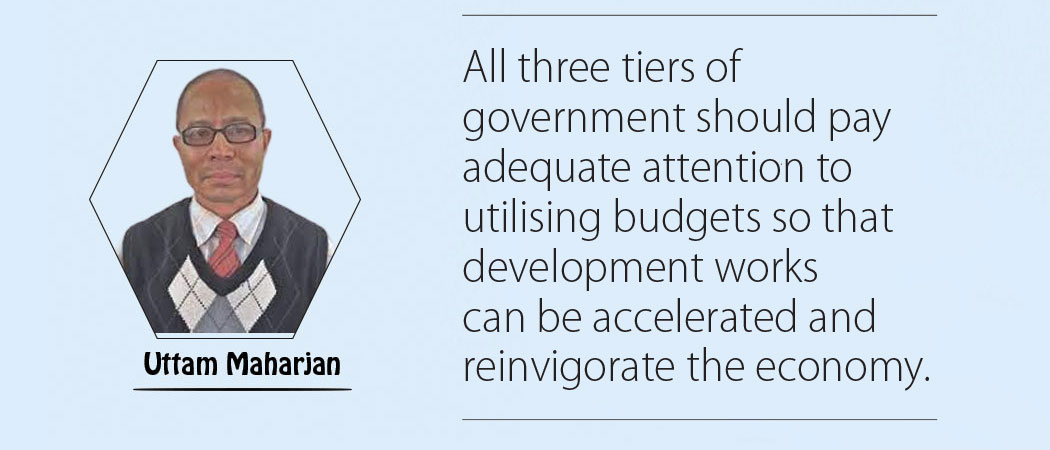
It seems there is no budget crunch; the problem lies in the timely release and utilisation of budgets. By improving budgetary arrangements, the implementation of development projects can be accelerated. For this, all three tiers of government should pay adequate attention to utilising budgets so that development works can be accelerated and reinvigorate the economy.
(Maharjan has been regularly writing on contemporary issues for this daily since 2000.)