- Saturday, 30 May 2026

How The Battle Against Leprosy Paid Off

For many years, leprosy was treated as one of the most dreaded diseases among human beings. The disease was then rampant, feared, and ominous. The ailing person had to live with the disease, thinking of having sinned in a past life. To our satisfaction, people's perception of leprosy has changed a great deal. The government's efforts to control leprosy have finally paid off. There was a time when leprosy had spread across the country. The estimated cases of leprosy had reached 100, 00 in 1966. In 1982/83, 21537 cases were registered, with a prevalence rate of 21 per 10,000.
The government began the Leprosy Elimination Campaign (LEC) in 1999 and 2001. The campaign was highly successful as the leprosy cases began dropping rapidly. By the year 2000 leprosy prevalence rate was less than 1 case per 10,000 inhabitants. The cases further plummeted to 2445 in 2009 with a prevalence rate of 0.89 per 10,000 population. This is no doubt a winning battle against leprosy. However, due to the long incubation period of the disease, complete eradication of leprosy may not be feasible for many years to come. Past experiences have shown that the disease might appear in an infected individual between 5 and 40 years.
Collective effort
Nepal is among 117 countries that have waged an open battle against leprosy. Due to collective efforts, leprosy has now been fully eradicated from many countries of the world. There are only a handful of countries, Brazil, Congo, Mozambique, Nepal, and Tanzania, where leprosy has yet to be rooted out. Though the number of people suffering from leprosy has dropped significantly, people’s attitudes towards this disease have not changed much.
Even today, many villagers do not accept leprosy patients living with them in the same village. They are forced to live on the outskirts of the villages, where a slow and rather painful death awaits them. There is a popular belief among the illiterate denizens of rural Nepal that leprosy is meted out by God to the people who had sinned in their past lives. This is the reason why many people are unwilling to show any sympathy towards the leprosy patients. Literally speaking, there is no one ready to commiserate with their pain and agony.
Despite the seriousness of the disease, many people, mostly living in villages, ignore early signs of leprosy. The stigma of leprosy is so ghastly that its patients just want to hide it from the people. But the disease as such cannot be hidden. Leprosy is a very visible disease. It grows in skin and nerve cells. Red, white patches on the skin and feeling numb are early symptoms. An immediate treatment of the disease is therefore necessary. If a regular treatment is started from the early stage, it can be treated successfully.
With the assistance of the World Health Organisation (WHO), the government has begun free treatment of leprosy. Today, the medicines required to treat leprosy are almost available in many clinics, dispensaries, health posts and hospitals. The medicine comes free of cost. This is the reason why the number of leprosy patients has dropped significantly.
At a time when the overall number of leprosy patients has decreased in the country, its prevalence has slightly increased in the Tarai region. Doctors working in the Tarai say that in recent times, an increased number of leprosy patients from neighbouring districts of India have poured into Nepal for treatment. This has led to an increase in leprosy patients in the Tarai. The medicine to cure leprosy is available free in Nepal. On top of that, the patients are treated much better in Nepal than in India. Since the two countries have an open border, leprosy patients can easily cross the border and come to Nepal. In addition, due to internal migration, leprosy patients keep on moving from one place to another.
Normal disease
Over the last decade or so, the number of leprosy patients has gone down. The situation is somewhat improved in urban areas, where leprosy medicines are available at many medical shops and clinical centres. The media has also played a positive role in the battle against the disease. It has helped spread general awareness among the people by educating them to accept the leprosy patients, because leprosy is a normal disease like many others. However, due to ignorance and superstition, many people living in rural Nepal still hold a negative attitude towards people with leprosy at large. The time has come to launch a mega campaign against leprosy, encompassing rural to urban areas of the country, so that leprosy can be fully eradicated from the country.
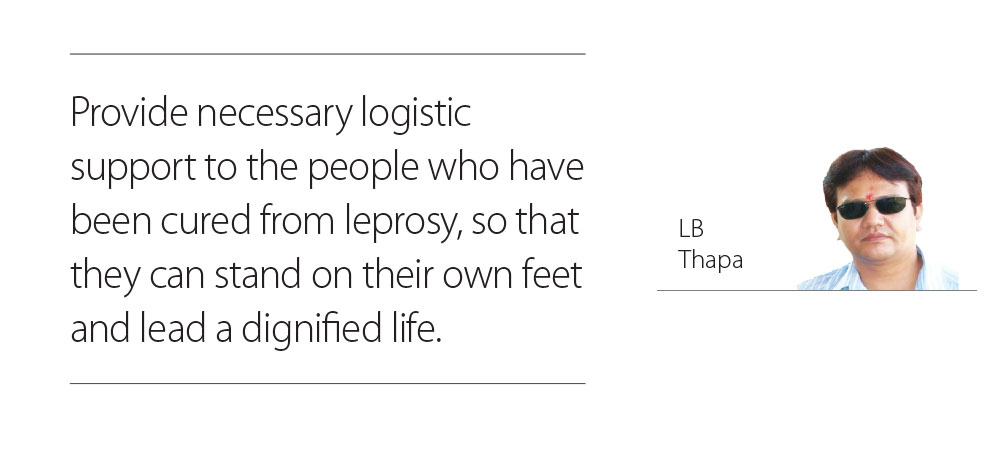
Hence, the government has to play a big role on two fronts. Firstly, make the medicines available to every single person infected by the disease. Secondly, provide necessary logistic support to the people who have been cured from leprosy, so that they can stand on their own feet and lead a dignified life. Nevertheless, there are voices heard that the government is not paying adequate attention to rehabilitating the leprosy patients, who are willing to start a new life. To achieve the desired goal of containing leprosy prevalence, the government must require renewed commitment from all stakeholders, helping to prevent and control leprosy.
(LB Thapa is a Pokhara-based writer and a regular contributor to The Rising Nepal.)
-original-thumb.jpg)