- Sunday, 26 April 2026

Major parties sideline women candidates in Karnali
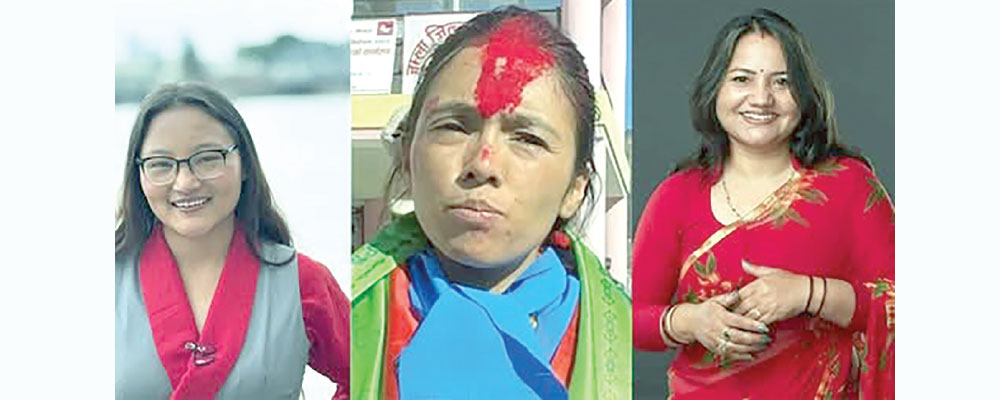
Three women candidates from Karnali Province

By Rajani Yogi,Surkhet, Jan. 25: Women candidates remain highly underrepresented in the upcoming House of Representatives elections scheduled for March 5.
Among both the established and new political parties, the number of female candidates contesting under the First-Past-The-Post (FPTP) system is extremely low.
Despite the constitutional requirement of 33 per cent representation for women through proportional representation, men continue to dominate the FPTP election system.
In Karnali Province, across 12 constituencies in 10 districts, 127 male candidates have been fielded compared to only 11 women. Although political parties have repeatedly pledged inclusive representation, this election highlights a glaring lack of female participation.
The CPN-UML and the Nepali Communist Party have not nominated a single woman in any of Karnali’s 10 districts, despite promoting inclusivity in their manifestos. The Nepali Congress has fielded a woman candidate in just one constituency, Basana Thapa, in Dailekh Constituency-1.
Independent and smaller parties have been slightly more proactive, registering a few female candidates.
The Rastriya Swatantra Party (RSP), which advocates for young and new leadership, has fielded only two women in Karnali’s 12 constituencies.
Similarly, former Chief Minister Mahendra Bahadur Shahi is himself a candidate. UML’s Provincial Chairperson Gulab Jung Shah is contesting for a House of Representatives seat, while Nepali Congress’ Provincial Chairperson Lalit Jung Shahi is running for a National Assembly seat.
The leaders who are part of the bodies responsible for recommending candidates have themselves become candidates. However, no measures have been taken to secure minimum seats for women.
In Kalikot, Jajarkot, and Mugu districts, all 32 candidates are men, with no women contesting. Some female candidates from smaller parties include Tulsi Khadka of Nepal Workers and Peasants Party in Surkhet, Tirthakumari BK of Aam Janata Party, Babita Shahi of Rastriya Prajatantra Party (RPP) and Menaka Shrestha of Aam Janata Party in Dailekh, Prema Damai of Aam Janata Party in Humla, Binita Kathayat of RSP in Jumla, Junu Bhandari of Metheri Party in Dolpa and Kamala Dangi of Rastriya Janamorcha and Anisha Nepali of RPP in Salyan.
Once again, the major parties have failed in selecting candidates, women leaders claimed.
Padma Khadka, a central committee member of UML, said that the candidate selection process lacked transparency. She criticised the nomination process, stating that women candidates are increasingly relegated to proportional representation, which makes direct elections even more challenging.
Bimala KC, Provincial Chairperson of the Nepali Communist Party, said that women rarely get opportunities to contest directly.
She informed that since women themselves are not proactive in seizing opportunities, it becomes difficult for them to make claims in direct elections.