- Saturday, 6 June 2026

West Asia On Brink Of War

The anti-government mass street protests going on in Iran since early this week and the war mobilisation initiated by the US with a threat of military intervention against the Islamic country has brought West Asia ever closer to an all-out war. President Trump's threat to carry out a regime change operation in Iran through Venezuela type military blitz has put the entire Gulf Region on edge, especially in the context of many countries of this region hosting US military bases. In response, the President of Iran, Masoud Pezeshkian, has said that any attack on Iran's spiritual leader, Ayatollah Ali Khamenei, would be treated as a declaration of war.
The street protests, which Iran said were sponsored by the CIA, Mossad and M-6, were depicted by Western media as spontaneous mass insurgency against economic difficulties, corruption and violation of human rights by the theocratic regime, which is under severe economic strain at present. According to Western media analyses, the Iranian economy has gone down because of its association with China's BRI projects, investment in war machinery, rampant corruption and politicisation of religion. But independent researchers say that it is only half-truth, the whole truth is something different.
External interference
Iran, like most of the West Asian countries, takes oil as the backbone of its economy. It ranks 5th largest global oil producer and sits on some of the world's largest oil reserves. Despite being under brutal US sanctions for over 47 years, beginning from 1979, it was doing well in developing alternative trade avenues through its alliance with China and Russia. China was fulfilling 80 per cent of its need for petroleum by importing it from Iran. Iran was selling Sahid drones and other war equipment to Russia despite inflation and its currency losing value. Iran's economy is clearly in difficulty but this situation stems not from Iran's inefficiency in managing its internal resources but from external interference.
As a nation presenting a unique case of endurance and survival against unimaginably heavy odds presented by its history and the realities of contemporary geopolitics. Despite being encircled by hostile ethnic demography, repeated depredation by colonial powers, and constant clashes between theocratic and secular civilisational value systems, this Islamic nation has not only survived but has emerged as a major military superpower of West Asia. This is primarily because of many historical coincidences. It is the most populous country of West Asia, with 91.6 million, consisting of diverse ethnic and religious communities. It is endowed with a vast geography rich in agricultural, mineral and oil resources.
Iran is protected by two strategically placed mountain ranges called Alborge and Zagros mountains, which, according to war strategists funnels aggressors into a narrow land corridor, making them vulnerable to an inescapable predicament. There are two vast deserts in Iran considered the hottest on earth, the Great Salt Desert and Lut Desert, which can singe any potential external intruders who dare to dream of territorial conquest.
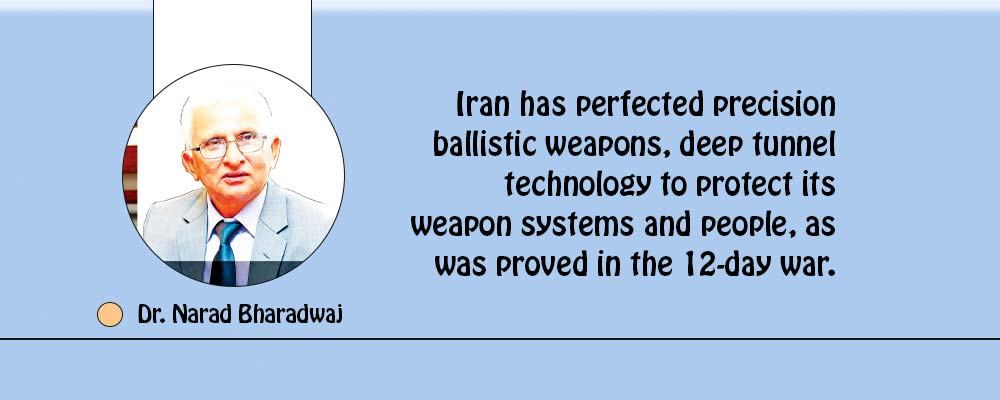
The invention of modern weapon systems and air transport capacity may have rendered the geographical and climatic factors largely insignificant if the objective is to inflict devastation. However, if the goal of war is regime change or control over the territory, these factors cannot be overlooked. Moreover, Iran is a country that is not only endowed with a complex geography, but it has also shown its extreme resilience in using modern technology for its defense as effectively as it has used its geographical features to its advantage in the past. Iran has perfected precision ballistic weapons, deep tunnel technology to protect its weapon systems and people, as was proved in the 12-day war.
Last June, Iran was caught off guard in a decapitating pre-emptive attack by Israel, in which an entire bunch of top military leadership was wiped out. During that war, Israel destroyed a huge number of fighter jets and S-300 Russian air-defense systems, crippling its air dominance at the very first strike. Even then, Iran reassembled itself quickly and mounted a devastating counterattack against Israel. Even bunker buster bombs dropped from B-2 bombers did not succeed in destroying Iran's nuclear facilities in Natanz, Isfahan and Bordow.
Better preparedness
Much water has flown down the Karun River since then in the Zagros Mountains of Iran. Its defense force, RGC, appears in a state of better preparedness. It has improved and replenished its old weapons; most surprisingly, it has also tested its first ICBM with a range of 20,000 km early last week. According to media reports, Iran has replaced its S-300 version of air defense system with the more advanced S-400. Iran is also reported to have acquired the HQ-9 Chinese air defense system comparable in efficiency to the Russian S-400, indicating that the USA must weigh in the China and Russia factor in addition to considering the possible Indian response to the loss of its access to Chabahar port, widely considered to be its gateway to Central Asia.
As the world observes unfolding war mobilisation with trepidation, the US president has publicly withdrawn his threat to attack Iran for the moment, citing Iran's decision to suspend execution of 800 people scheduled to be hanged this week as the reason. But whether the pause in the imminent military action is based on the cool calculation of the stakes involved or only a lull before the storm, will be clear in the days to come.
(Dr. Bharadwaj is a former ambassador and former chairperson of Gorkhapatra Corporation. Bharadwajnarad@gmail.com.)
-original-thumb.jpg)

-square-thumb.jpg)



-original-thumb.jpg)