- Wednesday, 20 May 2026

Pokhara struggles to manage growing waste

By Phadindra Adhikari
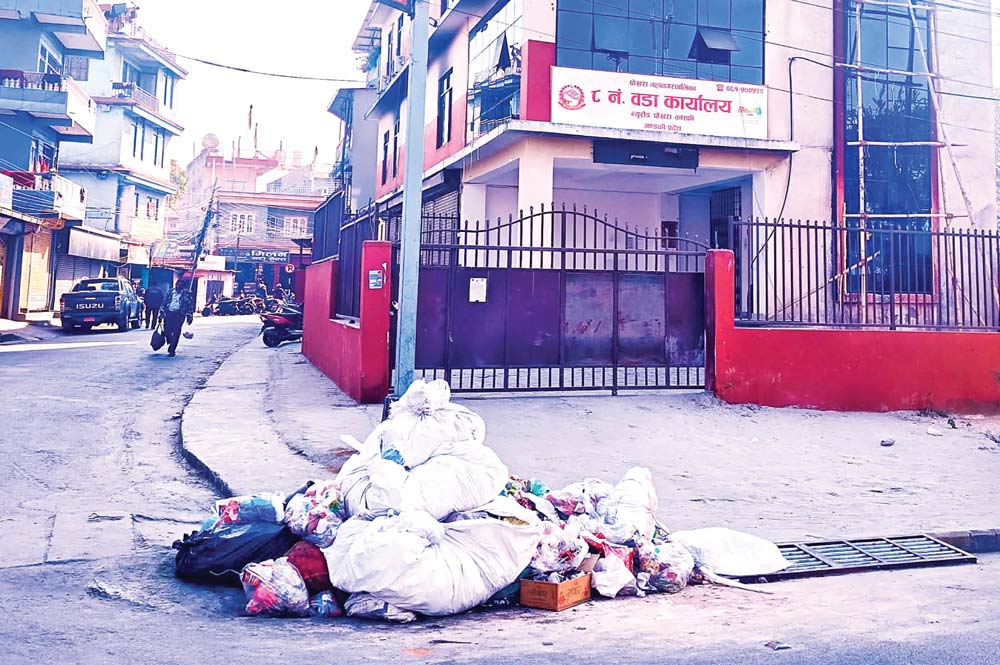
Lekhnath, Jan. 23: With around 200 tonnes of waste generated daily, Pokhara currently has no landfill site. The absence of a landfill site has begun to create foul smells in the tourism capital and has become a major headache for the local government.
Until about two decades ago, waste from Pokhara was dumped into cliffs and deep gorges along the Seti River near China Bridge. On Tuesday, Pokhara Metropolitan City dug pits near the same riverbank and buried waste from the main market area.
After a landfill site was built in Bachchhebuduwa-14 in 2003, Pokhara’s waste was managed there for years. Three years ago, ahead of the operation of Pokhara International Airport, the landfill was closed and a temporary site was identified in Lameahal-32. Although it was meant to be used for six months, waste was managed there for nearly three years.
After the site was filled up a week ago, piles of waste began appearing on roads and public places. The metropolitan city’s plan to build a waste processing centre in Ward No. 33 has not progressed. As the main market area began to stink, the city buried waste from some areas in pits on Tuesday.
Chief of the sanitation section, Harka Gayak, said efforts are underway to find a solution. “We are looking for a temporary landfill site until the processing centre is built.” Although several possible locations have been identified, agreement with local communities has not been reached.
Mayor Dhanraj Acharya stressed the need for collective support to build a waste processing centre at Jhankrikhola, Debrebar-33. The metropolitan city signed an agreement with Terasolve Renewal Pvt Ltd on November 18, 2025, to build the processing centre in Debrebar. Under the agreement, Terasolve will invest Rs. 1.5 billion and hand over the facility to the metropolitan city in operational condition after 21 years.
The centre, to be built under a public-private partnership, will cover 96 ropanis of land owned by 17 individuals. Locals have been protesting, saying waste management should not be carried out there.
Mayor Acharya said coordination with locals, political parties and other stakeholders is underway to find a solution. SANISA programme coordinator Netra Timilsina said the metropolitan city has been unable to secure suitable land for a landfill, as proposed sites have faced opposition.
According to the agreement, once land issues are resolved, the processing centre can be completed within a year, and Terasolve will pay the city a royalty of three per cent of total turnover.
Former mayor Krishna Thapa said the project must move forward in a planned and transparent manner. Thapa, who led the construction of Nepal’s first sanitary landfill in Ward No. 14, stressed that all sides must take the problem seriously.
-original-thumb.jpg)