- Saturday, 6 June 2026

Nepal’s Democratic Resilience And Promise

Nepal has once more given an example to the global community by establishing democratic values and practices, putting the country at the forefront. With the rise of Balen Shah and Gagan Thapa on the horizon of Nepali politics, there is strong potential to move the country towards the progress people have long aspired for. Let us hope that this time, change truly happens in the interest of the nation and its citizens.
The “taking over” of leadership in the Nepali Congress by the Gagan Thapa–Bishwo Prakash Sharma team is an example that should be applauded in South Asia, where even democratic political parties are often controlled by nepotism and senior leaders who are frequently accused of corruption. The change that has come in Nepali politics through the long-required but unanticipated revolt within the party, and the change of party leadership from Sher Bahadur Deuba to Gagan Thapa, is indeed a silver lining amid the dark clouds that have been hovering over Nepal. In fact, it can also be seen as a beacon of hope across South Asia, where national development is overshadowed by political hegemony exercised by senior leaders often facing corruption allegations.
A glimmer of hope
After a long time, with the leadership change in the Nepali Congress (NC) — the oldest democratic party of the country—there is a glimmer of hope for Nepal moving towards stability and peace. The challenge to authority and the dictatorial capture of party leadership by octogenarian and septuagenarian leaders by the Gagan-Bishwo team, leading to the holding of a Special Convention, has been a historic moment not only for the Nepali Congress but also for the country itself. The NC has traditionally followed a culture of abiding by what senior leaders dictate, which is not a democratic value system. However, this was justified for years under the slogan of “follow the leaders” to ensure that a split within the party would not harm the country.
With the advent of a Gen Z-led revolt that shook the political landscape, second- and third-generation leaders within mainstream political parties were compelled to rethink the value systems they had been protecting so far and question whether those systems were truly in the interest of the country. Therefore, although it was not anticipated and Sher Bahadur Deuba and his team tried their best to prevent it, Thapa rose to meet the aspirations of the youth within the party and conducted the Special Convention that made history, placing him and his team in the governing seat of the country’s oldest party.
As the world witnesses Gen Z revolutions in different countries led by youth below the age of 26, the step taken by the Gagan–Bishwo team in Nepal is an example that will motivate many. Within Nepal, as the country heads towards elections on March 5, 2026, amid anticipation and uncertainty, this development becomes a deciding factor in understanding where the old mainstream parties stand and how newly formed parties will progress. Voter confidence in the NC is bound to change now that Thapa has dared to take the step that party youth had long demanded but which had not been possible until now.
Youth protests have always been a force capable of toppling regimes in Nepal. Thapa may no longer fall within the conventional “youth” category, but he has devoted his youth to active involvement as an NC cadre and steadily climbed the ladder to reach the position of party president after leading an internal protest against the dictatorial control exercised by senior leaders accused of corruption, nepotism, and undemocratic practices. He enjoys tremendous support among the youth; therefore, his current leadership has been welcomed as a positive indication of change in the political scenario of not only Nepal but South Asia as well.
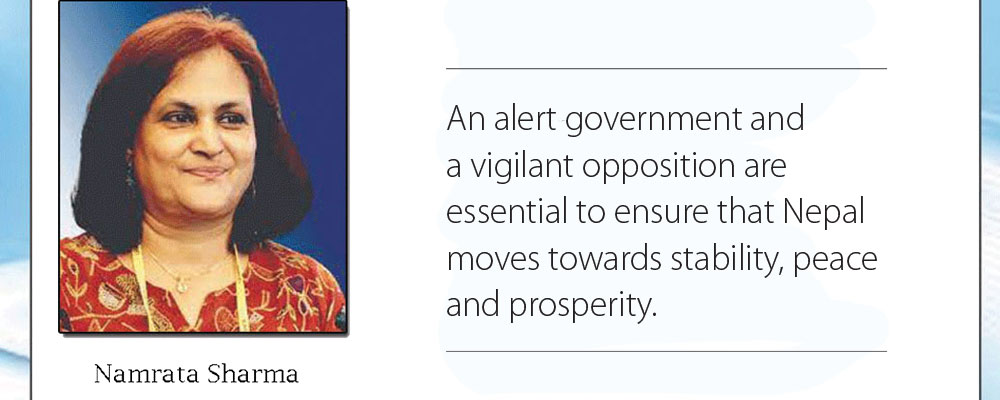
However, until the elections are held in March, the question of what Nepal’s future will look like remains a million-dollar question. Since the restoration of democracy, Nepal has not had a single government complete a full five-year term, adversely affecting national development. Now, amid several revolutionary changes, the focus should be on two key priorities. First, supporting Prime Minister Sushila Karki to hold elections on the scheduled date, and second, encouraging both old and new political parties to work towards a governance system that can complete a full five-year term. An alert government and a vigilant opposition are essential to ensure that Nepal moves towards stability, peace and prosperity.
External influence
Nepal’s strategic geopolitical position often invites external influence during elections to serve vested interests. This time, political parties contesting the election must remain alert to this reality and move forward with the intention of establishing a stable government focused solely on national development. This is possible only when the government remains committed and the opposition takes responsibility as a strong watchdog over governmental actions.
Looking at current developments in the country, there is a high possibility of a coalition government. In the past, Nepali political parties have crossed ideologies and value systems merely to secure parliamentary seats. This practice must stop. Coalitions should be formed strictly in the best interest of Nepal — to ensure necessities for all citizens and provide access to healthy livelihood opportunities that enhance individual prosperity and strengthen the national economy. After the overnight toppling of the Oli-led government and the recent change in leadership within the Nepali Congress, the time has come to ensure that elections are held in March, leading to the formation of a government and an opposition that can pave the path towards development in Nepal and peace in South Asia.
(Sharma is a senior journalist and women's rights advocate namrata1964@yahoo.com X handle: @NamrataSharmaP)