- Sunday, 3 May 2026

Nepali Army restoring Dugungadhi fort
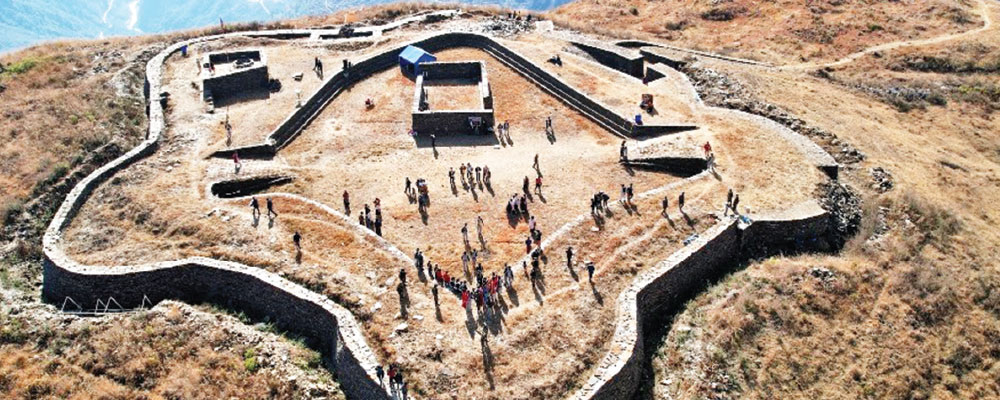
Photo: TRN Dugungadhi fort restoration begins in Bhotekoshi-1of Sindhupalchok district.

BY CHITRA MIJAR, Sindhupalchowk, Jan. 15: Restoration work is underway to revive the historic Dugunagadhi, which was damaged by earthquakes, floods, and landslides. Located in Yarmasing village of Listikot in Bhotekoshi Rural Municipality-1, Dugunagadhi is being reconstructed through combined efforts of the local government and various agencies.
The historic fort, built by the Nepali Army in 1935 under the directive of the first Rana Prime Minister, Jung Bahadur Rana, was severely damaged by the devastating earthquake of April 25, 2015. It is now being reconstructed in its original form under the leadership of the Nepali Army. The fort lies near the Tatopani area along the Nepal-China border.
Spread across about 200 ropanis of land in the upper part of Yarmasing village, Dugunagadhi stands at an altitude of around 2,200 metres above sea level and served as a strategic war fort. Historical accounts show that during conflicts between Nepal and Tibet, Jung Bahadur Rana fired at Tibetan forces from this fort, and his footprints are still said to be visible. Inscriptions also record that Nepali forces worshipped Listimai before using the fort to fight and win battles against Tibetan troops.
Local elder Krishna Bahadur Pradhan said that cannon fire from Dugunagadhi during the Nepal-Tibet war was powerful enough to damage doors and windows of houses as far away as Khasa Bazaar. Elders recall that because the fort was a secure strategic location, Jung Bahadur Rana regarded Dugunagadhi as a decisive site for Nepal’s military victories. To preserve this proud history, Bhotekoshi Rural Municipality and the Nepali Army have been continuously engaged in conservation and promotion efforts. Dugunagadhi reflects an ancient civilisation with its own identity, traditions, and culture.
Dugunagadhi is also a scenic and attractive tourist destination located in a Himalayan region. The area is inhabited by the Sherpas, Tamangs, Chhetris, and Brahmins. As it lies along the Nepal-Tibet border, much of the Tibetan landscape can be viewed from the fort. On the Nepali side, visitors can see panoramic views of the Ganesh Himal range, the Bhotekoshi River, Tatopani hot springs, the Friendship Bridge, Chautara district headquarters, and other scenic locations.
Ward Chairman of Bhotekoshi Rural Municipality-3, Nima Sona Sherpa, said efforts were underway to develop Dugunagadhi as a tourism destination that reflects its historical significance.
To preserve the fort and its history, the Nepali Army has been organising a Mountain Trail Race competition at Dugunagadhi for the past five years. The army has also been conducting trail races and training programmes with the objective of identifying, conserving, and promoting historic unification routes and forts used during Nepal’s unification period, as well as safeguarding military heritage.
Locals have urged agencies including the Department of Archaeology to become more actively involved in restoring Dugunagadhi to its former glory. They have also suggested that all three levels of government allocate budgets and organise tourism-related programmes to ensure the fort’s long-term conservation and promotion.