- Thursday, 4 June 2026

Digitalising Nepal’s Health Sector

Digital technologies are integral parts of our daily lives. More importantly, digital health aims to leverage digital innovations to promote healthy lives for everyone, everywhere, at all stages. Digital technologies are shaping the future of global health. Despite notable progress in digital transformation, there are deepening inequalities, widening the divide between urban and rural areas, and between well-served and underserved health facilities.
In the digital era, deepening our understanding of the interplay between human communities, cultures, and digital technologies is obviously contextual. People’s insights, behaviour, and practices in understanding and adapting to the growing landscape of digital technologies vary within and across societies. In this context, anthropology of digital health is more relevant in terms of understanding people’s beliefs, practices, social norms, and cultural meanings in accessing health information, medicine, and health care in their everyday lives.
Barriers
The innovations in digital technologies for health and education are not only driving growth but also creating barriers in terms of access to these fast-evolving technologies. These technologies may seem new to many and not easily accessible to all. On the other side, building a repository of digital knowledge for appropriate applications requires interdisciplinary ideas and viewpoints from stakeholders across human, social and data sciences.
Additionally, it is important to explore the intersection of technologies and human health. It is of great interest to understand how advancements in information and technologies are shaping health narratives in the digital age. Despite growing awareness, there is limited evidence on people’s choices for digital use and scalability at large.
Therefore, harnessing digital technologies is crucial to improve health and well-being of all. The benefits of digital health are enormous in terms of facilitating access to health care, thereby promoting health equity within and across social groups who are socio-culturally marginalised in societies. Furthermore, it is essential to empower communities through digital literacy for informed decisions in accessing health care. As technology continues to evolve, promoting digital health literacy is vital for achieving equity in access to health services for all.
Nepal has made significant progress in the area of strengthening digital health governance. Despite resource limitations, several attempts are made to establish an interoperable digital health ecosystem. As envisioned in Nepal’s e-Health Strategy 2017, there is a growing need for increased investments in digital infrastructures and scaling up of interoperable digital health solutions.
In essence, the digitalisation of Nepal’s health sector has been a high-priority agenda in recent years. The process started in early 1990, which sought to integrate the Health Management Information System (HIMS) and the Logistics Management Information System (LMIS), which were centrally managed. Moreover, initiatives such as District Health Information Systems Software (DHIS2) and Insurance Management Information System (IMIS) digital software platforms for social health insurance have been largely effective in national health systems.
Political leadership is crucial to ensure that digital health drives equitable, universal access to quality care. Digital tools can make health systems more efficient, affordable, and sustainable. In the early 2000s, Nepal introduced the piloting of telemedicine with the support of technical partners to improve access to health care services in remote areas. Nepal’s Digital Framework 2019, among many others, includes many crucial issues such as data security and privacy at large.
Similarly, coordinated efforts to strengthen electronic medical and health records have already begun, but these are not sufficient to scale up across all health facilities. So far, Nepal’s primary data sources in the health sector include routine data sources such as facility-based Integrated Health Information Management System (IHIMS), Logistics Management Information System (LMIS), Civil Registration and Vital Statistics (CRVS), and programme-specific reporting systems. Other population-based data sources include census, health surveys, and small-scale studies.
Last year, a preliminary draft of the Nepal Digital Health Blueprint was discussed among a range of stakeholders for inputs, which serves as a strategic framework to leverage digital technologies in advancing the Sustainable Development Goals (SDGs) and Universal Health Coverage (UHC). Unfortunately, the digital health literacy is still low at the local level. Therefore, more concerted efforts are urgently needed to enhance the capacity of local governments in accessing, reviewing and utilising health information from digital sources.
Focus
Nepal’s primary focus is on interoperability to strengthen digital health system at all levels. The health systems in remote areas still suffer from inadequate human resources, poor recording and reporting systems, and inadequate digital health infrastructures. In this context, strengthening digital health ecosystem is a very challenging priority in the local context. Yet existing digital health transformation efforts are not efficient to enhance the capacity of local health facilities. Such a slow progress undermines the effectiveness, efficiency and equity in delivering health care.
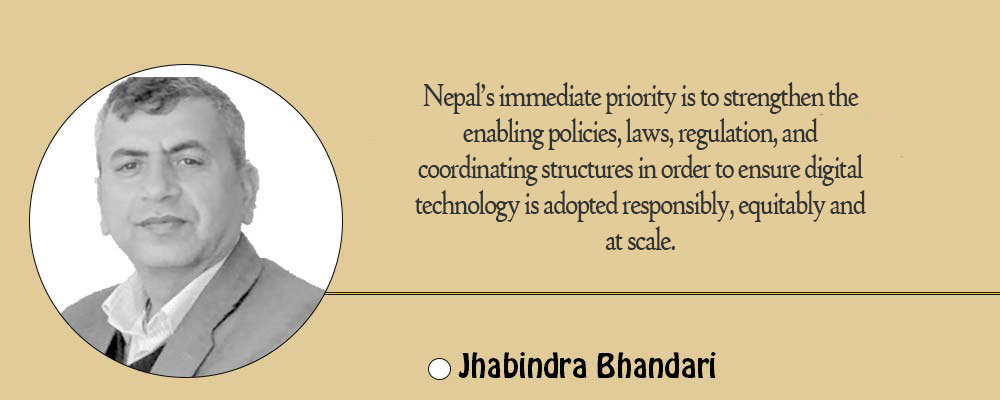
While digital transformation of health is crucial to achieve universal health coverage, existing interventions to strengthen health information systems including use of digital tools and technology are still fragmented and uncoordinated within health sector and beyond. Therefore, Nepal’s immediate priority is to strengthen the enabling policies, laws, regulation, and coordinating structures in order to ensure digital technology is adopted responsibly, equitably and at scale.
On the other side, there is pressing need to strengthen health data governance for maximising the use of health data from human rights and equity lens. With this approach, all people and communities can share, use and benefit from health data at all levels. Towards this end, more concrete actions are needed to ensure health for all in the digital world.
(Bhandari is a health policy analyst interested in anthropology.)