- Sunday, 7 June 2026

Nepal’s Tech Icon
 Aditya Tiwari, Yuwaditya N. Tiwari
Aditya Tiwari, Yuwaditya N. Tiwari
Aditya Tiwari, Yuwaditya N. Tiwari
As we move through the month of Poush, we celebrate the birth of a man who saw the future of Nepal long before the digital age began. In an era where scientific breakthroughs are often attributed to American, European, or Japanese researchers, the story of General Gehendra Shumsher Jung Bahadur Rana serves as a powerful reminder of Nepal’s intrinsic innovation potential. As the modern youth of Nepal spearhead a new wave of technological development, Gehendra’s legacy stands as the foundational blueprint for a scientifically self-reliant nation.
Gehendra Shumsher JBR was the son of Bir Shamsher Jung Bahadur Rana, the third Prime Minister of the Rana regime. Despite his noble military background and the privilege of power, his ambitions were destined for the laboratory rather than just the court. Educated at Durbar High School, Nepal’s oldest modern school, he was recognised early for his creativity and charisma. While he enjoyed music and sports, his true fascination lay in mechanics and ammunition.
His appointment to oversee the ammunition department of the Royal Nepal Army provided the perfect playground for his curiosity. Rather than merely managing inventory, he used this role to conduct experiments and build prototypes, effectively becoming a self-taught engineer at a time when Nepal was largely isolated from the world’s industrial advancements.
One of the most remarkable stories of his career involves a Ford car imported from Britain. To understand how it functioned, Gehendra dismantled the vehicle entirely, studying every component before successfully reassembling it. This exercise led him to manufacture a car of his own, which he gifted to King Prithvi Bir Bikram Shah Dev.
His commitment to indigenous capability was evident in his refusal to rely on imports. He utilised local iron and coal found within Nepal to manufacture weapons and tools. His inventions were not limited to the military; they addressed the very infrastructure Nepal is still developing today. He established Nepal’s first small hydroelectric power plants in Jamal and Sundarijal and designed water-powered rice mills and wind-powered water-pulling motors in areas like Bhojpur and Balaju. He developed the military’s arsenal from single-barreled rifles to the double-barreled Ge Rifle, the Bir Gun, named after his father, and the Dhir Gun, named after his grandfather.
When Dev Shamsher became Prime Minister, he sent Gehendra to Japan to study their technological advancements. Upon his return, Gehendra successfully adapted Japanese technology to the local context, proving that global knowledge could be integrated with national needs.
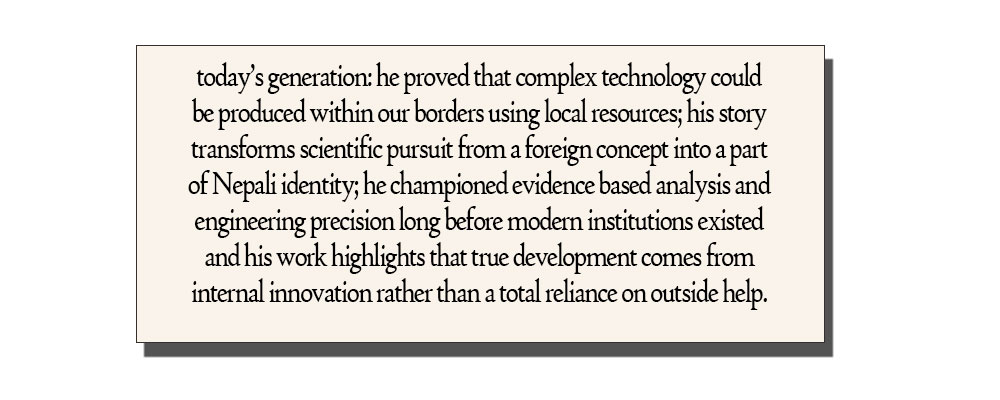
For the modern youth developing apps, building drones, or designing sustainable infrastructure, Gehendra is a critical reference point. His life offers four vital lessons for today’s generation: he proved that complex technology could be produced within our borders using local resources; his story transforms scientific pursuit from a foreign concept into a part of Nepali identity; he championed evidence based analysis and engineering precision long before modern institutions existed and his work highlights that true development comes from internal innovation rather than a total reliance on outside help.
Gehendra was more than a member of the elite; he was a pioneer who dreamed of a technologically advanced Nepal. As the country moves toward a knowledge-based economy, recognising his contributions is not just an act of respect but a strategic necessity. He remains the ultimate role model for every young Nepali scientist aiming to build a self-reliant future.
-square-thumb.jpg)