- Thursday, 14 May 2026

Consensus evolves on private-sector-friendly policies
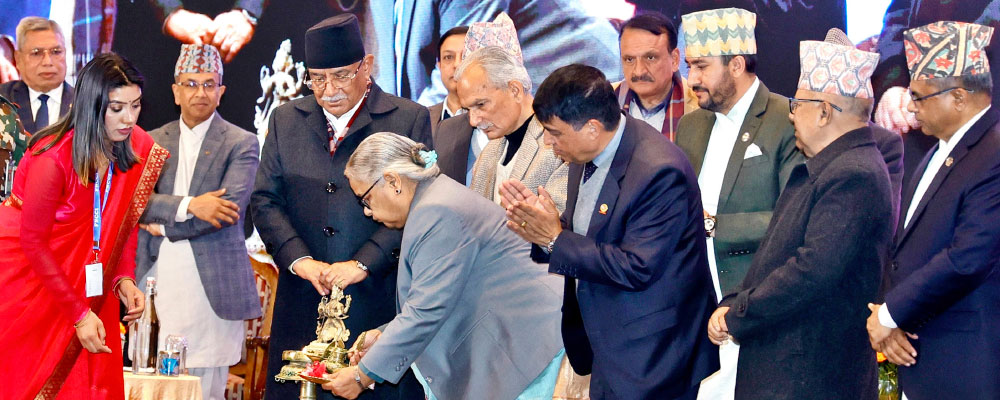

Kathmandu, Jan,1: Demand for private-sector-friendly environment echoed at the all-stakeholder conference on 'cooperation for peace, stability and prosperity' organised by the Federation of Nepalese Chambers of Commerce and Industry (FNCCI) in Kathmandu on Wednesday.
At the conference that brought together major stakeholders of business, politics, youth and the government, the private sector sought a commitment from the government and the leaders of the political parties as well as the representatives of a couple of Gen-Z alliances on respecting the investors and businesses and building their confidence through various policy and other measures.
In response, all stakeholders expressed their full and unfettered commitment to ensuring the security and stability of the private sector and creating an investment-friendly environment.
Shaken confidence of the investors due to the attacks and vandalism on the second day of the Gen-Z movement in September was at the centre of discussion while issues of good governance, better public service and adoption of technology in all walks of business and life also got priority.
The FNCCI created the first-ever platform to bring together the leaders of political parties, business community and youth alliances. Prime Minister Sushila Karki, Finance Minister Rameshore Prasad Khanal, Communication Minister Jagdish Kharel and Industry Minister Anil Kumar Sinha expressed their and government's commitment to good governance, protection of business, economic growth and development, and policy reform wherever possible.
Leaders of political parties – including former prime ministers Pushpa Kamal Dahal Prachanda, Madhav Kumar Nepal, Dr. Baburam Bhattarai, and leaders Dr. Prakash Sharan Mahat of the Nepali Congress, Dr. Rajan Bhattarai of the CPN-UML, DP Aryal of the Rastriya Swatantra Party, and Dr. CK Raut of Janamat Party also expressed their readiness to accept and address the demands of the private sector.
Likewise, Sudip Sheikh and Raksha Bam of Gen-Z movement voiced the concerns of the youth such as unemployment, hassles in business registration and rampant corruption. They also said that the demands of youth expressed during the Gen-Z movement mustn’t go in vain.
Speaking at the conference, private sector leaders – Chandra Prasad Dhakal of the FNCCI, Kamlesh Kumar Agrawal of the Nepal Chamber of Commerce and Birendra Raj Pandey of the Confederation of Nepalese Industries (CNI) and Bhagirath Sapkota of the Federation of Nepalese Industries and Entrepreneurs (FENIE) – demanded punitive actions against those involved in vandalism and damage of business establishments and proper compensation to the enterprises that suffered the loss.
Private sector seeks assurance
President of the FNCCI Chandra Prasad Dhakal said that the private sector still has an impression that an environment for doing business is not created in the country yet.
According to him, they need guarantee of the protection of property, respect to the private sector, support in the recovery of businesses, access to finance and removal of hurdles in business process.
"If we fail, this will impact our future generations so we need to make preparations to hand over a prosperous Nepal to them," he said while adding that the commitments from the government have been limited to rhetoric with many concerns yet to be addressed. In the aftermath of the vandalism of business and private properties during the Gen-Z movement, private sector business associations requested the government to penalise those involved in destruction and demanded a Private Sector Protection and Promotion Strategy (PSPS).
Stating that the strategy is particularly needed at this juncture as the employers, service providers, project developers, revenue contributors are apprehensive of further attacks, Dhakal demanded the government to take strong actions against those involved in arson, vandalism and destruction of properties during the movement.
"Leaving them unpunished will increase impunity," said Dhakal.
Similarly, President of CNI, Birendra Raj Pandey, said that the private sector is in favour of stability.
"Following the Gen-Z movement and its demands for good governance, corruption control and transparency in the public sector, private sector is confident that the country will move in that direction," he said while expressing hope that these demands would be implemented.
According to him, unless there is domestic investment, foreign investment will not come. The biggest foundation for investment is business-friendly laws and policies. Pandey added that increasing investment is not difficult in countries where laws ensure the protection of investors.
President of the NCC Kamlesh Kumar Agrawal said that it is impossible even to imagine peace, stability and prosperity without cooperation among the government leadership, major political parties, private sector and the young generation.
According to him, as the economy has not been managed effectively for nearly six years following the impact of COVID-19 and remained sluggish, the recent Gen-Z movement resulted in human casualties, loss of many young lives, and extensive damage to industrial and business establishments as well as private property. This has negatively affected the overall business and industrial environment and significantly weakened the morale of the private sector.
Likewise, President of FENIE Bhagirath Sapkota said that business confidence is all-time low while the society is in frustration. "The private sector is isolated from national politics, policy making and development process. We want to work with the government," he said.
Govt ready to remove hurdles
The government accepted the demands and expressed commitment to immediately work to improve the investment climate and support entrepreneurs with favourable policies.
Prime Minister Karki said that individuals involved in vandalism and damage in the business during the movement wouldn't be spared and would be brought to the book soon.
Stating that the current transitional government has some limitation, she said that there will be speedy service to the private sector with reduced procedural requirements.
"The government is ready to remove the hurdles to the investment," she said.
In order to incorporate the demands of the protesting youth and desire of people to have good governance and find ways for prosperity, the country is holding an election to elect new leadership, she maintained.
Meanwhile, the government has taken some steps to support the businesses such as extension of tax-submission date, advance payment of insurance claims, implementation of transaction price at the customs, issuance of online tax-clearance certificate, revision in full-audit system, simplification in profit repatriation from Nepal and facilitation in investment in IT business abroad.
"I would like to assure you about all the necessary support to create and maintain business environment," said PM Karki.
Finance Minister Rameshore Prasad Khanal said that despite conducive situation (excessive liquidity, good forex reserve, low interest rate and growing market demand) for investment, investors couldn't be attracted.
Stating that the private sector is often the first target during every movement and civic uprising, he stressed the need for harmonious relations between the private sector and the society.
“The wealth created within the country is meant for the benefit of society as a whole. Damaging or undermining it is a loss for all of us,” said Minister Khanal and added that from the profit of the business, the government receives taxes and revenue, employees receive bonuses, and funds are spent on corporate social responsibility to serve society.
Minister for Communication and Information Technology Jagadish Kharel said that the country has entered fully into the election, and environment has been created for it.
He claimed that the government has set the baseline for good governance.
Similarly, Minister for Industry, Commerce and Supply Anil Kumar Sinha expressed his commitment to implement the private sector protection and promotion strategy.
Focus on 'How to'
Speaking on the occasion, former Prime Minister Dr. Baburam Bhattarai, hinting at the senior
leaders of the political parties, said that the same group of people are talking about the same agenda for the
last two decades but progress is not satisfactory.
"We must focus on 'how to' rather than 'what’ in terms of doing anything. We are about a century back compared to other countries. A country that has 60 per cent people engaged in agriculture can't be led to a path of development," he said.
According to him, it is high time to devise effective policies and strategies to lead the country to industrial advancement from the current agrarian economy.
Dr. Bhattarai stressed on cooperation among the government,
private sector and community, and urged to begin good governance through the institutional reforms in the first stage.
Coordinator of Nepali Communist Party and former PM Prachanda said the leadership of political parties must identify their shortcomings and move towards reform.
He said that elections should be regarded not merely as political competition but as a process of building national consensus. “After the Gen-Z protests, we said that we must move towards national consensus and political unity. An environment for all-party consensus is gradually taking shape,” he said.
Prachanda stated that the current government has succeeded in creating an environment for holding elections despite operating under challenging circumstances, and urged all political forces to focus on elections.
He also maintained that economic prosperity, along with political stability, is not possible without the active participation of the private sector.
“Prosperity can be achieved only through cooperation between the state, the private sector and the community, leading to job creation, expanded investment and increased production," he said.
'Deterioration in rule of law' is a concern
Former Finance Minister Dr. Prakash Sharan Mahat said that legitimising the activities on September 9, peace would be hampered and stability would be impacted while prosperity would be a far-fetched dream.
"So, there should be an agreement on fundamental parameters that the September 9 events have directly impacted the investors and investment, business morale has gone down," he said. "Weaknesses should be redressed and we must be sensitive to the demands of youth, business and society."
Likewise, Dr. Mahat stated that the deterioration in the rule of law is a matter of serious concern.
Leader of the CPN-UML Dr. Rajan Bhattarai stated that the country is in a sen sitive situation where public expectations have gone unexpectedly high and people want the government to address all their aspirations.
"Meanwhile, challenges are increasing in terms of expanding investment and business, attracting Foreign Direct Investment and assuring business environment," he said.
President of Janamat Party Dr. CK Raut said that the government acting on populism and 'please the majority' strategy will create challenges to the private sector businesses.
He said that no political party has private-sector friendly stance and policy and urged for support to the political parties that have such philosophy.