- Monday, 8 June 2026

Challenges To Teaching Digital Natives

Most teachers of language and literature, social sciences, probably also science, technology, engineering and mathematics (STEM) in the metros and semi-metros, may have faced this situation one time or another: Students tend not to do the assigned tasks. If they do, it is mostly AI-generated. In the classroom, you may be delivering a lecture but they are thinking about the chat they had with their teenage crushes, or the last bet they may have put on online games. Bound by professional and ethical responsibility, you demand their full attention, warn them of mentioning their insubordination on their report cards, or warn that their lack of focus in the classroom will be communicated to their parents.
You (pretend to) shout at them, you make a stern, serious face to make them feel that you mean what you say. You come home but you have your students in mind. You go to bed thinking about how to make your lesson more effective the next day, how to convince them that digital distraction is taking a toll on their studies, how to make students pay attention to the subject, and how to motivate them to learn and do better.
Tough job
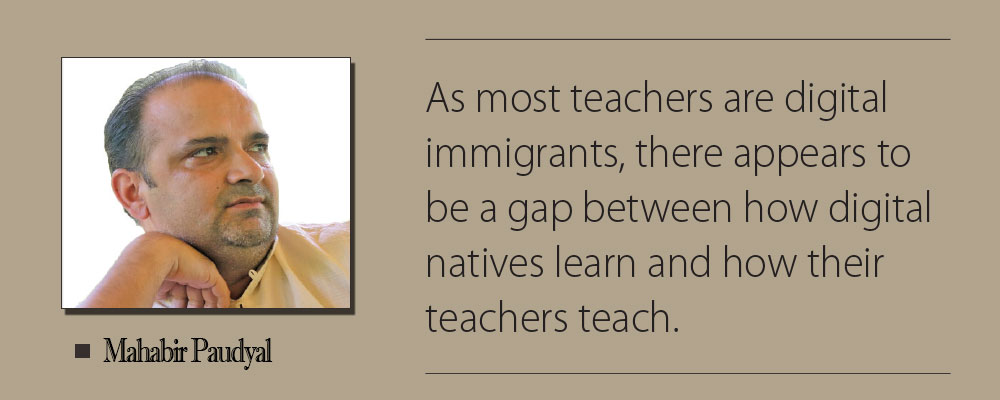
Teaching has never been an easy job. Teaching high school and undergraduate students at this age of AI is far less easy. The digital natives use, or waste, most of their productive time scrolling social media posts and chatting with friends rather than focusing on the lessons they have to learn and the work they have to do. These digital natives sleep with screens on and spend most of their waking hours with the screens. They consider AI tools their guides, they rely on AI to do the tasks given by the teachers, and they think AI is the future. On the contrary, teachers, the majority of them digital immigrants, find students’ overreliance on the digital world to be a great distraction from learning.
But as the students are evaluated based on their hand-written answers in the examination (at least in the global south), a teacher is bound by professional obligation and morality to ensure that his/her students are able to pass the exams with impressive scores–the reason they have to be constantly following up on their learning behaviours and try to check deviations, if any.As early as 2011, in its policy brief, the UNESCO Institute for Information Technologies in Education had stated about behaviour changes of the digital natives: They access knowledge in ‘random’ ‘hypertext’ approaches, cannot concentrate for a long time, multitask, and prefer learning through visuals and graphics rather than reading texts.
Therefore, teaching, as recommended, should take into account the new ways of thinking and processing information of the digital natives and the teachers, whose role will be that of organisers of the interaction between students and knowledge and knowledge mediators, have to take into account the huge differences between them and the students.
But how exactly can that be done? How should teachers teach in the age of AI, when the role of teachers is predicted to shift from being knowledge providers to being values ambassadors, emotional guides, critical thinking mentors, and connection builders? When, as I argued in my previous columns (“To What Extent Can Teachers Use AI (TRN, Dec 6, and “AI in Education: A Double-edged Sword,” TRN, Nov 19, 2025), AI has entered the classroom. What can create a better enabling environment for teachers in this respect?
According to Laxmi Prasad Ojha, Assistant Professor of Teacher Education at Saginaw Valley State University, Michigan, the government bodies and schools must make sustained investments in teachers’ professional development, particularly in relation to digital media and the use of AI tools, to enable teachers to understand how instructional and interactional technologies, including AI tools, shape the learning experiences of students. “The AI is an irreversible force in education, and rather than attempting to resist it, educators must learn to teach in and with AI by guiding students toward responsible and critical use of digital tools, including attention to digital safety, ethical participation, and informed literacy practices as students increasingly engage with technology beyond the early grades,” he said.
Acting upon the recommendations like these can show what exactly they can mean in the Nepali classrooms, and how educators can make the most of the AI tools, if at all, to help students understand the lessons better. Hopefully, the government, together with Nepal’s private education fraternity, will someday show the will and wherewithal to reimagine teaching in the age of AI.
Need of innovation
It goes without saying that teachers have to innovate themselves, forever learn and be updated and be able to rethink pedagogy in the age of AI. The digital age also demands that teachers have more skills and knowledge about their respective subject matters. It is a no-brainer, for example, that an English teacher teaching F Scott Fitzgerald’s The Great Gatsby will be able to deliver it better when he knows the roots and evolution of the American dream, including the context of America’s war of independence and how the country rose to become a global superpower.
A teacher has to be reading more than they used to but ironically, digital intervention appears to be taking a toll on people’s reading habits. Studies show Gen Zs either don't want to read or read way too less. Reading habits among adults, including college graduates, are also on the decline in the US. Nepali academic sphere, not so famous for reading culture, may have caught that malady too: The last time I had a book discussion with my colleagues was around six months ago.
(The author is a journalist and educator based in Kathmandu.)

-square-thumb.jpg)