- Thursday, 11 June 2026

Election Fever Gripping The Nation

With the date for elections to the House of Representatives (HoR) approaching, all the stakeholders have now been engaged with the electoral processes. In line with the mandate given to the incumbent civilian government headed by former Chief Justice Sushila Karki to hold fresh polls on March 5, it has been doing its bit to carry out its responsibilities successfully on time. Major political parties, including the CPN-UML and Nepali Congress (NC), were not fully confident that the Karki-led government formed following the September 8-9 Gen Z movement would be able to conduct free and fair elections.
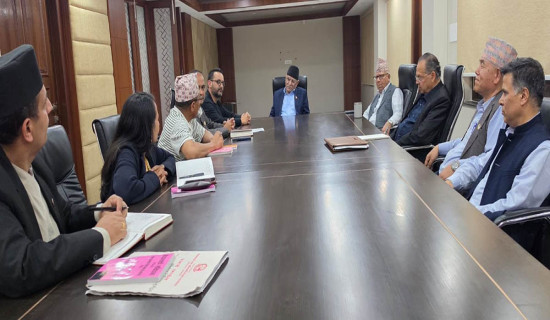
With the intensification of recent talks between the representatives of the government and the key political parties, an environment of trust has been created. As part of the dialogue between the two sides, Prime Minister Karki discussed with top leaders of the Nepali Congress, CPN-UML, and Nepal Communist Party (NPC), the other day. The gathering has not only been instrumental in eliminating the doubt about holding timely elections but also in building trust and confidence between the government and the main political forces.
Poll security
It is noteworthy that, during the meeting with the Prime Minister, NC president Sher Bahadur Deuba, UML chair KP Sharma Oli and NCP coordinator Puspa Kamal Dahal ‘Prachanda’ showed their willingness to take part in the coming elections. Their only demand was that the government ensure the poll security. In response to their concern, Prime Minister Karki promised that the government would make every effort possible when it comes to improving the security situation. She appealed to the top leaders to participate in polls in order to ensure a stable and sustainable democracy in the country.
It was for the first time that UML chair Oli returned to the Prime Minister’s official residence in Baluwater after resigning on September 9. UML and NC lawmakers of the dissolved HoR have already moved the Supreme Court, demanding restoration of the parliament. With the assurance of free timely polls, the major parties are now expected to expedite preparations for elections instead of staging street protests for House reinstatement. NC president Deuba has said that his party would not stand in favour of restoring the parliament. This hints at the party’s willingness to focus on polls.
The fruitful meeting between the Prime Minister and the senior leaders of the major parties was possible in the wake of a gathering convened by President Ramchandra Paudel at the latter’s office some days ago. Since the formation of the new government and announcement of the poll, the President has been telling the political parties to participate in the elections. As a representative of the government, Minister for Communication and Information Technology Jagdish Kharel was also calling on top leaders of the various political parties to take them into confidence. With Nepal reeling from an unprecedented political turmoil following the sudden Gen Z protests, holding new elections is the only way out for bringing the derailed politics on the right track.
Boosting the confidence of the security agencies is a must to ensure election security. Security experts say that the many prisoners who fled jails during the Gen Z protests may pose a threat to election security. A lot of weapons of security personnel have also been looted. Such weapons are likely to be misused during the elections. Keeping all this in view, the government must accelerate the tasks of returning the fugitives to jails and recovering the robbed weapons as soon as possible. The government also needs to make extra efforts to bring those involved in damaging public and private properties, vandalism and other untoward activities so as to discourage criminal activities and help bring an end to the state of impunity in the country.
With the political parties bracing for fresh elections, they must not forget the issues of growing corruption, unemployment, transfer of leadership to young generations and drastic socio-economic transformation as raised by the Gen Z uprising. But the two largest parties in the dissolved HoR—NC and UML— seem least bothered about a change in leadership. Oli has been reelected as UML’s chairman by the party’s 11th general convention held in Kathmandu recently.
Young generation
Although Deuba has announced to quite NC’s leadership as provisioned in the party’s statute, it appears that he, too, is not in favour of handing over it to the young generation. Despite huge pressure from the dissent faction to hold the general convention of the party before the coming by-elections, the establishment group seems to be trying to evade it on one pretext or another. Some top leaders of the party, including general secretary Gagan Kumar Thapa, have declared that they will not field their candidacies for the March 5 polls if the party fails to convene either its regular or special general convention immediately.
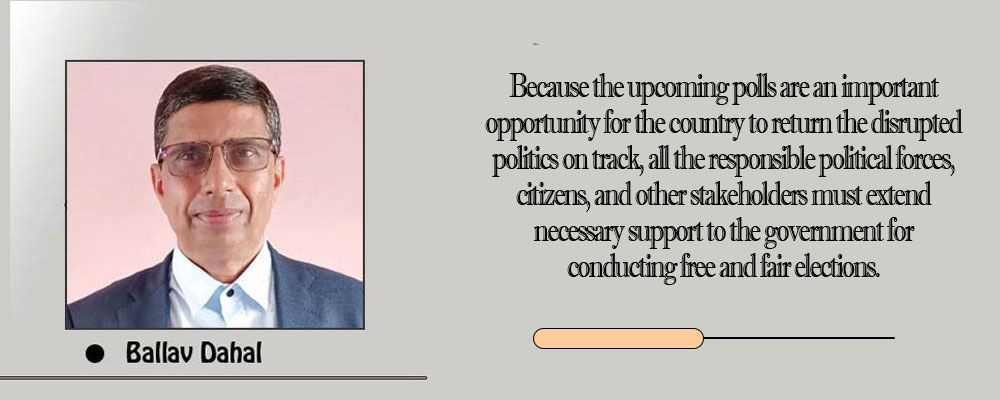
However, numerous other political forces, including new ones, are doing homework to take part in the forthcoming elections. Some parties have started holding discussions on forging an electoral alliance. Meanwhile, the Election Commission (EC) has been preparing to hold the polls. The national election body has brought out the final voter list, with a total number of eligible voters increasing to 18,903,689 for the coming polls from 17,988,570 in 2022. Because the upcoming polls are an important opportunity for the country to return the disrupted politics on track, all the responsible political forces, citizens, and other stakeholders must extend necessary support to the government for conducting free and fair elections.
(The author is a former deputy executive editor of this daily.)
Must Read