- Sunday, 3 May 2026

Federalism key to stability, prosperity: CM Yadav
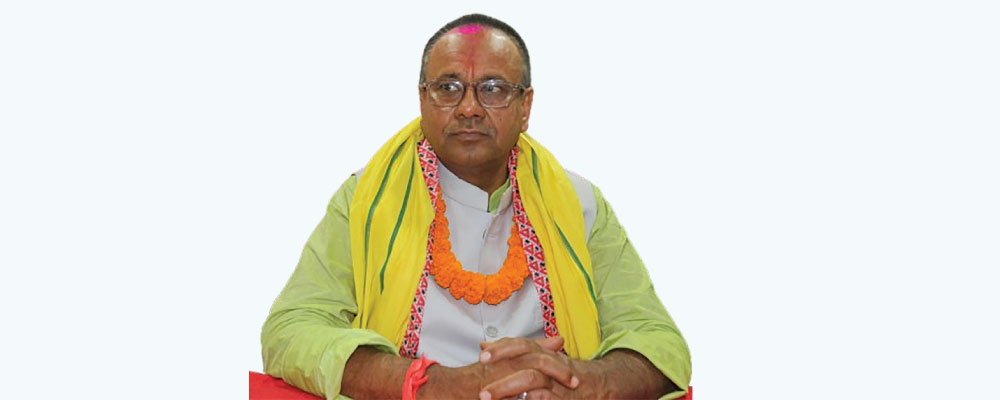

In Madhes Province, widely regarded as the cradle of federalism in Nepal, public attention has focused on the government formed under the leadership of the Nepali Congress (NC). The current administration faces major challenges, including addressing the constitutional crisis, countering attempts to weaken federalism, and overcoming the negative perception surrounding provincial governments. Recalling the NC's historic role in safeguarding federalism, Chief Minister of Madhes Province Krishna Prasad Yadav, has expressed confidence in the stability of the government and pledged to prioritise agriculture, education, and good governance to make the province prosperous. He has also committed to eliminating corruption and the practice of trading development plans. Our Janakpurdham correspondent, Laxmi Chaudhary, spoke with newly appointed Chief Minister Yadav about these issues. Excerpts:
Amid recent political upheavals, leadership in Madhes Province has now shifted to the NC. At a juncture marked by constitutional uncertainty, Madhes, often regarded as the cradle of federalism, has also drawn critical attention. As both the Chief Minister and provincial president of the NC, how do you see this development ?
Federalism in Nepal finds its origin in Madhes Province. The essence and necessity of federalism are most closely linked to Madhes because its people have historically faced neglect. Federalism was introduced with the principles of power-sharing and decentralisation, and it is indispensable for the betterment of the Madhesi People.
Those who oppose federalism are often accustomed to centralised and feudal systems of governance. The true spirit of federalism lies in all seven provinces moving forward with their respective rights, duties, and responsibilities.
We must also acknowledge our shortcomings. The spirit with which federalism was introduced has not been fully reflected in practice. Some actions in the past have caused public dissatisfaction. I believe in action rather than speeches, and I am determined to address and correct these distortions.
The NC itself has faced allegations of unconstitutional practices, for instance, submitting a claim for the chief minister’s post without a formal call from the provincial head a few months ago. How do you respond to this ?
That interpretation is incorrect. We had the required majority. Our objective was not merely to take power, but to prevent the dissolution of the Provincial Assembly and to send a clear message in favour of federalism. Our presence was meant to demonstrate that the NC stands ready to protect federalism. Unfortunately, other parties misinterpreted and misrepresented this move.
The media also plays a crucial role in nation and province building. I urge journalists to highlight positive and constructive aspects, not just negative ones. Responsible journalism is essential.
There are growing concerns that the country is heading toward collapse and that the constitution is being gradually weakened. In such a constitutional crisis, what role should the Madhes government play ?
Federalism is absolutely essential for Madhes. Our duty is to take ownership of the province and make it prosperous and developed. If we succeed, calls to dismantle federalism will lose credibility on their own.
NC is the party that introduced democracy, republicanism, and federalism. It has played a leading role in every major political transformation of the country. In the eight years since provincial governments were established, NC has not had an opportunity to lead Madhes. That is why all eyes are now on us. Now it cannot afford to make mistakes.
How confident are you that the Congress-led Madhes government, formed through a seven-party alliance, will remain stable ?
I am fully confident. All parties that wish to see Madhes become strong, prosperous, peaceful, and happy must support the current government. The government must deliver visible results so that people truly feel the presence of a provincial government. To dispel the negative perceptions created in the past and to safeguard federalism, collective support for the Congress-led government is essential.
This is the time to deliver results. What are the government’s priorities, especially with youth and Gen Z in mind ?
On the very day I assumed office, I committed to ensuring good governance. Our first priority is to streamline public services.
Agriculture is our top priority. About 90 per cent of Madhes’s population depends on agriculture. There is widespread frustration in the sector, and we aim to replace it with programmes that generate returns many times higher than the investment. The ‘Feed the Nation’ programme will be continued.
The second area of concern is education. Many students from Madhes are compelled to pursue their studies elsewhere. Strengthening affordable and high-quality educational institutions locally would help limit this migration.
Are there any specific plans for education reform ?
Strengthening community schools is our primary objective. We will invest in human resources, capacity development, infrastructure, and physical facilities. Given the province’s limited capacity, we will collaborate with donor agencies. There is also a plan to establish an education hub that can accommodate 10,000 to 15,000 students in one location.
Despite being one of the highest tax-paying provinces, Madhes faces an economic crisis. How will you strengthen it economically ?
There are ample internal resources, but they have not been properly managed. I did not become Chief Minister for the title; I am here to work. I will work relentlessly, ensuring that no matter who succeeds me, the legacy of the NC will be recognised for delivering results.
Madhes has long faced allegations of trading development plans. Can Congress put an end to this ?
When I served as Minister for Physical Infrastructure, I reduced plan trading and commissions to zero during my tenure. The same practice will continue. As this is a coalition government, past distortions must not be repeated. I firmly commit that no news of plan trading will emerge from any ministry under my cabinet.
Despite political turbulence, the country is moving closer to elections. How do you view the upcoming polls and coordination between federal and provincial governments ?
Even though elections have been announced, preparations do not appear adequate. With the right preparations, elections can certainly take place. After the Gen Z movement, the morale of the police and administration has weakened, and the central government must address this. The NC and the Madhes government will play a positive role in the upcoming House of Representatives elections.
How likely it is that Gen Z will be included in the Congress leadership through the party convention ?
Leadership in NC is determined through active members. Active membership renewal has not yet been completed. As new members are added, new groups will also emerge, and they must be included. The party president has already said he will not continue in leadership. Once preparations are complete, the general convention will be held.
Finally, as the first NC Chief Minister in Madhes, what message would you like to convey to the people of the province ?
I urge the people of Madhes to take ownership of provincial plans and projects and support them. The government has no room for mistakes. This administration will work to ensure that everyone truly feels the presence of a provincial government. I commit to establishing a result-oriented government by dispelling past misconceptions. Madhes has been neglected in budget allocation despite its population size, and we will work firmly to ensure justice in this regard

-square-thumb.jpg)