- Tuesday, 9 June 2026

Restoring private sector's confidence need of the hour: Gorkhapatra discourse
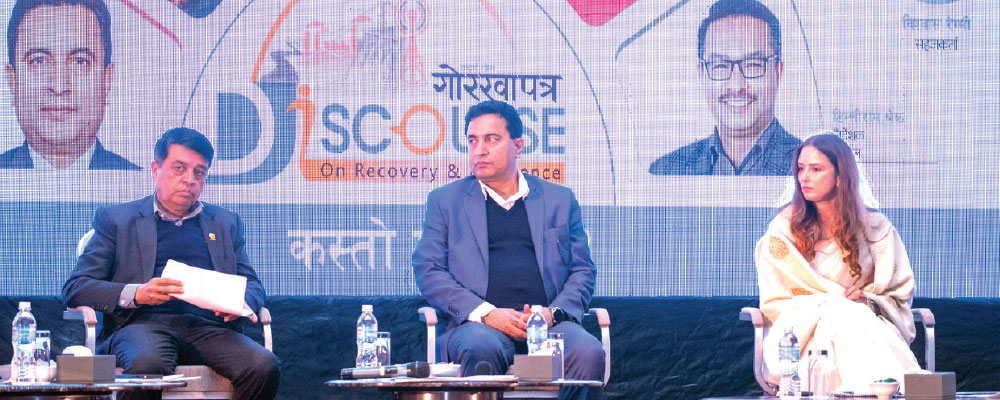

Kathmandu, Dec. 20: Amidst the uncertainty following the attacks on businesses, investments and private properties during the Gen-Z protests, economic slowdown that persisted for a couple of years, excess liquidity, and stunted economic growth, the private sector said that it is ready to move ahead hand in hand with the government.
Stating that most of the economic indicators of the economy are positive, the private sector leaders demanded reforms in tax, customs and forest laws, as well as respect for the business community. Despite four major shocks during the last decade – devastating 2015 earthquake, border blockade, COVID-19 pandemic and Gen-Z movement – the private sector quickly recovered, exhibiting an impressive resilience and confidence.
Speaking at the first-ever national-level 'Gorkhapatra Discourse on Recovery and Resilience,' organised by the Gorkhapatra Corporation (GC) the other day, business leaders said that the government and the Nepal Rastra Bank (NRB) should be proactive in addressing the private sector demands and constraints affecting the business environment.
The rhetoric of 'The government should give only when the private sector demands' should be changed. According to recent statistics published by the NRB, the private sector has utilised Rs. 5,562 billion in loans from the banks and financial institutions by mid-November. This is above 91 per cent of the Gross Domestic Product (GDP) – Rs. 6,107 billion – of the country.
Likewise, according to the latest study conducted by the Federation of Nepalese Chambers of Commerce and Industry (FNCCI) with the support of the International Finance Corporation, the private sector contribution to the national economy amounts to 81 per cent, and the employment share is 86 per cent.
According to Kamlesh Kumar Agrawal, President of Nepal Chamber of Commerce, despite its role as a major employer and taxpayer, the private sector feels publicly vilified and politically exposed. This perception gap has made businesses frequent targets during social unrest.
The private sector's heightened confidence in investment and doing business results in better revenue collection, job creation and economic prosperity. Thus, the government should give priority to the Public Private Partnerships in large development projects, said Chandra Prasad Dhakal, President of the FNCCI.
A national narrative recognising the private sector as a job creator, taxpayer and service provider is essential to counter hostility and misinformation.
Even during the period of uncertainty and fear, customs and excise revenues have gone up by around 10 per cent in recent months. Meanwhile, the number of tourists has also gone up significantly. This can be cited as evidence of expanding economic activity and a partial rebound in private sector operations. However, this growth is largely attributed to the growing consumption, which is largely satisfied by imported goods.
However, despite ample bank liquidity, large-scale investment remains stalled due to legal and structural barriers.
The CEO of Nabil Bank, Manoj Gyanwali, said that it is high time the government utilised the excess liquidity in large infrastructure projects, such as reservoir hydropower projects. This is a pragmatic suggestion because if the government takes away a large sum of money from the BFIs during normal times, funds would be scarce for the private investors.
But now, the BFIs are unable to mobilise their deposits, and overall liquidity has reached Rs. 1100 billion while the foreign exchange reserves are equivalent to Rs. 3055 billion.
The government can also facilitate the hydropower projects of more than 3,000 megawatt capacity so that they can be developed at the earliest.
Likewise, even after a prolonged financial distress, the central bank has taken no concrete resolution mechanism for blacklisted entrepreneurs, prolonging stagnation and discouraging reinvestment. However, signalling a positive step, the Governor of the NRB, Dr. Biswo Nath Poudel, has expressed his commitment to having an immediate review of the issue.
The national debate organised on the occasion of the first newspaper of the country, Gorkhapatra, in its 125th year of publication and the first broadsheet English daily, The Rising Nepal, entering its 61st year in print, also solicited solutions from the government ministers and entrepreneurs.
Finance Minister Rameshore Khanal, Infrastructure Minister Kul Man Ghising, Industry Minister Anil Kumar Sinha and Labour Minister Rajendra Singh Bhandari maintained that there are constraints to investment and business and that the government would take concrete steps at the earliest.
Minister Ghising said that the laws related to forests should be massively reformed and the next 10 years should be announced as 'Development Decade'.
Entrepreneurs demanded that the outdated and impractical laws be repealed or amended in a single, time-bound reform package to unlock stalled investments and infrastructure projects.
Regulations should follow innovation, not obstruct it. Clear, timely and adaptive regulatory frameworks are essential for fintech, digital services and emerging industries, they said.
According to them, a calibrated easing of contractionary policies is needed to revive credit flow, reduce interest burdens and stimulate private investment without destabilising macroeconomic fundamentals. Likewise, an immediate solution to the blacklisting crisis should be sought. A special restructuring and rehabilitation mechanism should be introduced for distressed but viable businesses to prevent permanent economic scarring.
Minister Sinha's commitment to taking strict action against vandalism and arson and to restoring investor confidence and protecting productive assets will reassure the private sector if the government makes quick moves in this direction.



-original-thumb.jpg)