- Sunday, 3 May 2026

NWSSRICDC expands CWIS training nationwide
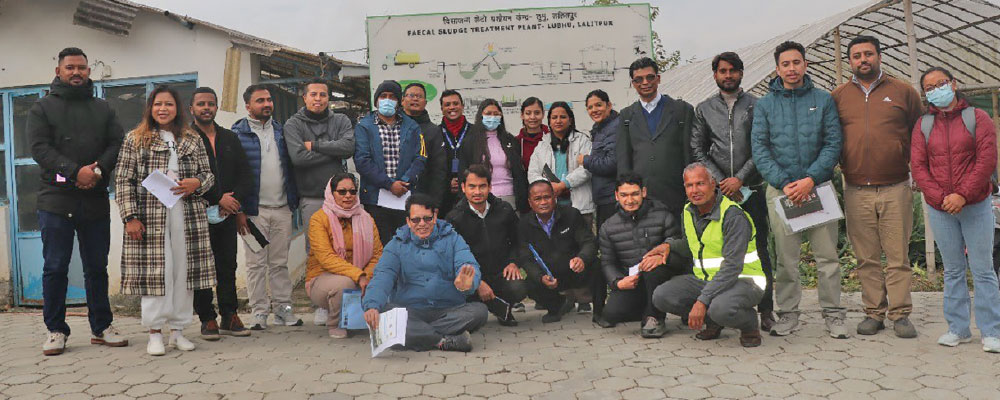

BY A Staff Reporter Lalitpur, Dec. 17: The National Water Supply and Sanitation, Research, Innovation and Capacity Development Center (NWSSRICDC), in collaboration with UN-Habitat and the Gates Foundation, is advancing a series of capacity-building initiatives under the “Scaling Citywide Inclusive Sanitation Service Systems (Nepal)” project.
With several training activities successfully completed and others underway, the programme continues to strengthen Nepal’s institutional and technical capacity for implementing inclusive sanitation solutions across municipalities.
Over the past months, the former National Water Supply and Sanitation Training Centre (NWSSTC)—now expanded as the NWSSRICDC—has been conducting intensive training programmes targeting municipal engineers, government officials, service providers, and urban development practitioners.
“These sessions were designed to deepen understanding of the Citywide Inclusive Sanitation (CWIS) framework and equip stakeholders with the tools to integrate CWIS into urban planning and service delivery,” said Dr. Rajit Ojha, former Chief, NWSSTC.
CWIS is a public service approach to planning and implementing urban sanitation systems, aligned with Sustainable Development Goal 6 (SDG 6).
Under the project, several key capacity-building activities have been completed, including the adaptation of CWIS training materials for Nepal’s context, Training of Trainers (ToT) residential programmes to develop a national cadre of CWIS champions, and technical workshops on fecal sludge treatment plant (FSTP) design, occupational health and safety, and gender-responsive sanitation.
At the same time, additional modules, refresher sessions, and technical backstopping activities are in the planning phase, ensuring that the momentum for inclusive sanitation learning continues nationwide.
Importantly, NWSSRICDC also serves as the government’s responsible body for endorsing CWIS training modules. To date, eight CWIS training modules have been officially endorsed, providing a standardised framework for municipalities and sector professionals to adopt inclusive sanitation approaches across Nepal.
According to Sudha Shrestha, National Programme Officer/WASH (UN-Habitat), Nepal now boasts a growing workforce ready to translate CWIS principles into practice. She emphasised that municipalities are encouraged to actively engage trained personnel in sanitation planning, infrastructure development, and policy integration.
“CWIS training opened my eyes to the real impact of sanitation on people’s lives. Now, every project I oversee considers equity and accessibility, not just construction standards,” shared a participating municipal official.
The project aims to utilise the expanding pool of trained professionals for the implementation of inclusive sanitation systems, while mainstreaming CWIS principles into municipal policies, strategies, and investment plans. It also seeks to strengthen national and regional knowledge hubs to ensure continuous learning, innovation, and support.
The restructuring of NWSSTC into NWSSRICDC under Ministry of Water Supply reflects a strategic expansion of scope—from primarily a training-focused institution to one that also promotes research, innovation, and capacity development in the water, sanitation, and hygiene (WASH) sector, read a statement issued by NWSSRICDC.
Through these efforts, NWSSRICDC, under the leadership of Ram Kumar Shrestha, Executive Director, is positioning Nepal as a regional leader in inclusive urban sanitation.
“CWIS is not just a technical issue, but also a legal responsibility and a human right. The ongoing capacity-building journey marks a shift from learning to action—turning plans into tangible impact.” said Shrestha.