- Sunday, 3 May 2026

Gen-Z demands are relevant

The recent Gen-Z movement has laid growing public frustration with traditional political parties, raising serious questions about trust, representation and the future of party politics. At a time when dissatisfied forces are increasingly visible on the streets and across social media, Nepal is preparing for another crucial electoral mandate.
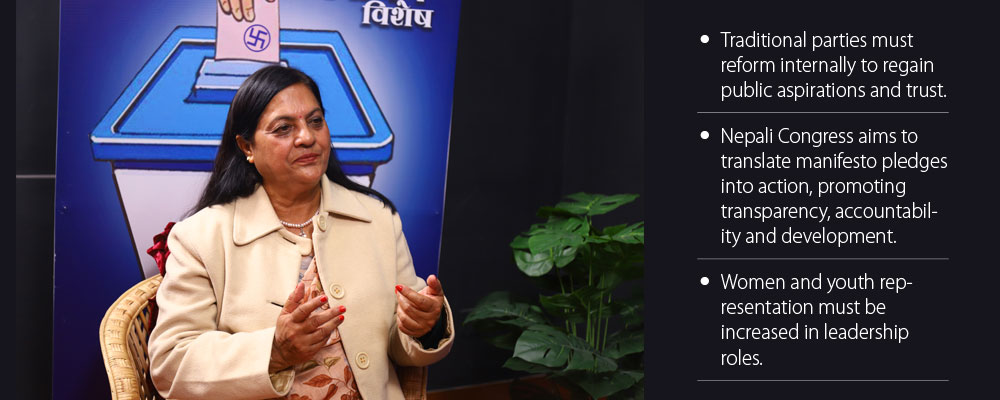
In this context, Arpana Adhikari of The Rising Nepal, together with a Gorkhapatra team, spoke with Nepali Congress central committee member, head of the party’s Women’s Department, former Deputy Speaker and former lawmaker Pushpa Bhusal. In the interview, Bhusal shared her views on the Gen-Z movement, public disillusionment with political parties, preparedness of traditional parties to regain public trust and, increasing youth and women participation in party and state mechanism and broader issues related to the electoral system and democratic practice. Excerpts
How do you view the recent Gen-Z movement led by the youth?
The demands raised by the Gen-Z movement in recent times, calls for good governance, a corruption-free society, and a prosperous Nepal in which young people are fully represented, are, in themselves, highly relevant. While the manner of protest can certainly be discussed and debated, the issues they have raised reflect the aspirations of every household and of younger generations across society. The movement has also conveyed a clear message: to move the country towards prosperity and encourage young people to stay and contribute within Nepal, the government and political parties must act responsibly, civil society must exert pressure, and the media must play a more active and effective role in addressing these demands.
Do you see this movement merely as an expression of dissatisfaction, or as a warning that compels traditional political parties to engage in self-reflection?
The agenda raised by the youth during the protest on September 8 was, in itself, extremely important and deserving of serious reflection by all. However, such issues should have been addressed through transparent and sustained dialogue, by staging protest in streets, raising voices in parliament, through responsible action by those in government, and through active engagement by civil society and the media. Unfortunately, the protest took a violent turn, leading to attacks on political leaders, their residences, national property, and business establishments, the consequences of which were ultimately borne by Nepal and the Nepali people.
The core issues raised by the youth must now be addressed. In Nepal’s context, young people constitute around 42 per cent of the total population, making it imperative for the government and political parties to respond to their demands through their ideas, behaviour, and policies. While the incident involved serious and regrettable violence, it also conveyed a positive message, governments and political parties must become more alert, better informed about public and youth aspirations and more responsive to people’s needs. Elections remain a vital democratic avenue for political parties to engage with the public, reflect people’s aspirations in their manifestos, and implement those commitments after gaining a mandate. Therefore, despite some negative factors, the incident has delivered an important message that deserves serious and thoughtful consideration by all.
Why do you think public dissatisfaction is increasing towards the political parties that played a decisive role in the struggle from the Rana regime to the establishment of democracy?
The traditional political parties that once led major political transformations, from the end of the Rana regime to the establishment of a federal democratic republic, have played a decisive role in shaping Nepal’s political system, international relations, and global identity. They led the peace process, transformed a decade-long conflict into peace, advanced inclusive and proportional representation, and helped institutionalise federal republicanism, achievements that were long-standing demands of society itself.
However, the new Constitution also generated very high public expectations. While it brought major political gains, the country has struggled to meet people’s economic, social, and developmental aspirations, particularly those of youth, women, Dalits, Madhesis, and marginalised communities who still feel excluded from the benefits of democracy. Political instability, frequent changes in government, and an excessive focus on power arithmetic weakened economic priorities and policy delivery. As a result, many of the promises embedded in the Constitution remained unfulfilled, leading to growing public frustration and a negative perception of traditional parties.
In the 21st century, science and technology have connected Nepal’s youth to the wider world, raising their awareness, expectations, and aspirations. Yet, young people appear increasingly disengaged not only from political parties but from politics itself, reflected in declining enthusiasm for party membership. This dissatisfaction is not a rejection of democracy, but a response to unmet expectations. At the same time, independent constitutional bodies and oversight institutions, meant to strengthen democracy and hold governments accountable, must also be reviewed for how effectively they have fulfilled their roles. Ultimately, political parties must reform themselves through more democratic internal practices, lifestyle changes, and genuine competition, while developing clear strategies to attract youth.
Governments and parties must prioritise youth-focused, economic, social, and foreign policies, and provide stronger constitutional and policy guarantees that reflect young people’s aspirations. If such meaningful dialogue and reform move forward, trust can be rebuilt, and political parties and the government can regain the support of the younger generation.
With the House dissolved and elections announced, is simply forming a new parliament enough, or should the incoming leadership show a truly new and effective approach to governance?
Nepal is heading to the elections on March 5 under the mixed electoral system, which we believe should proceed as scheduled. This election is a key mechanism to uphold the achievements of the Constitution, reconfirm parliamentary and governmental structures, and further strengthen democratic governance. However, the mixed system also raises concerns. With so many political parties participating, it is unlikely that a single party will secure a majority. While the Constitution prevents sudden dissolution of parliament for at least two years, uncertainties about government stability beyond that remain. Therefore, post-election, constitutional amendments addressing these issues are essential, and a stable government should be able to serve a full five-year term to implement national policies, plans, and development agendas effectively.
After the Gen-Z movement, with parties rushing to their conventions, can the Nepali Congress elect a leadership that makes the party stronger and more dynamic?
In the upcoming 15th general convention, delegates will be elected from each constituency through a transparent internal election. Political awareness has significantly increased, and younger members within the party are actively seeking leadership roles and responsibilities. This heightened engagement suggests that delegates will vote thoughtfully, prioritising leaders with a clear vision who can transform the party, strengthen internal democracy, ensure proportional inclusion, and connect the party to both national aspirations and the international stage. The strong activity and awareness among members indicate that the Nepali Congress is likely to elect capable, visionary leadership that meets the expectations of the public and the democratic world.
How is the Nepali Congress implementing the Gen-Z movement’s demands for transparency, participation, and accountability in its organisation and governance, beyond just slogans and documents ?
The Nepali Congress has demonstrated that its commitment to transparency, participation, and accountability, values highlighted by the Gen-Z movement, is not limited to slogans or documents but is embedded in organisational and governance practices. The key institutions and laws addressing corruption, such as the Anti-Corruption Act, were established under Congress leadership. Historically, during BP Koirala’s cabinet in 1959, the party actively monitored government decisions, guiding policies on economic and social issues to ensure effective implementation. Congress believes democracy is not only about principles but also about delivering prosperity and development. Its commitment to a corruption-free society and effective governance is reflected in party deliberations, central committee discussions, and policy implementation. As it heads into the upcoming elections, the party aims to translate its manifesto pledges into tangible action, pursuing good governance and a corruption-free society through new strategies and renewed commitment.
Despite Dwarika Devi Thakurani becoming the first female MP and minister in 1959, no woman from Nepali Congress has reached top leadership or become Prime Minister or President. How will the upcoming elections and convention promote youth and women’s leadership?
In 1959, Dwarika Devi Thakurani became a minister, marking the first time Nepali Congress sent a woman to the cabinet in Asia. Since then, women from Congress have held positions up to Deputy Prime Minister and Deputy Speaker, and some ministerial roles. However, women are still underrepresented in key decision-making positions. To ensure meaningful participation, the party must actively promote women internally. The Constitution mandates proportional and inclusive representation, but in practice, even achieving one-third representation in decision-making bodies remains a challenge. Party leadership and rules need to guarantee women’s presence at critical tables, while internal advocacy must push women into leadership roles. Historically, Congress included marginalized women, Dalit women, women from Karnali, and others, in its central committee even before the 2015 Constitution. Building on this, amendments to party statutes and proactive internal measures are essential to ensure women reach decisive leadership positions both within the party and in government.
How achievable is the goal of ensuring 40 per cent women’s representation in parliament by 2030?
Nepal aims to ensure 40 per cent women’s representation in parliament by 2030, but achieving this is challenging under the current mixed electoral system. While proportional representation guarantees 33 per cent women, this may not be sufficient if future constitutional amendments alter the system. To meet the target, introducing women-only constituencies, alongside rotation mechanisms is crucial, as done by countries like Uganda, Afghanistan, and India. Direct elections must guarantee women’s participation and victory, as simply nominating female candidates often fails in male-dominated parties. The Constitution’s preamble recognises proportional and inclusive representation as a fundamental right, guaranteeing up to 50 per cent participation for women in all structures. While federal parliamentary provisions exist, strong political will and legal amendments in the constitution or electoral law are crucial.
You’ve spoken about increasing women’s representation. What measures can be taken to enhance youth representation in politics?
For women, representation can be increased through reservations, but enhancing youth representation requires active engagement within the party. While young people today have knowledge, vision, and awareness, they must first increase their political interest and participation. A young minister alone does not guarantee impact; it is through active involvement in party work that youth can influence the party’s vision, mission, and commitments.
With the party now opening new memberships and holding its general convention, young people who believe in democratic ideals can join, contribute their ideas, and play active roles. When youth enter a party with both vision and participation, it strengthens the organisation and ensures a dynamic and promising future for the party.
How can the Nepali Congress reform its structures to ensure women and youth are represented not only as activists but also in decision-making roles?
Regarding women and youth, they have historically been treated primarily as campaigners rather than leaders. To elevate them to decision-making positions, the Nepali Congress must amend its party statutes to ensure representation of women and youth in key leadership roles, from the central committee to local levels. The party’s provisions already allow youth representation, but further amendments are needed to guarantee leadership roles for women from all communities, including Dalit, Madhesi, Muslim, and indigenous groups. Similarly, in government structures, from the cabinet to provincial and local leadership, youth and women must be given real opportunities. Without granting them these roles, their potential cannot be fully realised. This principle guides the party’s approach to both internal and government leadership positions.
With the Nepali Congress’s 15th general convention underway and the House elections on March 5 which party position are you contesting, and will you seek a direct or proportional seat in the House?
Having contested four times for the House of Representatives, it is natural for the younger generation to ask when their turn will come, and I fully understand that. In my constituency, I’ve encouraged the youth-led district committee to nominate capable individuals where needed, ensuring both youth and women are included in leadership roles. At the Nepali Congress 15th general convention, discussions are underway on statute amendments, leadership selection, women’s representation, and youth participation. We agree that at least one-third party office-bearers should be women, a critical mass to ensure their issues are prioritised and influence decision-making. Having contested multiple elections myself, I am committed to participating without hesitation, but I have currently delegated the responsibility of decision-making to the party. Having been successfully elected to the central committee three times and being a well-respected member, we must step forward ourselves as office-bearers, while also creating space for other women and youth to join the central committee and leadership positions.
Will this general convention will make both party statute amendments and leadership selection? As a former Constituent Assembly member, what constitutional amendments are needed to ensure youth and women’s representation and meet their aspirations?
Currently, some amendments are needed in the constitution, such as ensuring a stable government, since the principle is that once elected, the parliament and government should run for five years. To achieve this, certain changes to the electoral system are necessary, while still guaranteeing proportional and inclusive representation. Similarly, various commissions have been established, including inclusive commissions. In other countries, such commissions are often unified under a single umbrella, which reduces costs and allows fewer members to achieve more. Likewise, the number of ministers could be reduced. By consolidating multiple commissions into a single, more effective body, human resources can be used more efficiently. The constitution already provides mechanisms to ensure women’s representation in decision-making positions, and through amendments, these provisions can be strengthened. The upcoming constitutional debates should advance reforms in a women-friendly, youth-friendly, and transformational direction, supporting meaningful change and inclusive governance.
Social media and digital platforms have increased women’s political participation but have also created challenges. How can political parties turn this into an opportunity?
I believe social media is the best tool to showcase the work of women and grassroots leaders in politics and social reform. The party should create its own media network to highlight these efforts. Leaders must also actively use media personally. Social and digital platforms play a crucial role in establishing youth and women’s leadership, as well as promoting diverse community leaders.
Do you have any message for all the youth, women, and political parties?
First, with the elections announced and around 800,000–900,000 new voters, I believe this is an opportunity for youth and women to engage in politics, play active roles, and establish their leadership.