- Thursday, 11 June 2026

Managing Revolution Of Rising Expectations

The expectations of human beings for quality of life grow with the growth of their consciousness about modern progress. Non-fulfillment of rightful expectations stokes up popular discontent. The ability of human beings to compare their living with others' lives and progress spurs them to expect similar amenities and demand matching improvements. Legitimate expectations of people can be fulfilled by the government within the reach of its resources, institutional capacity and constitutional bounds. For example, basic needs are non-negotiable ones. A government committed to human rights and social justice is obliged to fulfill them and keep the expectations of people within tolerable limits.
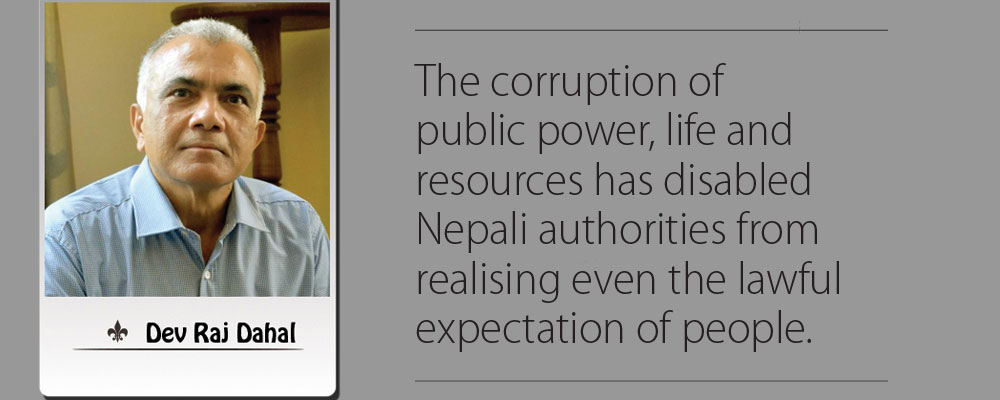
Illegitimate ones arising out of passion, greed and ego of elites stir up anguish, fighting instinct and musters technology and resources to engage in demand articulation, protest and strife. The corruption of public power, life and resources has disabled Nepali authorities from realising even the lawful expectation of people, thus barreling the eloquence of fire, fury and dissent. The revolutionary demands of certain political forces in Nepal remain a flashy show, unable to concretise. It has upset the balance of power in the polity, flagged the tradition and laws and failed to adapt to the evolution of society, civic institutions and the state.
Compromise
In Nepal, each political movement (of 1950, 1990, 2005 and 2022) has added fuel to the revolutionary expectation of people for social transformation but ended in a compromise of interests between traditional forces standing for culture, strong statehood and continuity of national independence and civic power of political parties for the universal conformity to freedom, democracy, free market and change. The modern, digitally saturated, and unorganized force of Generation Z’s expectations of digital liberty, anti-corruption, good governance, and generational justice is consumed by the swamp of their own dissonance and organized political classes.
The Gen Z politics now find a distraction from their demands by the parliamentary election, as the interim government has only this mandate. It is unprepared, weak to synchronise its desperate elements, form organisations, programmes and leadership and support for a politics of patriotism over profits. Its recent position looks like a mouse in a treadmill, not an active pursuit of mutuality with other like-minded forces, thus prompting it to indulge in drills of baffling ineptitude.
The expectation of people and the condition of scarcity in Nepal have failed to balance the competing power of these forces and adapt to their respective demands for national independence, democracy and inter-generational justice. Others collectively symbolise the struggle for the expectation of democratic and development dividends and recognition of separate identities. Social, gender, class, ethnic, caste, regional, communal and professional entities anticipate the fulfillment of their expectations for entitlements, sectoral rights and privileges and share in power and resources. Other demands are arising out of the nation’s commitment to the enormity of constitutional rights and universal humanitarian obligations in matters of labor, minorities and climate change.
These all require mediators, conciliators and adjudicators to bring the representatives of all these forces into an inclusive dialogue, synthesise their legitimate demands and satisfy expectations through a shared constitutional path for sustainable development. So far, each force is trying to diffuse its values in the entire Nepali society for wider support for its individual cause and harness social trust and credibility. But each clashes with the other actor not in goals, which are essential for nation building but in means, attitudes, personalities and political culture. This means democratic stability in Nepal requires the need to evolve a common pattern of political socialisation, teamwork and combined effort that can liberate the nation from the state of chronic crisis, a crisis largely capitalized by noisy protest movements of various actors imbued with sadistic and narcissistic attitudes against each other.
But the needs are to safeguard the integrity of national territory, independence and expedite sustainable progress beyond the show-business of politics. The cult of patriarchs is met with hostility from Gen Z. Nevertheless, the latter could not establish itself in power to spark desirable change. Their failure to reconcile emotion and prudence rewarded it with a dose of torment and dispirited vigor, leaving the revolution of rising expectations of people only tormenting. The deserted partners within many Nepali political parties are weakening their institutional core and adding extra volatility in politics with a revenge mindset whose impulsive energy can release a pathology that by no means is stability-driven or peace-promoting.
The devouring of ideologies by selfish genes has swelled the costs of elections and daily politics, which many small parties and individuals can ill-afford. It is unclear whether elections will produce better outcomes. The political energy that circulates into the collective position of each force is applied more to seize power by either negating, challenging and even displacing the rivals, mobilising the channels of mass appeal to capture media attention that influences politics and engineer new associational swing. Each organises collective action in its symbol, which is justified by its members.
The question of who is the centripetal force to socialise and unite all Nepalis into a common zone of feeling and loyalty, reduce the gap in multiple identities and glue them into national civic culture is a basic one. To be sure, the identification of citizenship with equal rights and duties can build affinity, connections, networks and solidarity to help realize democratic expectations of people so far saturated by flashy promises of leaders. The optimism is that youth leaders from all parties have, in part, confirmed the Gen Z spirit and goals, making top leaders’ paternalism less adoring, if not sterilised. The ongoing fracas within political parties for organisational, leadership and programmatic reforms aims to make them functional to the people.
Long-drawn-out deadlock in politics can reduce Nepali political actors into paralysis. This may invite non-political forces and the deep state to maneuver. One element of rational action expected of Nepali parties is not only to demand but also to offer positive values for cooperative action so that the nation can steer to a path of positive direction and subdue the anarchy of free wills. The sensible question is whether Nepali leaders engaged in political transition are skilled to bring all actors into a common focus of attention of the national crisis or are habitually caught in dry legality?
Are they ready to resolve inter-personal differences within and across party lines for common public interests, bring politics into balance and draw them to a common national vision? Or as usual, routinely pander to inflating their personal egos, leaving people with nervous expectations and finding space in the conflict dynamics while searching for a new electoral legitimacy or wait for the supremacy of the court's verdict for or against the restoration of parliament? Obviously, ego adjustment is a basic problem of Nepali leaders’ political culture. Frustrated elements consumed by irrational nature are spoilers of elections.
The transitional government of Nepal arising out of the mandate of youth revolt outside legal-rational legitimacy has a primary duty to reconcile irreconcilable differences of political actors through regular inclusive dialogues along with the President and Election Commission in steering wheel, create election-friendly security, administrative and political environment, ease communication among them for a modified behaviour, transcend personal interest, deliver public goods to people and coordinate all institutional structures of the polity for a modicum of political order. The challenge is how to neutralise those who do not have trust that elections take place on time.
Maladaptation of those seeking radical transformation, comprehensive reforms of political economy and constitutional status quo can only open another cycle of conflict and provide an entry point for geopolitical forces to step in and ignite conflict density, intensity and scale and soaring of burdensome demands on the Nepali government to dispense. The turbulent situation is bound to inspire several forces to bargain for space, power and resources and keep the condition of political stability at risk. In this context, sensible media, public intellectuals and leaders have a critical role to highlight the costs of confrontational politics among high-leverage actors for a weak state and benefits of peace for its people.
Political roadmap
This can reduce the scale of distrust and confusion pervading the political landscape, put the brakes on conflict escalators and craft a political roadmap for a future political course that is better than the existing one. It might help mollify the anxiety reaction of Nepalis and furnish an insecurity-abolishing option. It is equally vital to educate about the condition and boundaries of the Nepali political system. Every political order must find a judicious balance between the reasonable interests of individual leaders representing political parties beyond their rewarding careers and status and the imperatives of the state. The conflict between the civic power of parties and the legitimate power of the state can polarise worldviews, laws and policies.
In such a context, the interim government cannot perform its functions with respect to electoral initiatives, law and order and supply of public goods to people. Different reaches of political life in Nepal that swarm to face each other cannot be concerted by any artificial appeal of ideology but by contextual, informed and inclusive dialogue to evolve mutual understanding among political actors about the art of governance consented by electoral zeal and statecraft.
The second is a rebound investment-friendly environment to recover the infinite regress of social psychology and economy to satisfy most of Nepalis' material needs, education, health, job and infrastructural development. The third is the revitalisation of democratic institutions and rules that are no longer governed by anarchist, patriarchal or deep state impulses but by the constitution, tradition and cultural norms of life that do not negate any other but satisfy legitimate expectations of people through norm-governed politics.
(Former Reader at the Department of Political Science, TU, Dahal writes on political and social issues.)
Must Read