- Sunday, 3 May 2026

A Letter To Pashupati Shumsher JBR

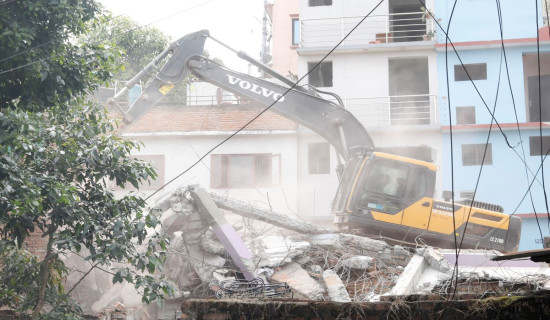
When I witnessed the burning flames of Singha Durbar, along with several other monumental buildings across the country on September 9, I felt as if my Topi of pride and dignity were burning with them. I cannot imagine what must have gone through your heart and mind as you watched the building where you spent your early childhood being turned into ashes. I cannot explain what kind of anguish drove the young people to destroy the very foundations of their own country. Nor do I understand why the Army, stationed to guard the building, was unable to stop the mob from entering Singha Durbar.
It appears, however, that the message of the revolt was not communicated across the political level. No effort was made so far to understand desperation of the youths who were prepared to destroy huge properties. Whether it was spontaneous action or brewed over a long period of time and whether it was a local action or propelled by foreign hand, the truth will one day come to the fore. Questions like why the state apparatus failed to withstand the public anger, what the appropriate actions should have been to calm the situation and how the unrest could have been contained, still linger.
Political developments following the revolt, however, look quite different. The establishment interpreted it as an assault on the constitution. The interim government is now working to hold polls to safeguard the constitution. Political parties are now preparing for their party conventions to face the election. What remains unclear is the political agenda they will pursue to address the demands of the Gen Z movement. Some parties have suggested allocating more seats to youths, while others are preparing to include a few Gen Z leaders in the proportional representation list. The main question is whether these measures will address the demands of Gen Z, such as political stability, good governance, and action against corruption.
Obviously, the Gen Z revolt was an outcome of bad governance over the decades. The anti-Panchayat mass uprising was to establish democracy and good governance. However, after the fall of the Panchayat system, the government institutions that had been built under it —at every level from village to central — began to follow party-political norms. Student wings were created in schools and universities, and industries established during the Panchayat era were either privatised or closed.
When the Maoists began their armed insurgency, peaceful villages turned into fearful battlegrounds. Youths were left with only two choices: leave, or join the insurgency. As the young people departed, the agricultural economy collapsed, while the cities offered no employment opportunities. Eventually, many opted for foreign employment simply to survive. The fancy promises of various movements served only to enrich their leaders, fuelling deception, hopelessness, and anger among the masses.
The destruction of September 8 and 9 was estimated to amount to nearly one third of our GDP. Nepal now stands at a crossroads: either rebound toward the glory of its past or risk disintegrating into various kabilas of traditional communities. Institutional decay and corruption are visible everywhere. In such a grim situation, it is difficult to pinpoint where the rebuilding process should even begin.
In my opinion, there could be two initial areas for intervention, from which we can add more bricks as we move forward. The first is to revive the rural economy so that income and employment opportunities can be created, helping to check the pace of urban migration. At present, investable capital is piled up in commercial banks, yet credit demand has not increased across the country because the working environment in the rural areas has not improved.
Therefore, the capital accumulated in commercial banks can be utilised to regenerate demand on the ground. The Gen Zers can be mobilised across the country so that they gain a deeper understanding of rural problems and, in the process, a future generation of leadership can be developed. The second area is to rebuild the capital, Kathmandu. For centuries, Kathmandu has been the identity of Nepal. However, after September 9, it looks like a ghost city. In rebuilding Kathmandu, Singh Durbar must come first, because it is, once again, the central identity of the capital.
At this point, I would like to make a humble request for you to consider undertaking the rebuilding of Singh Durbar. Given that it was originally constructed by your great-grandfather, it seems fitting for you to be associated with this project. Clearly, it will require a substantial investment. I recall one of your interviews in which you mentioned visiting ancestral land that, by then, had road access and significant market value.
I am not aware of whether you have similar properties elsewhere, but at this stage in your life, such assets may no longer serve a personal purpose. Allocating them to this monumental project would be a remarkable contribution to Nepal and a legacy that could be remembered for generations. After rebuilding it, you can display a grand plaque at the front gate of Singh Durbar, bearing the inscription: "Built by Shri 3 Maharaj Chandra Shamsher JBR and Rebuilt by his great-grandson Shri Pashupati Shamsher JBR."
I sincerely hope that you will view my proposal favourably.
(Dr. Paudyal served as the Director General of the Center on Integrated Rural Development for Asia and the Pacific (CIRDAP) Dhaka, Bangladesh.)