- Sunday, 3 May 2026

Challenges Of Using AI In Academia

Students and teachers used to heavily rely on textbooks and other reference resources for teaching/learning until two decades ago. When the Internet came, though it was very low speed, they started searching on websites in order to explore more information on the required content. Now, the scenario has totally changed. AI is being used excessively in every corner of the world, whether efficiently or not, in academia.
AI has many applications in almost every field, such as engineering, scientific research, and creative writing, among others. Its application in academia is no exception. AI has been an integral part of people's lives. Most of people use AI every day for many reasons. We can get whatever we want in AI by just typing a prompt, and the answers that we get amaze us. Therefore, it is necessary to use AI in academia in such a way that it should help us to be more creative and research-oriented rather than just blindly copying/pasting, user.
Paid version
I had not used AI (in particular ChatGPT and similar) as much before I started pursuing MTech. I used AI almost every day when I was an MTech student. I had to subscribe to the paid version, not just because it eased my study but because it was essential for studying the way I needed to. In addition to simply knowing the basic uses of AI, you should also be able to analyse the answers it provides and filter out what you actually need. Given recent technological advancements and scientific development, AI must be accepted. You have to use it in academia.
There are a lot of complaints regarding students’ learning behaviour—that they have almost quit reading standard textbooks and trying to solve the problems that they are given, because they use AI just to get direct answers. AI should be used differently. For instance, even after reading a book, taking teachers’ lectures, and self-studying, if you aren’t getting concepts clearly, you can use AI there. Similarly, you can use AI to do some routine work that would not help you learn something new.
Except for regular course contents, you can learn advanced-level concepts in more depth than your teacher may cover in the classroom by using AI. Teachers can also use AI for various tasks, including designing assignments that promote deep learning through research, enhancing content understanding, exploring different efficient teaching approaches, and saving time on routine paper checks and PowerPoint slide preparation. The only thing you need to remember is that you can learn as much as you want from AI if you are honest and hard-working.
Academic institutes should introduce policies and strategies to teach students to use AI efficiently. Neither can restrict students from using AI, nor is it beneficial to do so. They should teach and give problems such that students would not get answers just by typing for a few seconds but by studying several documents, brainstorming, and cross-checking AI answers and their own deep thinking.
Almost all prestigious institutes throughout the world have already started teaching students to be able to extract as much as possible from AI and cope with it without killing creativity and real learning. Institutions should develop clear policies and guidelines for academic AI use, train students to analyse and verify AI-generated content, introduce AI literacy as part of the curriculum and design assignments that require reasoning, creativity, and originality.
AI has enormous potential when used constructively for literature review and research summarization. AI assists in scanning large volumes of journal papers and generating structured summaries that save time for deeper analysis. It helps students refine grammar, improve articulation, and write more confidently. AI tools can solve problems in mathematics, programming, and simulations, helping users understand steps instead of memorizing solutions. AI can generate videos, diagrams, and animations to explain complex scientific processes and adaptive AI platforms identify weaknesses and suggest tailored materials.
Self-learning tool
Alongside benefits, AI poses certain limitations and risks. One challenge is misinformation, as AI may produce incorrect or partially accurate responses if the prompt is unclear or the data is insufficient. Another concern is the digital divide.
Access to AI tools is unequal, and students who lack digital resources may fall further behind. There is also the risk of overdependence, where students may lose problem-solving ability, originality, and deep thinking if they rely solely on AI-generated content.
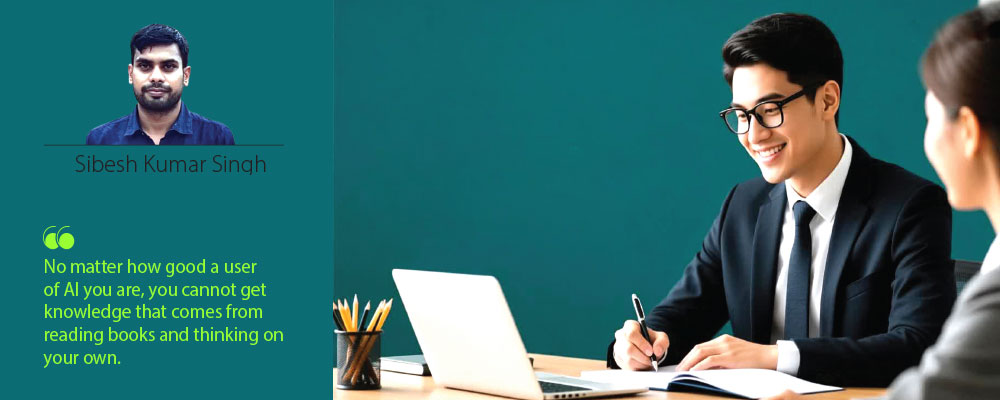
No matter how good a user of AI you are, you cannot get knowledge that comes from reading books and thinking on your own. AI should be used as a supporting and self-learning tool. By just copying/pasting the use of AI, you would be just overcrowded with information that may not be useful for you.
There has been a lot of research on making AI more powerful. Hopefully, in the coming years, it will evolve differently from what it is now. It would be fascinating to see its further development in the near future. However, one thing is that it would ease our teaching/learning practice and bring a revolution in our education system. Using AI efficiently in academia would certainly help research-oriented teaching/learning.
(The author is an engineer at Bardibas Municipality in Mahottari district.)