- Sunday, 24 May 2026

Govt, Gen-Z sign 10-point accord
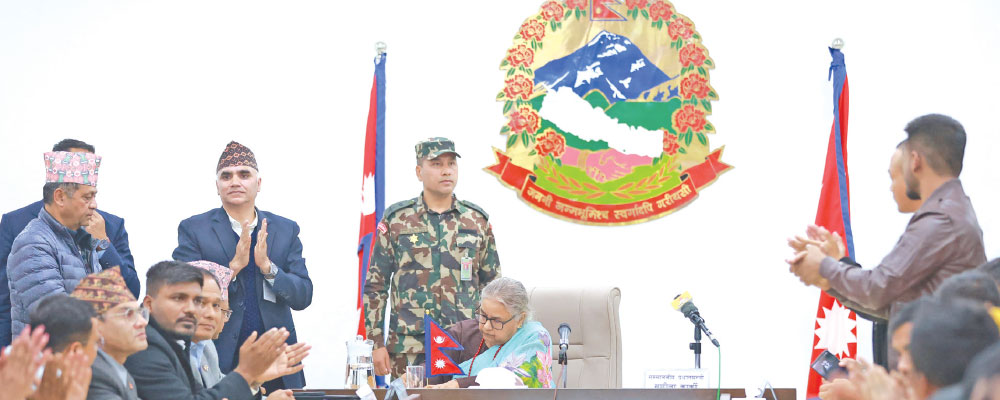
Prime Minister Sushila Karki and Gen Z representatives signing an agreement amid applause at the PM’s Office in Singha Durbar, Kathmandu, on Wednesday. Photo: Sujan Gurung/TRN

By A Staff Reporter,Kathmandu, Dec. 11: The government and the family members of the martyrs and those injured in the Gen-Z Movement signed a 10-point accord, recognising the Gen-Zers’ protest of September 8 and 9 as the Gen-Z People’s Movement.
The accord was signed by Prime Minister Sushila Karki on behalf of the government, and Bhoj Bikram Thapa, on behalf of Gen-Z martyrs’ families, and other victims on Wednesday evening, 92 days after the Gen-Zers overthrew the powerful government of the CPN-UML and the Nepali Congress through a two-day street protest.
With the signing of the agreement, the government has formally owned up the Gen-Z Movement.
Certain groups of Gen-Zers were demanding institutionalization of the demands of the September 8 and 9 protests, and both the government and Gen-Zers took a long time to document the issues and finalised them through formal agreement.
The 10-point agreement includes a commitment that no one will face criminal investigation or prosecution for participating in the political uprising of September 8 and 9.
The agreement states, “No criminal investigation or prosecution shall be initiated against anyone for participating in the political activities related to the People’s Movement of September 8 and 9.”
The agreement came into effect immediately upon signing.
The accord also addresses political reforms, including a provision in the law on political parties that does not allow the party presidents or chairs to serve more than two terms.
It further stipulates that impartial investigations will be conducted into the events of the people’s movement, identifying individuals responsible for extrajudicial killings, violence, and human rights violations, and ensuring criminal accountability.
Investigations will distinguish clearly between planned crimes committed in the name of the movement and the actual movement itself. All pending cases against protesters will be screened within 15 days, with innocent individuals released and charges withdrawn.
A separate mechanism will be established to prepare necessary reforms within security agencies to prevent such incidents from recurring in the future.
The agreement stipulates the formation of a high-level investigation commission to curb corruption at both political and policy-making levels. It also provides guidance to end the politicisation of public institutions, dissolve illegally operated foundations, funds, or trusts, and nationalise their assets. A separate mechanism will be established to reform the administrative structure.
Regarding electoral reforms, the agreement ensures voting rights for Nepalis living abroad, mandates candidates to submit asset declarations, introduces legal measures to make political parties’ and candidates’ expenditures transparent, and adds an option on ballots for voters to indicate ‘None of the above.’ It also proposes making primary elections mandatory within political parties.
A separate commission will be established for constitutional review, with the process, including public consultations, to commence within three months.
The review will provide detailed recommendations on proportional representation, anti-corruption measures, judicial independence, structural reforms, term limits, and fixing the minimum age of poll candidates at 21.
Key points of the agreement
This comprehensive agreement addresses the events of the Gen-Z People’s Movement (September 8 and 9, 2025), the rights of martyrs and the injured, good governance, judicial reforms, electoral improvements, and constitutional amendments. The key points are as follows:
Expediting the process of declaring individuals who were killed in the People’s Movement as martyrs, establishing a high-level task force to provide long-term support for the families of martyrs and the injured, ensuring interim relief, compensation, healthcare, education, employment, social security, and the creation of memorials, and constituting a constitutional commission to address issues of martyrs and the injured on a permanent basis.
Likewise, another point is about identifying those involved in extrajudicial killings, violence, and human rights violations, and recommending criminal accountability, distinguishing between premeditated crimes committed in the name of the movement and legitimate movement activities, and investigating them accordingly.
If any activists have been prosecuted, a screening should be conducted within 15 days and release those found innocent and withdraw the charges. The agreement seeks the establishment of a separate mechanism, along with reforms in security agencies, to prevent the recurrence of violence in the future.
Setting up a high-level commission to investigate issues such as partisanship, nepotism, unexplained wealth, and misuse of public office is another point of agreement. Establishing a separate mechanism to recommend reforms in administrative structures is another key feature of the agreement.
Ensuring voting rights for Nepalis living abroad, requiring candidates to submit mandatory declarations of assets, implementing legal reforms to ensure transparency of party and candidate expenditures, adding a “None of the above” option on the ballot paper, making primary elections within parties mandatory, and limiting the term of party presidents/chairpersons to a maximum of two terms are important components of the agreement.
The two sides agreed to conduct a review of the Constitution within three months with public consultation.
Ensuring representation of women, Dalits, Indigenous Nationalities, Madhesis, Tharus, Muslims, persons with disabilities, marginalised communities, farmers and labourers, underdeveloped regions, and economically disadvantaged Khas Arya in all mechanisms is another key point of the agreement.
Likewise, the two sides agreed to strengthen arrangements to make government decisions, expenditures, and processes public and publish the reports of previous investigation commissions in accordance with the law. The agreement seeks the application of a transparent and competitive system for appointments to public positions.
Legal and technical reforms to ensure freedom of expression and data protection on digital platforms and the formation of a “Gen-Z Council” to fulfill the objectives of the people’s movement and ensure youth representation in government mechanisms are other key points of agreement.
The agreement has internalised the relevance and legitimacy of the Constitution of Nepal issued by the Nepali people through the Constituent Assembly and termed the dissolution of the House of Representatives a historical fact after it lost public trust.
After PM Karki and Thapa inked the agreement, it received loud applause from those present in the agreement inking ceremony.
Home Minister Om Prakash Aryal, Energy Minister Kulman Ghising, Law Minister Anil Kumar Sinha, Sports Minister Bablu Gupta, and Chief Secretary of the Government Sumanraj Aryal were present in the signing ceremony.
Injured Gen-Zers, family members of martyrs, and leaders of various Gen-Z groups were also present in large numbers.
Speaking on the occasion, Prime Minister Karki described the agreement as a milestone in history. She stated that the agreement would guide the future transformations.
The Prime Minister remarked that Nepal has become the guiding nation of the Gen-Z movement, and it has inspired similar movements in other countries.
She also admitted that there had been some delays in signing the agreement, as it took time to make the documents broadly acceptable.
“The document has been prepared to ensure that the contribution of the martyrs who lost their lives during the Gen-Z Movement, the injured fighters, and all Gen-Zers remain recorded in history,” she said.