- Sunday, 3 May 2026

Adhere To Anti-nuclear Treaties

The world is faced with multiple crises ranging from poverty, economic downturn, global income inequality and armed conflicts to climate change catastrophes. As armed conflicts escalate in different parts of the world, the spectre of nuclear war seems to be looming large. This is not a mere intellectual assumption but is based on the behaviour and rhetoric of leaders of some nuclear-powered countries.
Some nuclear-powered countries are already at war. Russia is at war with Ukraine, while Israel is in armed conflict with Palestinians, which has ravaged Gaza and its adjacent areas, killing tens of thousands of civilians. The chances of escalating war in the entire Middle East are high. Israel has already attacked several sites in Lebanon, Yemen and Syria, suspecting hideouts of anti-Israeli militant outfits and also the nuclear sites of Iran. Tehran has designated Israel as the enemy and threatened to eliminate Israel from the map of the world. Similarly, several Arab countries have expressed their indignation at Israel’s behaviour over the Palestinian issue.
Conflict-prone world
The scenario in other parts of the world is also dangerously pathetic. A recent case is Venezuela, where the crisis appears to be deepening, raising fears of war in Latin America. Africa has witnessed multiple armed conflicts of different natures, both between states and non-state actors. East Asia is also not free from tension. The South China Sea and East China Sea are newer theatres of conflict. Even in our neighbourhood, armed conflicts took place between India and Pakistan some months ago, while India and China too have engaged in occasional skirmishes along their Himalayan border. So the entire world is conflict-prone.
While some nuclear powers are already at armed hostilities and some are waging proxy wars, there is a chance that such a scenario may one day lead to nuclear disaster. The recent remarks of US President Donald Trump and the behaviour of some other leaders like Russian President Vladimir Putin and North Korea’s ruler Kim Jong Un have sent a shudder worldwide with fear of renewed nuclear arms race and ultimately nuclear war. So far, a total of 191 countries have signed the Nuclear Non-Proliferation Treaty (NPT) and have been parties to it. But not all countries seem to be honestly abiding by this treaty’s provisions.
While some countries continue to ignore international treaties and initiatives concerning nuclear non-proliferation and test ban treaties and anti-nuclear weapon instruments, some have gone against their own commitments. Russia has withdrawn the ratification of the Comprehensive Test Ban Treaty (CTBT), implying that Moscow now intends to build new nuclear arsenals and conduct tests. There are also some other nuclear-powered countries that have not signed the NPT and also the CTBT. These events and developments have heightened worries and concerns all over the world.
In response to Russia’s decision to withdraw from the CTBT, US President Donald Trump recently issued a statement stating Washington’s possible resumption of nuclear weapon testing. The European Leadership Network's (ELN) on Protecting the NPT, an anti-nuclear weapon proliferation initiative, quickly reacted, calling upon all states to abide by the UN and other international treaties concerning nuclear weapon proliferation and testing. It says ‘US President Donald Trump’s statement about the possible resumption of nuclear testing has heightened concerns over a renewed arms race and the erosion of the global norm against nuclear testing enshrined in the comprehensive Nuclear-Test-Ban Treaty (CTBT)’.
Already concerned over the fate of the CTBT and other nuclear non-proliferation regimes, due to Russia’s de-ratification of the treaty, North Korea’s continued tests and modernisation of nuclear test sites, the European group is further worried about the possibility of a fresh nuclear arms race in the world following the new US policy. According to ELN, ‘undermining or rejecting the CTBT and NPT may cause mistrust between Nuclear-Weapon States, and negatively impact long-term international security’. Thus, all nuclear states are required to strictly and honestly respect the NPT and CTBT and those that are party to the NPT, CTBT and other nuclear-non-proliferation and anti-testing treaties also need to work together to ensure weapon weapon-free world.
Wars are not in the interest of humanity. In war, none wins but all parties and actors involved in war ultimately suffer in the form of human casualties and collateral damage. Innocent civilians suffer more than others in all wars and conflicts. The nuclear wars would be even more dangerous not only for human beings but also for the entire environment and ecosystem. The repercussions of the nuclear weapons remain for generations as the people of Hiroshima and Nagasaki continue to suffer the consequences of the atomic bombing of 2045. Thus, the nuclear wars, proliferation of nuclear weapons and nuclear testing must be totally banned.
Urgency
It is thus very urgent for people in all walks of life in the world to get united and act collectively in persuading their governments to abide by the NPT, CTBT and other similar international initiatives against proliferation, test and use of nuclear weapons. The other important initiative is the Treaty on the Prohibition of Nuclear Weapons (TPNW) that seeks the complete abolition of all nuclear weapons, including a ban on the production, testing and use of nuclear arms. This treaty was adopted by the United Nations in 2017 and entered into force in 2021.
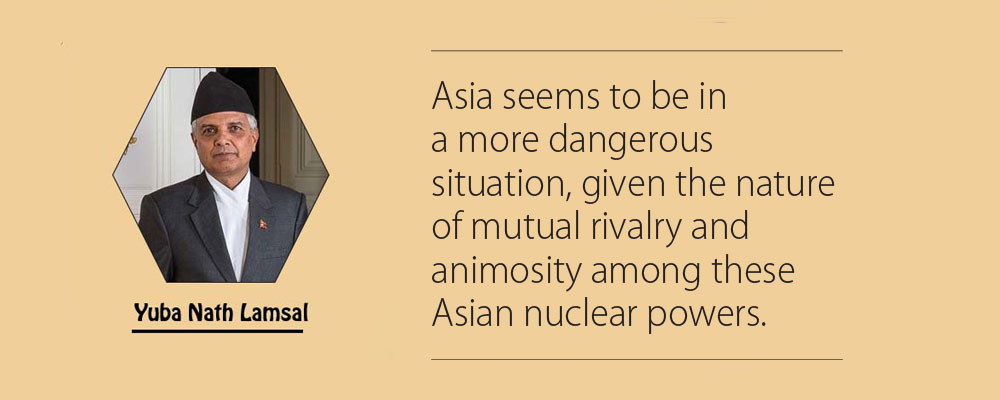
However, several countries have yet to sign and ratify this important treaty. It is thus high time that all people exert pressure on their governments to ratify all anti-nuclear weapon-related treaties, including TPNW and sincerely abide by them for the larger safety of the entire humanity and the planet earth. Of nine nuclear powers, five are in Asia: China, India, Pakistan, Israel and North Korea. Asia seems to be in a more dangerous situation, given the nature of mutual rivalry and animosity among these Asian nuclear powers. Nepal is surrounded by two rival nuclear powers. Nepal, thus, needs to play a more proactive role in persuading countries to denuclearise the region. For this, Nepal needs to first demonstrate its commitment by ratifying the TPNW.
(The author is a former chief editor of this daily and a former ambassador. lamsalyubanath@gmail.com)