- Sunday, 3 May 2026

Critically endangered vultures vanish after crossing into India

By Avinash Chaudhary,Dhangadhi, Dec. 10: Critically endangered vultures from Shuklaphanta National Park in Sudurpaschim Province are dying or disappearing after crossing into India.
Satellite-tagged Slender-billed Vulture (dangar giddha) and Himalayan Griffon Vulture (sano khairo giddha) that migrated across the border have either been found dead or have gone missing in recent years.
In the past two years, two satellite-tagged vultures that flew into India were confirmed dead, while the whereabouts of two others remain unknown.
According to Bird Conservation Nepal (BCN), in 2024, a critically endangered white-rumped vulture tagged as J-11 was found dead inside a cattle shed on the banks of the Sharda River in Tataraganj, India.
Likewise, a slender-billed vulture tagged as J-26 that travelled to Lakhimpur has not moved from a single location for a year and is presumed dead.
Similarly, a J-20-tagged white-rumped vulture was found dead near the Nepal-India border in November, but its tag had been cut off and removed. Another tagged Himalayan Griffon Vulture, J-25, which has been stationary in India since November 27, has also gone missing. It has not moved for the past 10 days. Two white-rumped vultures tagged J-12 and J-19 were also found dead inside Shuklaphanta National Park in 2024.
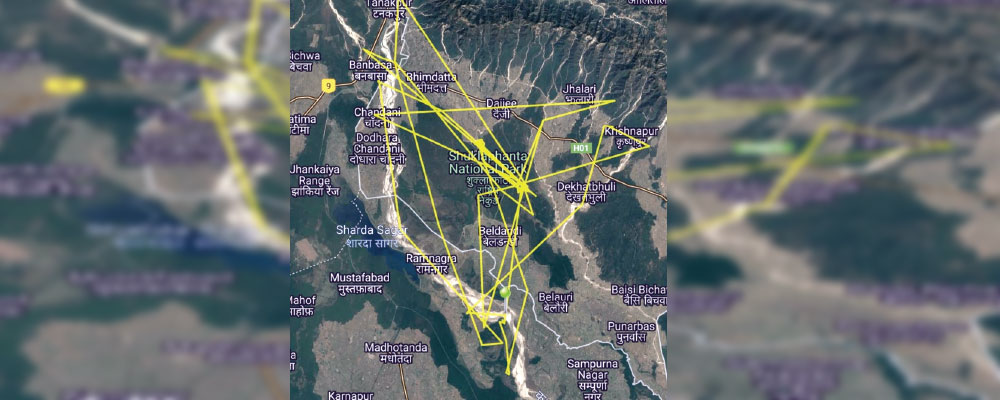
According to Ankitbilas Joshi, BCN’s Vulture Conservation Programme Manager, vultures nesting inside the park frequently fly into India’s river systems in search of food.
“There is more carrion available across the border. But the exact reasons why vultures die there are still unknown. We have not been able to conduct post-mortem examinations on the carcasses,” he said. Joshi said the trend of satellite-tagged vultures dying or disappearing in India shows an urgent need for cross-border cooperation.
BCN has tagged 15 slender-billed vultures and four Himalayan Griffon vultures in Shuklaphanta for satellite monitoring. However, only a small fraction of the estimated 300 vultures in the park are tagged.
Ornithologist Hirulal Dangoura said that untagged vultures also likely die in India but cannot be tracked.
He added that although the harmful drug diclofenac is banned in India, other toxic veterinary painkillers -- ketoprofen, nimesulide and aceclofenac -- are still widely used.
“Controlling these drugs in India is a major challenge,” said Dangoura, who also serves as a BCN field officer. “We hear that some medicines meant for humans, such as diclofenac and aceclofenac, are being used on livestock, which is dangerous for vultures.”
These drugs, used to reduce pain in livestock, are deadly to vultures. BCN said that vultures die after consuming carcasses of animals treated with such medicines.
Vultures from Shuklaphanta often travel as far as the Dodhara-Chadani border area, Palia in Dudhwa National Park and Kisanpur Wildlife Sanctuary. However, no samples have yet been collected from India for testing the vultures found dead there. Only bones have been recovered, making it difficult to determine the exact cause of death.
Joshi admitted that the inability to reach the sites on time to retrieve carcasses is a major weakness. “We have installed satellite tags, but failing to search for missing vultures in time is our shortcoming,” he said.
In India, the Bombay Natural History Society (BNHS) has been leading vulture conservation efforts. Diclofenac use across South Asia was banned after vulture populations crashed in the 1990s due to exposure to the drug.