- Thursday, 4 June 2026

Sugarcane farmers in ‘wait and see’ situation
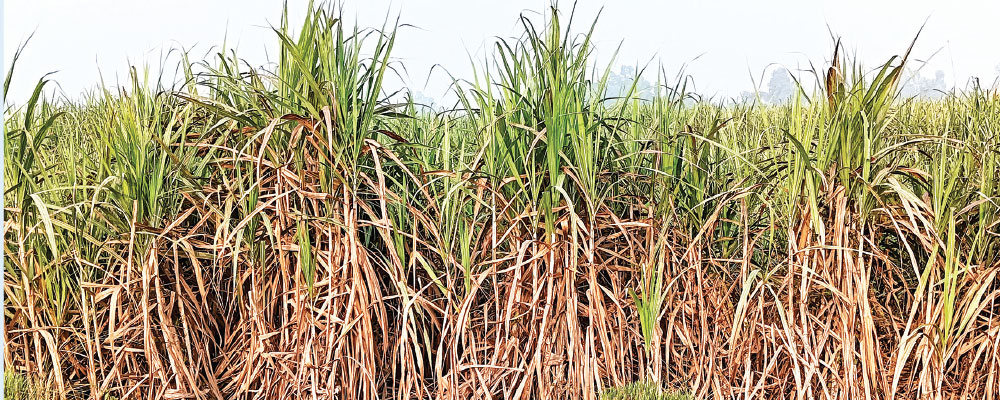

By Rabindra Upreti,Bardibas, Dec. 9: Sugarcane farming—one of the major sources of income for farmers in Tarai- is currently suffering from a triple blow of agitation, uncertainty and government inaction.
After sugarcane farmers intensified their agitation demanding the restoration of subsidies and the fixing of a minimum support price, the crushing season of sugar mills across the country has been affected this year.
This situation has exposed both the sensitivity of the agricultural sector and the weakness of the government’s decision-making process.
Last year, the Everest Sugar Mill in Ramnagar, Mahottari, which was operational on time, crushed more than 3.1 million quintals of sugarcane. However, this year, due to the farmers’ agitation, the mill is likely to operate only towards the end of the month.
Sugarcane farmers have been claiming that their demands are logical and objective.
“Reducing the subsidy from Rs. 70 to Rs. 35 per quintal is unfair. And our demand for a minimum support price of Rs. 750 per quintal is justified considering rising inflation and production costs,” said Mahashankar Thing, a central member of the Federation of Sugarcane Producers' Association.
As sugarcane farmers are preparing for a nationwide protest, even as Nepali month of Mangsir is ending, all sugar mills have not been able to operate.
Currently, 13 sugar mills are waiting for crossings, including Everest in Ramnagar, Mahottari, from Sunsari to Kanchanpur in the Sudurpashchim.
According to Financial General Manager of Everest Sugar Mills Bimal Chandra Thakur, these mills have been producing 1.9 to 2 million quintals of sugar annually.
This production is about 1 million quintals less than the country's requirement.Nepal consumes about 3 million quintals of sugar annually.
He said that the shortfall in sugar is met through imports from other countries, including India.
Thakur said, "Due to the shortage of sugarcane, Nepal's mills have not been able to produce sugar to their capacity. If sufficient sugarcane is available, required sugar for the country can be produced domestically."
According to Thing, there is no alternative to increasing sugarcane production to reduce foreign dependence on sugar.
"The state should be serious about this. On the contrary, sugarcane production is decreasing due to the state's neglect of the demands of sugarcane farmers," he said.
He said, "This problem affects about 1.5 million sugarcane farmers across the country. If the demands of the farmers are not taken seriously, the farmers will be displaced from sugarcane farming."
Although sugar mills have completed technical preparations for operation, the uncertainty surrounding the agitation has left the crushing season in limbo.
Any prolonged delay risks reducing sugar recovery rates as harvested sugarcane dries in the fields, ultimately hurting both farmers and the industry.
The Ministry of Agriculture and Livestock Development has urged farmers to “wait and see,” promising a solution by December 15, 2025.
The delay of even one to two weeks in the agricultural industry based on the annual season can cause huge economic losses. This loss will affect not only the industry but also millions of farmer families dependent on sugarcane farming. Leading farmers said that it will also affect the country’s gross domestic product (GDP).
Naresh Singh Kushwaha, president of the Sugarcane Producers’ Farmers Association, Mahottari, said that the government needs to find a sustainable solution by factually assessing the imbalance between farmers’ production cost, subsidy structure, and market prices.
“Sugarcane is one of Nepal’s last major agro-industries. Any damage to this sector will weaken the country’s agro-industrial foundation,” he said.
Central Member Thing pointed out the need for transparent dialogue and rational pricing between the government, sugarcane farmers and the industry.
According to him, operating sugarcane crushing on time is not only an issue for the sugar industry. It is also a problem related to the livelihood of about 1.5 million sugarcane farmers across the country, he said.
He said, "The problems of sugarcane farmers are also a direct issue for the country's economy and the credibility of the agricultural sector. It should be understood that delay in decision-making can also be counterproductive for the government."
-square-thumb.jpg)