- Sunday, 31 May 2026

Farmers in Lamjung at rush to harvest finger millet
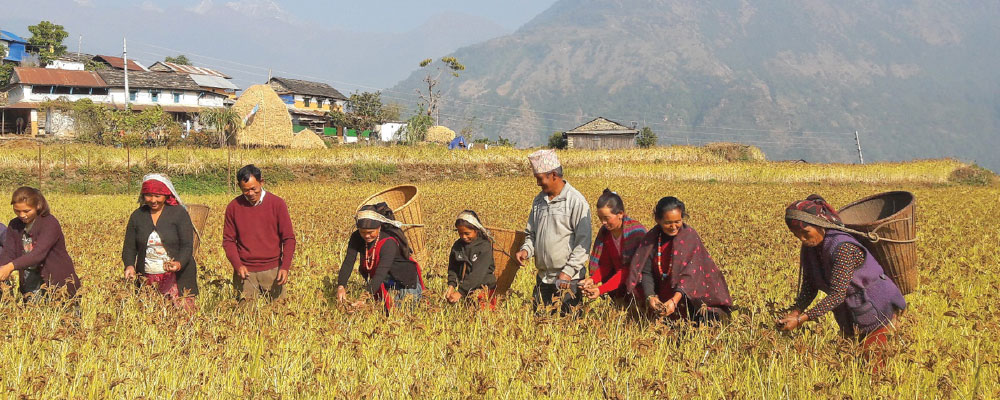
Photo: TRN Farmers harvesting finger millet in Bhalamchaur, Marsyangdi Rural Municipality-9.

By Nabin Raj Kuikel,Lamjung, Dec. 7: With paddy harvest completed, farmers across Lamjung district are now busy gathering finger millet, one of the region’s major staple crops.
Harvesting began in mid-November, especially in areas where millet was planted early in mid-July. Crops sown in August are expected to be ready for harvest by late December.
Ratna Bahadur Gurung, a farmer from Simpani–Bhalamchaur in Marsyangdi Rural Municipality-9, said locals in Bhalamchaur, Simpani, Mirche and nearby settlements are busy harvesting finger millet.
Finger millet is grown across all eight local levels of Lamjung, particularly in rural belts, and farmers anticipate higher yields this year.
“There were no major pest attacks and the weather remained favourable, so production looks promising,” said Deukashi Gurung of Bimdabesi in Besisahar Municipality.
25 varieties under trial
In Samibhanjyang of Madhya Nepal Municipality-5, 25 varieties of traditional millet were cultivated as part of a programme to promote indigenous crops. Supported by the Nepal Agricultural Research Council (NARC), the trial has shown encouraging results.
Under a traditional crop conservation project funded by the Food and Agriculture Organisation (FAO) and implemented through NARC’s National Genetic Resource Centre (Genebank), 22 millet varieties were planted in Parajulibesi Magar village and 25 varieties in Aamdanda.
Ward Chair Ombir Gurung said both native and local varieties have yielded well during varietal trials.
According to the Agriculture Knowledge Centre, production is expected to rise by more than 25 per cent this year. In previous years, armyworm infestation and unfavourable weather had reduced output. Millet remains a key crop in Lamjung’s rural hills, with 7,915 hectares producing 20,000 tonnes last year.
Nutritious millet increasingly used for alcohol production
Despite rising production, much of the harvested millet continues to be used for brewing homemade alcohol rather than for food.
Although millet is highly nutritious, limited public awareness means it is often turned into alcohol instead of being consumed as a healthy staple.
A few years ago, millet was considered a food primarily for the poor, but nowadays even wealthier households enjoy it as a delicacy. Health workers say millet-based dishes are particularly beneficial for people with diabetes.
However, as more millet is being used to make alcohol, it has become increasingly difficult for those who enjoy traditional millet dishes like Dhindo to obtain flour.
According to the Department of Food Technology and Quality Control, millet is rich in carbohydrates, protein, healthy fats, minerals and calcium.
Owing to its high nutritional value, the Ministry of Health and Population also recommends including millet flour in supplementary food for infants.