- Sunday, 3 May 2026

Hill-grown pumpkins in high demand of Madhes consumers

By Rabindra Upreti,Bardibas, Dec. 7: The demand for green vegetables produced in the hills—especially pumpkins—has increased significantly in the markets of Madhes.
After reopening the BP Highway, about 9–10 varieties of seasonal vegetables grown in Ramechhap and Sindhuli have begun arriving in Madhes regularly.
Traders said that pumpkins from the hills have the highest turnover in the region.
Easy supply from the hills is helping stabilise market prices and has gradually shown signs of replacing imports from India.
As agricultural trade between the hills and Madhes has expanded, farmers and traders from both regions have benefited.
Consumers said that vegetables from the hills have now made their way into everything from the kitchen to the feast in Madhes.
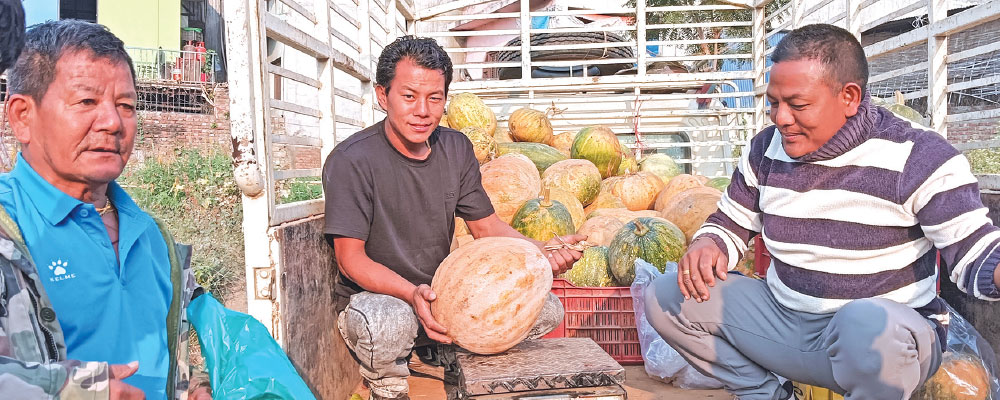
Man Kaji Hayu, a 63-year-old vegetable trader from Badi, Ramechhap Municipality–8, has been collecting pumpkins grown in the hills and supplying them to markets in Madhes.
According to him, he collects pumpkins from remote hill settlements such as Bhalukhor, Rampur, Khanidanda, Badi, Mugan, and Lyanglyang in Ramechhap and delivers them to various markets in Madhes, including Bardibas and Dhalkebar.
As his business has grown, his son Baburam has also joined him. Their pickup van has now become a mobile shop, selling vegetables across Madhes markets.
As of December 3, Hayu has sold about 162,000 kilograms of pumpkins, equivalent to 55 pickup loads, in the markets of Bardibas and Dhalkebar.
“There is no need to worry about not being able to sell vegetables after reaching Madhes,” Hayu said. “Even 50–100 kilograms are sold on the way.”
According to Ramchandra Mahato, a vegetable trader from Bardibas, the arrival of hill-grown produce has helped stabilise green vegetable prices in Madhes.
The retail price of pumpkin in Bardibas was previously Rs. 50–60 per kilogram. After the arrival of pumpkins from the hills, the price has dropped to Rs. 25–30 per kilogram.
According to local consumers, the consumption of hill pumpkins has increased in Madhes due to their sweet taste, religious and cultural importance, and affordable price.
Mahato said, “The demand for pumpkins is stable because they are used in Madhes weddings, feasts, and traditional meals. This is why the business of hill traders is flourishing even more than that of Madhes traders.”
Sabitri Mahato, 65, of Bijalpura, Bardibas Municipality–9, who purchased 13 kg of pumpkin from Hayu’s mobile shop in Bardibas Bazaar for her daughter’s wedding, said that vegetables from the hills have enhanced the taste of everything from the kitchen to the feast.
Pumpkin is also considered a healthy vegetable.
According to Dr. Ritesh Ghimire of Bardibas Hospital, vitamins, minerals, potassium, and fiber found in pumpkin help improve eye health, skin quality, and immunity. This is why health-conscious consumers eat it regularly.
There is no official data on pumpkin demand and consumption in the district. However, it is estimated that around 3,000 tonnes of pumpkin is consumed annually in Mahottari.
According to Devananda Ray, Chief of the Agricultural Knowledge Centre, about 5,600 tonnes of pumpkin is produced annually in Mahottari from about 350 hectares of land. But as local production does not meet demand, pumpkins are imported in large quantities from India.
According to Kishor Yadav, Plant Quarantine Officer at Jaleshwor Customs, about 512 tonnes of pumpkin worth Rs. 12.2 million were imported from India in fiscal year 2024/25.
There is no official accounting for pumpkins brought through the open border without customs duty.
Local traders said the growing demand for hill pumpkins shows signs that they may soon replace Indian imports.
Hayu said, “We are not only bringing products from the hills, which are 105 kilometres away from Bardibas. We have also balanced trade by supplying seasonal vegetables and fruits such as tomatoes, chillies, and onions from the Tarai to the hills. We have acted as a bridge between hill and Madhes trade. We have connected the feelings of both.”