- Friday, 29 May 2026

COP30: A Call For Accelerated Climate Action
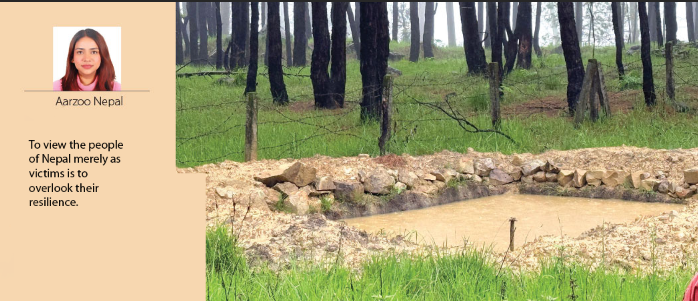

The conversations about climate change always felt like a fight for the distant future. It was a fight I was not always willing to have, not when there were so many other, more immediate issues to be addressed. That was before I saw what it looked like up close, what it feels like to stand in the middle of this crisis rather than hear about it on the news. Before I met people who barely had the basics of development yet were bearing the weight of global environmental changes, despite having a minimal carbon footprint. Think about it. Someone who walks for hours just to get a pot of water, because they do not have a simple tap at home, now finds that source has dried up completely. It is heartbreaking.
As the delegates leave Belem following the conclusion of the UN Climate Conference (COP 30) in November 2025, the headlines are filled with talk of the “Mutirão decision,” (Portuguese term of Indigenous origin that means collective effort or community work) finance goals, and implementation accelerators. But for the communities the Local Adaptation to Climate Change (LACC) Project works with, these are not abstract political terms. They are matters of urgent and daily survival. It is something that affects what they will eat a month later, whether the roads survive the next rain, or whether their children will stay in the village. For many in rural Nepal, it is a threat to their survival.
The Paris Agreement target
When we talk about “1.5 degrees”, the target set in the Paris Agreement in 2015, we are not talking about the weather changing from 20 degrees Celsius to 21.5 degrees on a Sunday afternoon. We are talking about the global average temperature compared to the pre-industrial era– the time before humans began burning fossil fuels on a massive scale. Much like the human body, where a deviation of only 3 degrees separates health from critical condition, the Earth operates within a narrow band of stability. The 1.5-degree threshold serves as the planetary equivalent of a high-grade fever; exceeding it risks pushing global systems into a state of irreversible breakdown.
Ten years have passed since the Paris Agreement, and it is difficult not to feel discouraged. According to the UN Environment Programme’s Emissions Gap Report 2025, global emissions rose by 2.3 per cent in 2024. Instead of slowing down, we have continued moving in the wrong direction. The amount of carbon dioxide in the atmosphere is now higher than at any point in at least two million years. To stay on track for the 1.5-degree pathway, global emissions would need to fall by about 55 per cent by 2035. Even the less ambitious 2-degree target requires a 35 per cent drop.
Meanwhile, current national commitments only bring us to a 12–15 per cent reduction, even if countries deliver everything they have promised. It is a sobering reminder of how far we still must go. The current trends point toward roughly 2.6 degrees Celsius of warming. And as always, the consequences of this failure are not shared evenly.
Nepal contributes less than 0.1 per cent of total global emissions, yet we still find ourselves listed among the ten most climate-vulnerable countries. We are also home to the Himalayas, and by extension to the Hindu Kush Himalayas (HKH), a region so vast and icy it is known as the “Third Pole.” Stretching 3,500 kilometers across eight countries, this region holds the largest reserve of ice outside the polar regions. But it is dying.
Scientists estimate that up to 75 per cent of the region’s glacier volume could vanish by the end of the century.
The Himalayas warm faster than the rest of the world, also known as Elevation Dependent Warming (EDW). A 2023 ICIMOD report shows temperatures rising by +0.28 degrees Celsius per decade between 1951 and 2020. Some specific areas, like the Tibetan Plateau, have experienced even higher rates, up to +0.66 degrees Celsius per decade. Because of EDW, even limiting global warming to 1.5 degrees will result in a significantly higher temperature increase in the mountains (potentially 2 degrees or more). And, for the ice reserves that feed billions, that extra half-degree is the difference between melting slowly and disappearing entirely.
The circle of loss
This melting is creating ticking time bombs. As glaciers melt, they leave behind massive lakes held back only by loose rocks and ice. Of the 47 glacial lakes in the HKH region identified as being at imminent risk of bursting, 21 are right here in Nepal. These are not just numbers. They show up in real tragedies. We are told to adapt. But how do you adapt when disasters are becoming unprecedented?
August 2024: A Glacial Lake Outburst Flood (GLOF) tore through the village of Thame in the Khumbu (Everest) region, destroying homes and heritage in minutes.
September 2024: Massive floods and landslides in central Nepal killed over 200 people. Science confirmed that climate change made the rains 10 per cent more intense.
July 8, 2025: In a span of 24 hours, two separate glacial floods struck. In Rasuwa, the Miteri Bridge (Nepal-China Friendship Bridge) was swept away, leaving 19 dead or missing. Simultaneously, in Upper Mustang, an ice-dammed lake burst, causing devastation downstream.
While the world watches large disasters, the pain is most acute in the remote corners of Karnali and Sudurpashchim. Take the story of Til, a village in the Limi Valley of Humla that has survived for at least 1,000 years. On May 15, 2025, a flash flood forced families to carry their elderly on their backs to safety. Til is the most remote of the three settlements, nestled in an offshoot of the main valley. At this junction, a four-meter-wide bridge was destroyed a few years ago during another flash flood. A smaller bridge was built upstream, reconnecting Til to the outside world. But in July, the new bridge was also swept away in a second flash flood of the year.
In November, construction on a third bridge was completed, paid for by GoFundMe donations. The community struggled for months to build a single bridge to connect them to the world, only to watch the changing climate erase it in seconds. Now, the people of Til, custodians of a millennium of culture, are discussing the heartbreaking possibility of abandoning their village forever.
This is the stark reality of a warming world. The community of Til faces a threat they cannot solve alone and one they did not cause.
A map for survival
Funded by the Government of Nepal, Finland and the European Union, the Local Adaptation to Climate Change (LACC) Project is our response to the impacts of climate change. The LACC Project empowers local municipalities to build their own futures. In the remote corners of Karnali and Sudurpashchim, we are building resilience led by the people themselves.
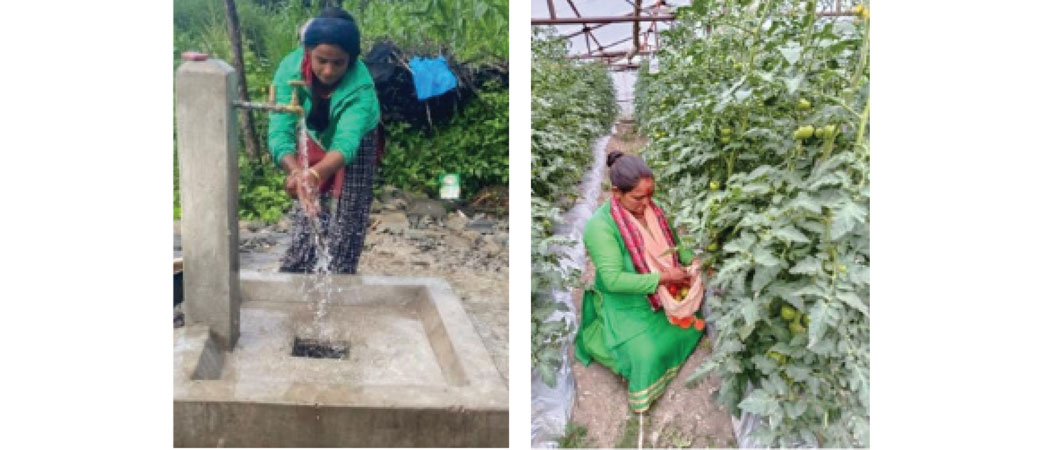
Our work is guided by what we call Result Areas, a term for what is a map of survival tools for these communities – communities with only minor carbon footprints. By introducing climate-smart technologies, from solar-powered irrigation to poly-house farming, we are helping families move from surviving the season to thriving despite the weather. This economic stability is the strongest defense against climate migration.
The project works directly with communities to develop Climate-Resilient Water Safety Plans. We are not just installing taps; we are healing the watershed. By managing the catchment areas, we ensure that springs refill and water remains safe even during droughts. This ensures that the most vulnerable women and children are not walking hours for a basic human right.
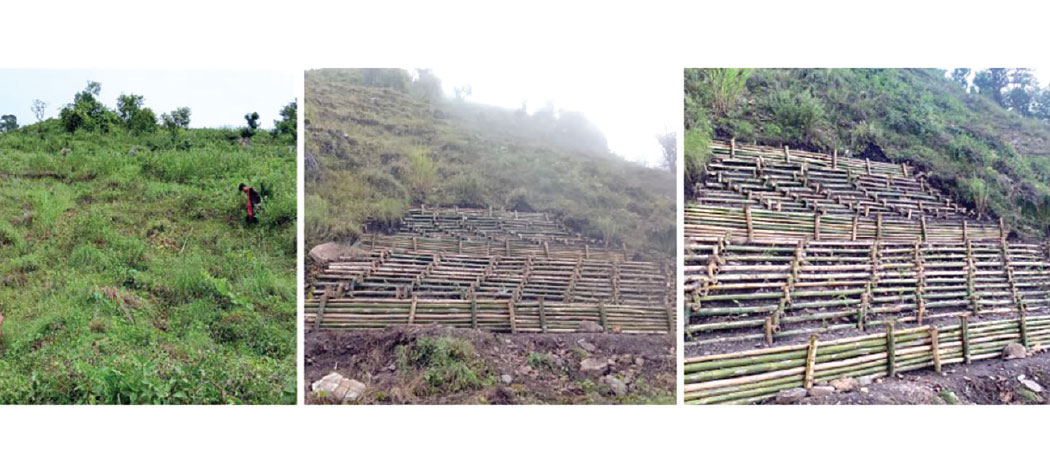
We are implementing bio-engineering interventions by utilising nature-based solutions, such as local bamboo and native plants on the hillsides to stabilise slopes.
These aren't just walls; they are living barriers that breathe through the landscape, designed to hold back the earth when the rain comes. These are just a few examples of our work that is currently underway. We will be working with 41 Rural Municipalities in the region over the next five years (2024-2029).
This collaboration between Nepal, Finland, and the EU is providing a blueprint for what effective climate adaptation looks like. It shows that when resources reach the grassroots level, led by local government, we can turn vulnerability into strength. And this is what we expect and ask from the world leaders: give voice and agency to those who are directly impacted by the effects of our collective failures, especially people in the most vulnerable situations, such as women, persons with disabilities and ethnic minorities.
Adaptation is not a magic shield. We are helping communities build stronger boats, but the storm is getting stronger and faster.
The catastrophic floods that drowned a third of Pakistan in 2022 were a terrifying warning to us. The examples of devastation in Nepal in 2024 and 2025 prove that loss and damage are not a future risk; it is our current reality.
Adaptation has its limits
A new irrigation channel is useless if the river it draws from becomes a debris-filled torrent. A new bridge in Limi is useless if a glacial lake washes it away twice every year. The outcome of COP 30 centered on the concept of Mutirão, a call for collective effort. In Karnali and Sudurpashchim, we have been building a blueprint for what this global “Mutirão” looks like in practice: the Government of Nepal, the EU, and Finland collaborating to turn vulnerability into strength.
We welcome the decision in Belem to triple adaptation finance by 2035. This sends a vital political signal. However, for us, 2035 is a distant horizon. As glaciers melt and floods intensify, the gap between the finance we have and the finance we need is still widening. The launch of the Global Implementation Accelerator is a promising step. But an accelerator is only as good as the fuel you put in it. The models we have built together in the LACC Project are working, but the need is outpacing the resources.
When Nepal states that its climate plan requires international support that is not a bureaucratic ask. It is the cost of survival. When we talk about the disasters that have already hit us, it is not just to re-emphasise the same narrative. It is to realise and internalise that the time to act is now. To view the people of Nepal merely as victims is to overlook their resilience.
They are fighting on the frontlines of a crisis they did not engineer, holding the line for the rest of us. But courage alone cannot stop a flood. It is time for the world to stand with them, not just with words, but with action. We must ensure that those doing the hardest work have the strongest support before the window for adaptation closes forever.
(The author is the Communications Officer of the Local Adaptation to Climate Change (LACC) Project. The opinions expressed here are her own and do not necessarily reflect the official policies of the project’s funders or partners.)