- Thursday, 11 June 2026

Every Generation, Not Just Gen Z, Matters

In recent years and months, Nepal’s public discourse has become fixated on the promise of Gen Z leadership. Commentators, activists, and even seasoned and established politicians have argued that this new generation is the sole antidote to corruption, stagnation, and political decay. Yet the obsession with youth as a cure-all is both misleading and dangerous. Leadership is not a matter of age but of vision, integrity, and people-centred governance.
The narrative that equates youth with progress and old age with decay distorts reality. Yes, the country has been repeatedly betrayed by senior leaders who clung to power, enriched themselves, and failed to deliver the prosperity that we Nepalis have been pining for. But their failure lies in corruption and self-interest, not in their age. If old leaders had governed honestly, we would not be condemning them merely for being old. By the same token, if a young leader is corrupt, reckless, or power-hungry, his youth will be no shield against criticism. The age of a leader tells us nothing about their ability to govern well.
Wisdom and humility
Even a person on their deathbed can offer insight into life and the world. Likewise, even a newborn can bring us euphoria and offer us hope. Wisdom, humility, and perspective do not vanish with age. If we truly value knowledge and guidance, then why the relentless breast-beating about the supposed indispensability of Gen Z leaders? The real question is not whether our leaders are 25 or 75, but whether they are people-centric and nation-centric – or, as too often happens, party-centric and power-centric.
This obsession with youth risks creating another form of elitism, one based not on wealth or caste but on age. It suggests that younger people alone are fit to lead, while older generations are inherently obsolete. Such a worldview is not only unfair but historically false. Around the world, history is full of examples of extraordinary contributions made by people at all stages of life. Carlos Soria, the Spanish mountaineer in his mid-eighties, conquered Mt. Manaslu on Sept 26 – a dream he realized after 50 years. He had had a failed attempt to scale the same summit when he was in his thirties. If age were to be a deciding factor to label somebody as worthy or unworthy of something, then why did he have to wait for such a long time? Moreover, why are all daring and adventurous activities not dominated by Gen Z youths only? Yes, it is only one vivid reminder that age is no barrier to resolve, determination, or achievement.
In fact, society functions precisely because generations complement one another. For every daring and impulsive youth, there is a steady and experienced elder. For every frivolous nephew, there exists a calm and measured uncle. The English idiom “an old head on young shoulders” exists because wisdom is prized–yet there is no equivalent “young head on old shoulders.” The point is clear: age brings value. Youthful energy is necessary, but so too is the experience and restraint of older generations.
What is often overlooked is that youthfulness itself is fleeting. Today’s Gen Z leaders will inevitably become middle-aged and then old. If their only claim to legitimacy rests on being young, then their authority will vanish the moment they age out of the category. To base leadership on something as temporary as biological age is to build a castle on sand. Far more enduring is the commitment to integrity, accountability, and service to the people.
The rise of Gen Z as a political category is understandable. It is, after all, a reaction to decades of failed governance. Young people see entrenched leaders recycling themselves through parties and coalitions, clinging to privilege while the country struggles with unemployment, migration, and inequality. The hunger for change is genuine and justified. But the answer is not to romanticize youth in the abstract. Rather, it is to demand systemic reform – anti-corruption measures, transparent governance, and policies that put people first. These reforms can be championed by leaders of any age, provided they are willing to break with the status quo.
Sober consideration of geopolitics
Nepal’s future should not be decided by rhetoric about “young versus old.” It should be shaped by sober consideration of geopolitics, history, culture, and the lived realities of its people. Leadership requires both daring and patience, both vision and experience. To pit generations against one another is to weaken society at the very moment it needs unity. Instead of idolizing or demonizing age groups, we must learn to see value in every stage of life. Youth brings energy, but age brings perspective. Both are indispensable. A healthy democracy requires intergenerational cooperation, not rivalry. It requires leaders who are accountable to the people, not to their egos or their parties.
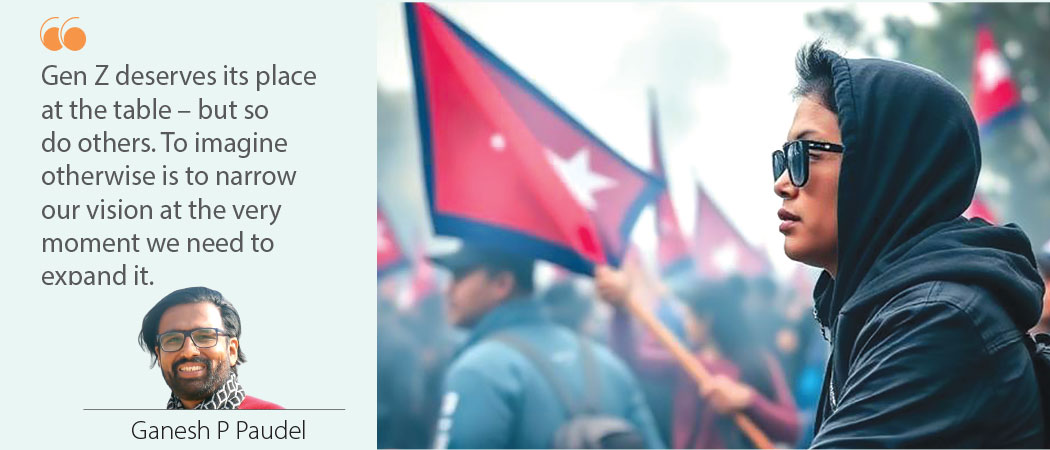
The challenge before us is not to anoint Gen Z as saviors but to demand peop le-centric, nation-centric leadership across the board. Only then can we build a political culture where character, not age, determines legitimacy. Only then can we free ourselves from the cycles of disappointment that have plagued our politics for decades. Gen Z deserves its place at the table – but so do others. To imagine otherwise is to narrow our vision at the very moment we need to expand it.
(Paudel is a schoolteacher and a freelancer from Dang and can be reached at ganeshprasadpaudal@gmail.com.)
Must Read