- Sunday, 3 May 2026

Strong Emotional Impression
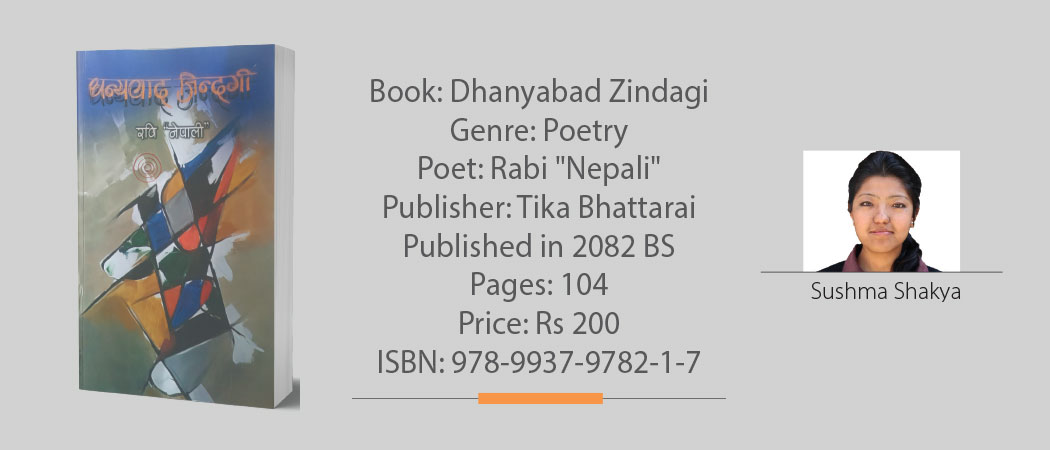

Rabi Nepali’s Dhanyabaad Zindagi, a collection of fifty-three poems, leaves a strong emotional impression on the readers. Many of his poems open with a tone of heaviness or pessimism, yet almost every piece moves towards light, hope and resolution. This shift becomes one of the defining traits of his work, and it encourages the reader to rise with him.
One of the pieces that stands out is ‘Adhyaro Raat’. Readers may connect deeply with the exhaustion the poet expresses as an honest, ordinary individual carrying out many roles in society. Although the poem carries a tired tone, his love for nature appears again as his source of healing. Nature becomes his constant companion in sadness, and this pattern repeats across the collection. Throughout the book, the poet reveals his pain, the dualities of life, his struggles, gratitude and moments of inner reflection. In a fast, overwhelming modern world, these poems echo the quiet suffering and resilience of common people. They feel close and familiar.
‘Timro Khojima’ is one of the more symbolic poems in the collection, open to many interpretations. A reader searching for happiness may feel the poet is seeking the same. Someone focused on their dreams may see determination and purpose. Others might read it as a spiritual search, or the poet might be looking for God or a divine presence. Even when people try to pull him away from his path or claim that his search does not exist, he stays firm. He suggests that his search will continue not only in this life but beyond it. The 'you' in the poem can be understood as his goal, his aspiration or even the divine he hopes to attain. His way of writing shows a quiet brilliance in how he chooses and shapes his words.
‘Ma Bhitrako Ma’ carries a deep, universal message. It invites the readers to look inward and recognise parts of them in the poet’s reflection. This poem blends calm imagery with inner restlessness. The repeated sound of 'vulvul' beautifully mirrors the poet’s own restlessness, almost like a heartbeat of anxiety. Comparing that inner movement to a hidden spring rising inside a mountain is a powerful metaphor; it suggests something deep, natural and uncontrollable growing within him.
As the poem moves forward, the poet admits he is confused, overwhelmed and searching for a way out. The honesty in lines like 'Ma Kehi Harairahechu' and 'Ma Kehi Khoji Pani Rahechu' makes the poem relatable, because it mirrors the uncertainty many people feel.
The closing reflection brings the poem into a spiritual dimension. The poet wonders whether the peace he seeks is God, truth or simply his own inner self.
This unresolved question leaves the reader gently suspended, which suits the theme of searching.
The satirical poem 'Buddhako Bansaj' offers a clever contrast. The poet calls himself a descendant of Buddha, a figure of non-violence, yet becomes irritated by a cuckoo’s repetitive call and kills it with a stone. The irony is sharp and effective.
This poem uses a simple dialogue between the speaker and a cuckoo to reveal a sharp irony. The speaker proudly calls himself wise, peaceful and a descendant of Buddha, yet loses patience when the bird keeps asking 'Ko Ho, Ko Ho?' In a moment of frustration, he kills the very creature he should have treated with calmness and compassion. The final image of the bird’s lifeless eyes staring back creates a strong emotional weight.
The poem shows how easily people forget their own values, making it a concise but powerful satirical reflection on human nature. Poems like ‘Jharipokhari’ show his admiration for nature and his ability to play with language in a lively way. Meanwhile, ‘Timro Pratikshyama’ speaks across ages and experiences. Whether you are a student, dreamer, patriot, optimist, pessimist, struggler, and homemaker or simply tired of life’s demands, the poem feels personal. It carries the sense that the poet is voicing your own thoughts.
Some pieces also reveal his political side. They suggest he cannot tolerate injustice and carries a rebellious love for his country. A few of the poems read more like reflective philosophical pieces than traditional verse. For example, ‘Aama’ is written in a simple and direct narrative style. A poem usually carries some rhythm, imagery or emotional layering, but here the focus is on telling what happened and what the poet wants to say. Because of that, it reads more like a short moral story or a reflective paragraph than a lyrical piece. The message is beautiful, but the style is simple, direct and conversational rather than poetic.
One thing readers may notice is his repeated use of certain words across the collection. This repetition seems to reflect the poet’s personal attachment to those expressions. Since the poems come from his own lived feelings, this becomes natural and understandable.
Overall, Dhanyabaad Zindagi offers a rich blend of emotion: political concern, satire, personal grief, hope and quiet resilience. Rabi Nepali’s voice often feels like he is speaking the reader’s own emotions. The collection is worth reading for the honesty it carries and the many shades of human experience it brings to light.
A poet, Shakya writes on art, culture and literature.