- Sunday, 3 May 2026

Wedding losing originality amid growing glamour
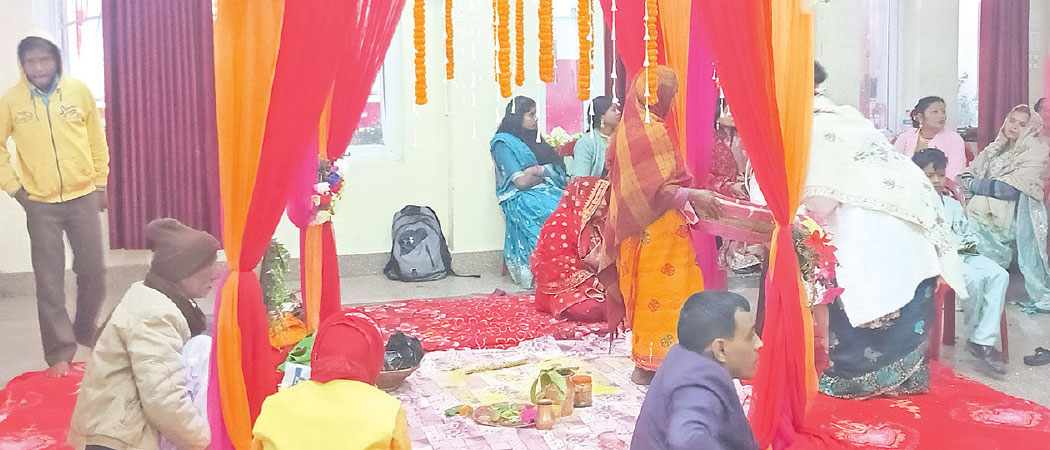
Photo: Shiva Shankar Mishra An iron mandap installed instead of a traditional bamboo mandap at a hotel wedding.

By Shiva Shankar Mishra,Kalaiya (Bara), Dec. 5: Of the 16 rituals of human life, marriage is the most impactful, but today, with the rise of modernity, luxury, and showiness, its Vedic and original form seems to be rapidly fading.
In the present era, from rural to urban societies, marriage is considered not just a union of two souls, but also a bond of religious, traditional, cultural, and social responsibility that shapes the future of a family.
In ancient times, marriage was not just a programme but a cultural promise between two families, upheld within the rituals, faith, and dignity of one’s ancestors.
During those ceremonies, the Brahmin or Pandit would perform the rituals with Vedic chants in the presence of gods, ancestors, Dhruvatara, fire, and nature. In recent times, this ritual has become increasingly rare.
Back then, in rural weddings, a bamboo pavilion (madwa-mandap) was built, where all rituals were performed. A clay pot (ghaito), a kalash or sacred pot, cow dung, a coconut, and mango leaves were used during the ceremony.
The religious belief that the groom represents Bishnu and the bride represents Laxmi, the recitation of mantras, the observance of fasts, and the complete performance of rituals from Saptapadi to Kanyadan combined with low expenses, deep intimacy, and collective participation, helped maintain unity, faith, tradition, and purity in society.
According to astrologer Gyanendra Pandey, Founder of Om Astrology Office Kalaiya, these traditions are gradually disappearing.
Today, tradition is fading while performance and display are dominating weddings. With the influence of modernity spreading even to rural areas, the nature of marriage has changed completely.
Instead of bamboo pavilions, ready-made iron pavilions are now installed. In the past, young people, brothers, and neighbours worked together to cut bamboo and build the pavilion. Now, once a contractor is hired, an iron pavilion is set up within a day.
He said this shift has led to the loss of collectivity, increased expenses, and a weakening of originality.
Priorities have shifted toward making social media reels with camera setups, microphones, designs, and photoshoots, often stopping Vedic chanting or rituals midway.
Ramakant Tiwari, 82, of Kalaiya-27, said that the depth of cultural practices is declining due to the reduced role of Brahmin elders, curtailed rituals, and shortened mantras. Village weddings have also begun to take place in hotels and resorts in recent years, as their convenience becomes more appealing.
As a result, the external glamour of weddings is increasing, but actual rituals and customs are decreasing, said Bijay Kishor Pandey, international patron of the Bhojpuri Literature Development Forum, Pheta Rural Municipality-3.
Marriage is not just an event; it involves religion, society, psychology, family commitment, and collective identity, said Kanhai Prasad Yadav, 78, of Inarwa, Mahagadhimai Municipality-2.
He emphasized that preserving marriage traditions is not just the responsibility of the older generation but a shared responsibility of all generations. As original culture starts to disappear, it weakens the foundations of society.
Premlal Pandey, central secretary of the Nepal Brahmin Society, said it is important to reduce wasteful expenditures in marriage ceremonies. To preserve original customs and traditions, communities should prioritize traditional practices, educate younger generations about their importance, collectively encourage traditional marriages in villages, and maintain a balance between modernity and originality.