- Sunday, 7 June 2026

Forty years on, SAARC struggles to realize its regional vision
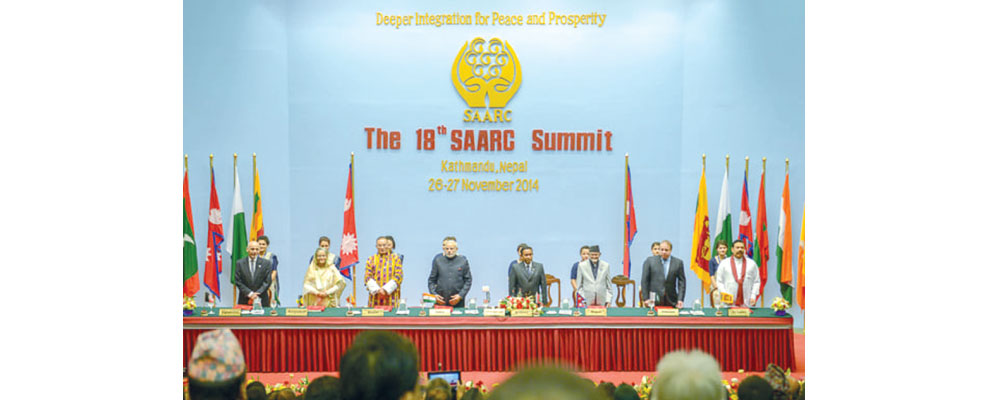
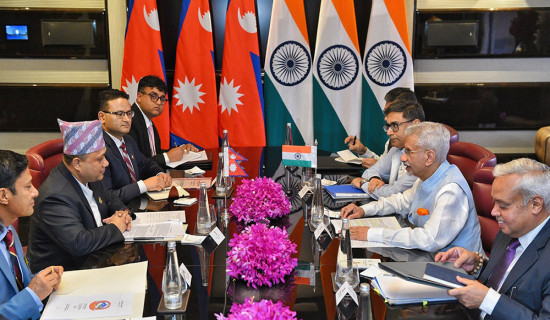
The 18th SAARC Summit was held in Kathmandu in 2014.
Sharachchandra Bhandary
Kathmandu, Dec 3: As the South Asian Association for Regional Cooperation (SAARC) approaches the 40th anniversary of its Charter this Monday on December 8, questions about its relevance and effectiveness are more pressing than ever. Established on 8 December 1985 in Dhaka, SAARC was built on the hope that regional cooperation could uplift one of the world’s most populous yet economically challenged regions.
The Charter emphasized poverty alleviation, quality-of-life improvement, trust-building, and collective welfare as the guiding principles of regional engagement. Four decades later, these goals remain vital, yet the organization itself stands largely dormant, struggling to achieve the promise envisioned by its founding leaders.
Around the world, regional groupings have demonstrated how structured cooperation can transform regions. ASEAN, created in 1967, has evolved into a relatively cohesive bloc capable of balancing political diversity with pragmatic economic collaboration. The European Union, formalized through the Maastricht Treaty in 1993, shows how political will and institutional commitment can turn a region into a global actor. Even with internal frictions, these organizations function with regular summits, decisive actions, and effective coordination—qualities that SAARC has failed to sustain.
SAARC represents over one-quarter of the world’s population and possesses immense human and natural resources. Yet its economic potential remains largely untapped. The last SAARC Summit was hosted by Nepal in 2014, and since then, the grouping has been effectively stalled. Former Secretary-General Arjun Bahadur Thapa has described SAARC as having entered a period of deep dormancy, warning that mutual mistrust among member states must be addressed before the organization can regain momentum.
Pakistan’s Ambassador to Nepal, Abrar H. Hashmi, is of the view that despite its challenges, SAARC has succeeded in building a shared South Asian identity that took decades to take shape. He noted that technical processes of cooperation still function, with the Secretariat and regional centres continuing their work. However, what remains absent is the political leadership required to guide new projects and revive stalled initiatives. Ambassador Hashmi reiterated Pakistan’s readiness to host the next Summit once all member states agree to participate.
A persistent obstacle has been the bilateral tensions between India and Pakistan. Cross-border terrorism, political mistrust, and repeated diplomatic breakdowns have undermined the consensus essential for SAARC to operate. The Charter requires unanimity for all decisions, including the convening of a Summit.
This means that even if a single member state objects, the Summit cannot be held. This principle—originally intended to build trust—has instead allowed bilateral disputes to freeze regional cooperation. India’s refusal to attend the 2016 Islamabad Summit due to security concerns, followed by similar positions from other member states, demonstrated how easily the consensus requirement can immobilize the entire organization. Pakistan, meanwhile, accuses India of politicizing a regional platform meant to foster cooperation, not confrontation. This deadlock continues to cast a long shadow over SAARC’s future.
Beyond the India–Pakistan rivalry, domestic political turbulence across member states has further weakened regional collaboration. Afghanistan’s political transformation and the Taliban’s return to power created institutional uncertainty. SAARC nations have not recognized the current Afghan government because of concerns related to governance, human rights, and regional security. Many governments fear a deteriorating rights situation, especially for women and minorities, and worry that instability could spill across borders through terrorism, displacement, and regional insecurity. Humanitarian engagement continues, but formal recognition remains withheld pending inclusive governance and respect for international norms.
Nepal, traditionally an active advocate of regional cooperation, has been grappling with persistent political instability and the rise of the Gen Z movement, which has mobilized youth frustration against corruption, unemployment, and governance failures. These internal political pressures have absorbed national attention, reducing the bandwidth available for regional initiatives. Bangladesh has been marked by heightened polarization, disputes over democratic processes, and internal political tensions, while Sri Lanka continues to recover from its economic collapse, contending with debt restructuring, inflation, and social grievances. The Maldives has experienced political polarization and foreign-policy shifts that have affected its regional posture, while Bhutan has maintained a cautious and measured approach, focusing on internal reforms and stability.
Former Foreign Secretary Madhu Raman Acharya has consistently emphasized that political differences among member states should never obstruct economic activities and developmental initiatives. Trade, connectivity, energy cooperation, and other practical endeavors must proceed regardless of political disputes, as economic pragmatism is essential to restoring SAARC’s relevance. He also stresses that while the specialized and technical bodies of SAARC—including those focused on agriculture, disaster management, education, energy, climate action, health, and youth development—continue to function effectively, their work alone cannot sustain the organization’s vision. Convening high-level Summits is crucial because they provide strategic direction, align national priorities, and accelerate initiatives across the region. The long hiatus in Summit-level engagement has not only limited coordinated regional action but has also shattered the hopes and aspirations of nearly two billion South Asians who look to SAARC as a platform for progress, integration, and collective well-being.
Over the years, SAARC’s cooperative efforts have expanded into areas such as agriculture, technology, energy, environment, disaster management, tourism, and countering terrorism and drug trafficking. During moments of crisis, such as the COVID-19 pandemic, member states demonstrated their capacity for solidarity. Secretary-General Golam Sarwar has frequently highlighted these examples as evidence that the spirit of SAARC remains alive. He has emphasized that the region’s demographic strength, cultural richness, and economic potential could propel it onto the global stage—if only political will aligns with the needs of its people.
Yet despite these expressions of optimism, SAARC’s most fundamental goal—improving the lives of nearly two billion South Asians—has been hindered by prolonged political paralysis. South Asia remains one of the least integrated regions in the world, with intra-regional trade far below potential and critical connectivity projects stalled. The absence of regular Summits has deprived SAARC of visibility, momentum, and strategic direction, underscoring how deeply the region’s hopes and aspirations have been affected.
Still, there is a growing realization that no country can navigate today’s interconnected challenges alone. Climate change, pandemics, energy insecurity, and economic shocks transcend borders and demand collective solutions. For South Asia to move forward, cooperation must outweigh conflict and pragmatism must prevail over political rivalries.
Despite years of setbacks, SAARC remains the only platform that brings together all South Asian states. Its Charter envisions a peaceful, stable, and interconnected region, united not by uniformity but by shared purpose. For SAARC to regain its relevance, the region’s political leadership must rediscover the institution’s founding spirit and allow it to serve as a vehicle for collective progress. With renewed commitment, practical engagement, and a willingness to rise above narrow national interests, the dream of a more integrated and prosperous South Asia can still be realized. (RSS)