- Tuesday, 9 June 2026

Shram Sanskriti Party's initial commitments made public
.jpg)

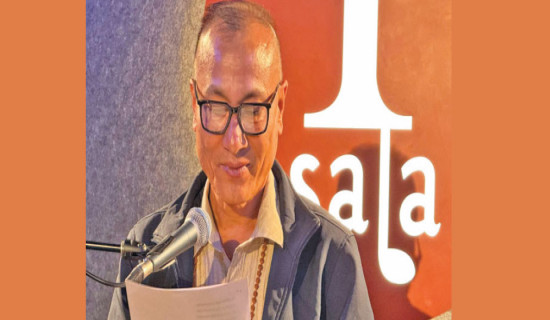
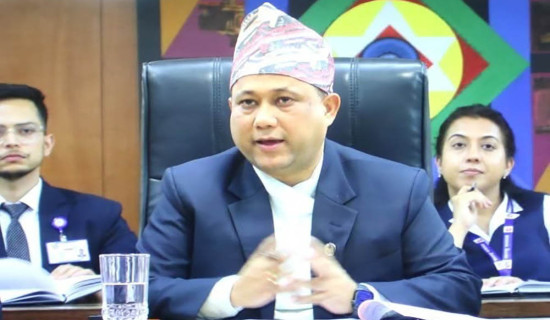
By Nisha Rai,Dharan, Dec. 3: The Shram Sanskriti Party led by Dharan Sub-metropolitan City mayor Harkaraj Rai (Sampang) has unveiled its initial commitments by organising a press conference here on Tuesday.
The party’s chair and Dharan mayor Sampang presented the foundational principles of the party’s commitment.
In his statement, Sampang explained that the core ideology of the Shram Sanskriti Party is based on ‘Harkabad,’ a political philosophy, which emphasises the balanced and proper development of nature, culture and technology.
He explained that such a balanced development was essential for the preservation and advancement of human life and the world.
"To achieve this, both mandatory and voluntary labour are essential, with the continuous implementation of these policies being the only way to eliminate poverty, inequality, division, and the resulting conflicts, wars, destruction, and unrest," he said.
The Sharm Sanskriti Party expressed its support for a directly elected executive with voting rights for all citizens. The party proposes a five-year term for the President, allowing no individual to serve more than two consecutive terms.
In its manifesto, the party has called for a bicameral legislature at the federal level, with the Upper House (National Assembly) providing equal representation for all provinces, and the Lower House (House of Representatives) being proportional to each province's population.
Additionally, the party asserted that all indigenous languages of Nepal should be recognised as national languages. These languages would be used in education and governmental operations, it said.
The party also emphasised that the state would not endorse any religion, although it supports individuals’ freedom of religious belief.
Furthermore, it advocates for cultural decisions to be made by the respective ethnic and community groups without compromising the country’s territorial integrity, sovereignty, or independence.
The party also outlined its commitment to inclusive development. "All citizens actively contribute to development through labour and the unequal and unjust distribution of development, which often favours urban areas, particularly Kathmandu, should be ended," read the commitment paper of the party.
The party intends to shift the focus of development from city-centric to village-centric growth.
Moreover, the party said it was committed to engaging Generation Z (Gen Z) in productive, manufacturing, and innovative sectors.
It advocates for a new educational system that reduces the workload, with a proposal for students to attend school only three days a week, focusing on practical knowledge and reducing subject content.
The party also pledged to foster the development and use of new technologies, promoting self-sustaining industries while building an export-oriented economy. Economic development will be central to the party’s planning, with the goal of achieving significant national economic progress within the next 10 years.
Party chair Rai also highlighted the role of culture in shaping human behaviour and society.
He further emphasised that labour is essential to human life, noting that it is the activity that allows people to sustain themselves.
He said, “Shram Sanskriti Party refers to the culture of work, where human development is the central focus. The most important form of progress is the positive transformation of the individual through this culture.”
-square-thumb.jpg)