- Sunday, 31 May 2026

Trade potential between Nepal and China is enormous: Dr. Gao
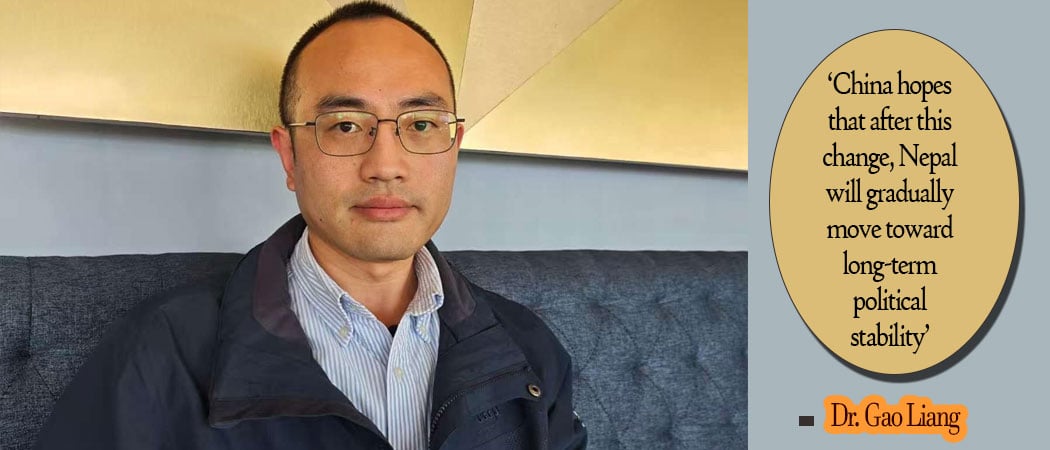
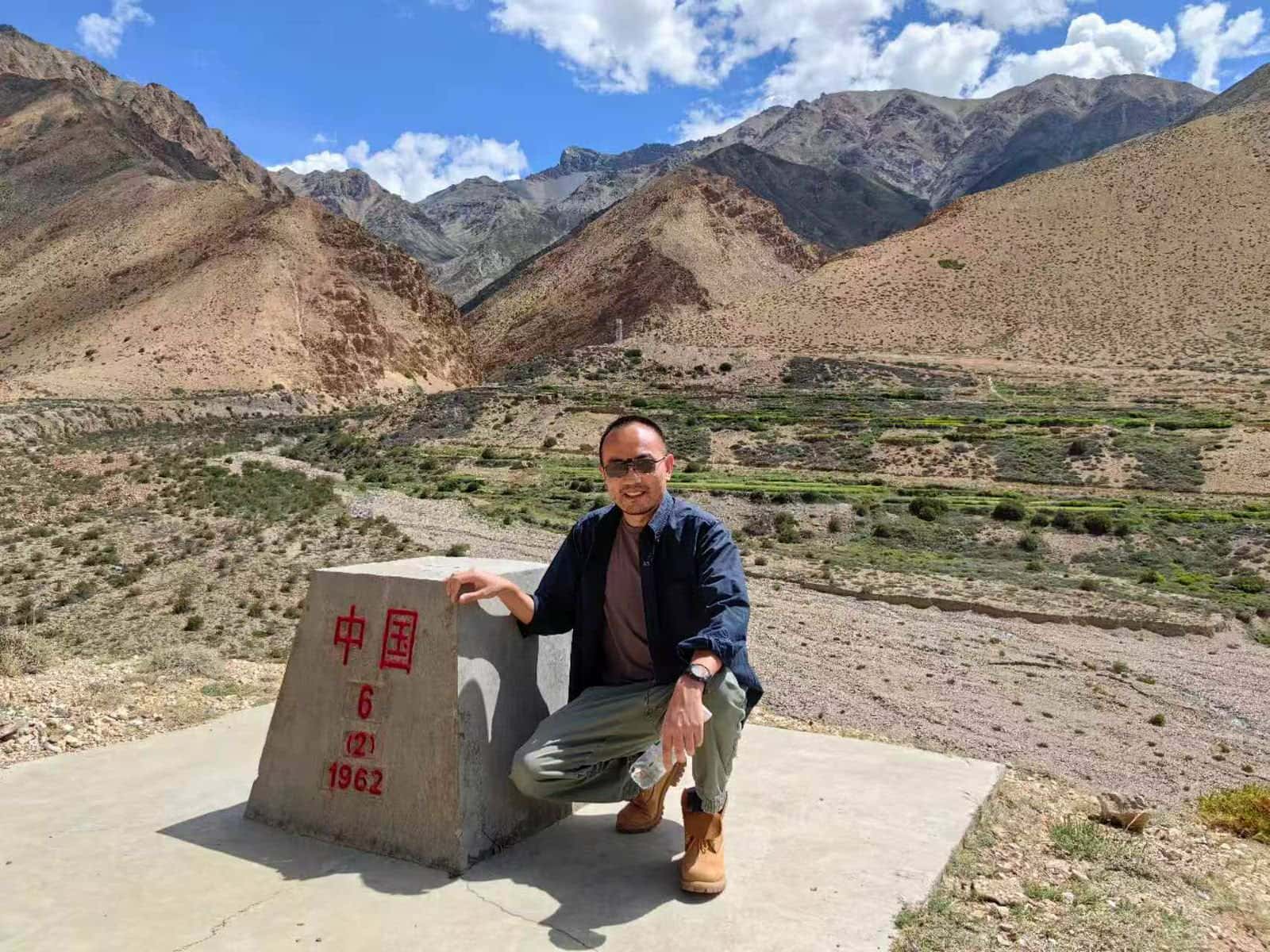
Dr Gao Liang is Vice Director of the Centre for Nepal Studies at Sichuan University, China. The Centre is part of the University’s Institute of South Asian Studies (ISAS), which is China’s key think tank studying the region for over six decades.
Gao, whose doctoral dissertation focused on governance of the Terai, has lived in Nepal, visited more than three dozen times, and travelled extensively across the Country.
He is also a prominent Chinese scholar on Sino-Nepal affairs. He is widely regarded in both countries and elsewhere as a leading voice of the new generation of Chinese scholars studying Nepal. In this recent Interview conducted by Raman Paudel for The Rising Nepal (Online), he spoke on a wide range of topics from the Gen-Z movement to the much-talked-about Trans-Himalayan Railway.
Given your expertise and exposure to Nepal, what do you make of the recent Gen-Z protest and how it is being watched from Beijing?
Based on my observations, the root causes of the GenZ protest movement lie in Nepal's long-standing economic and social development issues, representing a total eruption of accumulated contradictions across various sectors. The social media ban was merely a trigger. Lagging economic development and social inequalities have left young people without a hope for the future, leading to extreme disappointment—even despair—that has fueled this round of intense protests.
As a friendly neighbor, China has always paid close attention to developments in Nepal. First and foremost, China respects the Nepalese people's independent and autonomous choice of their country's development path and direction, and will not interfere in Nepal's internal affairs. At the same time, China is deeply concerned about the political instability caused by this movement and any potential instability it may bring in the future. China hopes that no matter which political forces lead Nepal's government, China's legitimate interests will be respected.
For many years, China has advocated for a stable government- and you recently rephrase that term ‘at least stable policy’ for long-term and ambitious engagement in Nepal. In that regard, where are we now in Nepal-China relations?
Yes, China has always emphasized the importance of a stable government for development and cooperation, and China's own rapid development has benefited from a stable government and predictable policies. I believe that people across Nepalese society have a deep understanding of the various problems and challenges brought by long-term political instability. In fact, the "stable policy" I mentioned not only refers to policies that do not change with government transitions but also to their long-term nature and predictability, which are essential prerequisites for further deepening and consolidating cooperation between our two countries. From the current perspective, our bilateral cooperation in many areas is constrained by political uncertainties on the Nepalese side. China very much hopes that after this change, Nepal will gradually move toward long-term political stability.
China is now the number one trading partner with the highest number of countries in the world. But, despite being good neighbours, the bilateral trade networks have never been stable. The main Rasuwa border point is still not in operation since ‘the miteri bridge’ and road leading there was swept away by flood in July. Other border points are also not in full operation. How must this terrible reality be dealt with?
The natural environmental challenges facing transportation connectivity between China and Nepal are evident. Even so, bilateral trade has achieved significant growth in recent years. The trade potential between our two countries is enormous, and facilitating transportation connectivity would be an important condition for promoting Nepal's economic—and even political—independence and autonomy in the future. From the current situation, we must return to the topic of political stability. On the issue of connectivity, efforts are a matter for one generation, but they will benefit countless future generations. China's stance is very clear: we are willing to engage in pragmatic cooperation with Nepal, and we have already made full preparations in terms of policies and infrastructure on the Chinese side. However, no cooperation is one-sided. The main difficulty at present lies in Nepal needing to form a high level of political consensus on connectivity issues and demonstrate strong political determination.
Many claim that Nepal has been the victim of global and regional geopolitical rivalry. Do you have a different opinion or is it the same?
Nepal's unique geopolitical environment is a long-standing and undeniable fact. But whether Nepal is a victim or a beneficiary is not entirely determined by other countries. Being surrounded by major powers and positioned at the forefront of global great-power strategic competition is certainly a constraint, but it is also an opportunity. Nepal itself can maximize its national interests through flexible diplomatic strategies.
You have extensively travelled across Nepal, visited this country dozens of times, and did your PhD on Nepal. Given these exposures, how do you view Nepalis perspective – from people to bureaucrats to leaders- towards deeper engagement with China? Has it broadened over past years?
Since 2010, I have continuously visited various places in Nepal and interacted and exchanged with Nepalese friends from all walks of life. This rare experience has allowed me to observe Nepalese people and society from different angles up close. If I had to summarize this country with one simple word, it would be diversity. Despite differing opinions among Nepalese on many issues, there is a very broad consensus on strengthening relations with China. Moreover, this consensus has continued to expand over time. Even those who do not particularly like China do not deny the importance of this neighbor to Nepal; they simply have different views on how to engage with China.
In one of your recent articles, you have talked about ever expanding rail networks in Tibet, more precisely closer to the Nepal border. But do you feel preparations on the Nepal side have kept pace?
China completed the railway line connecting Qinghai to Lhasa as early as 2006, greatly improving connectivity between Tibet and other parts of China. The line from Chengdu in Sichuan to Lhasa is currently under construction. Additionally, a railway from Xinjiang to Shigatse in Tibet will soon break ground. Ultimately, this will form a rail network connecting Tibet from the north, east, and west, linking up Tibet's major cities. The rail lines will pass near the China-Nepal border, which is undoubtedly a huge boost for the China-Nepal railway project as stipulated in our agreements. However, from the current situation, the pace on the Nepalese side has clearly not kept up with the Chinese side. Such a railway project will benefit generations to come, so our vision needs to be even more long-term.
Do you still believe the rail project will be the game-changer in Sino-Nepal relations?
I have always firmly believed so. But the practical difficulties still need to be addressed one by one in a pragmatic manner.
Finally, now as the relations between China and India are on the mend with more flights, talks and visits, can Nepal see this as an opportunity or worry about it as many Nepalis are alarmed with the understanding both had on Kalapani without consultation of Nepal, the territory which Kathmandu claims?
Considering regional and global geopolitical realities, the improvement in China-India relations is certainly positive news for Nepal, meaning greater space and opportunities. The Kalapani issue is a matter that needs to be resolved through negotiations between Nepal and India. China holds no special position on it and no intention to alter the status quo.

-square-thumb.jpg)


-original-thumb.jpg)
-original-thumb.jpg)