- Monday, 1 June 2026

Role Of Medical Education Commission

Nations throughout the world should thrive on their investment in Health. It is the best investment in terms of return on investment. All medical professionals, from physicians to pharmacists, nurses to co-medical workers, who serve the people are trained by the education system they receive. It depends on the quality of the education system, which determines whether the public gets competent and ethical professionals or not. If the system fails, the whole health system is at stake.
The Medical Education Commission (MEC) was established in Nepal with the vision to improve the overall health system. Its main purposes are to improve medical education by increasing state investment, ensuring integrated and efficient management of medical institutions, and maintaining quality, professionalism, and accountability. It was established as a response to problems such as unjust admissions, commercialisation of medical education, and asymmetrical quality among health education colleges.
Focus
Nepal already has several professional councils, such as the Nepal Medical Council (1964), Nepal Nursing Council (1996), Nepal Ayurvedic Medical Council (1999), Nepal Health Professional Council (2003) and the Nepal Pharmacy Council (2005). Each has its own jurisdiction to regulate its own areas of health practice. The main focus of the MEC is on the health education system of the country. It has been conducting a single entrance exam. This has reduced the burden to students as they had to sit for multiple entrance tests for different universities, deemed universities, and colleges. The system in the past was expensive, perplexing, and prone to manipulation.
The MEC has introduced the minimum standards for health science colleges that include infrastructure, qualifications of faculty, and pedagogies, reducing wide variations in the quality of education among colleges. The MEC decides the number of seats to be allocated for each medical field based on national needs and the capacity of colleges. Hence, MEC is responsible from the establishment and operation of institutions to setting curriculum standards.
On the other hand, all the professional councils are older than MEC and focus more on regulating practice and licensing. Each medical profession has its own council. These councils are guardians of professional standards. Their main task is to set standards, register practitioners, promulgate, and enforce a code of conduct to protect the public and ensure quality care. In short, councils are established in order to ensure that graduates entering into professional practice are competent and ethical.
Now, here's where the tensions lie. Both the MEC and the councils have jurisdiction over education and standards; their responsibilities often overlap. A health science college is repeatedly inspected by MEC for quality standards and also by councils for professional requirements. MEC sets curricula, but councils also influence them. Differences in priorities can cause disputes.
MEC oversees admissions and other requirements for quality education, such as training needs, while councils license graduates and also plan to conduct skill tests. Hence, it is necessary to align; otherwise, students may face difficulties. Still, MEC is under strict state control while councils believe respective professionals should control their fields. MEC represents centralised state control, while councils believe that professionals should regulate their own fields.
Despite challenges, MEC has made some important progress in health education. Admissions are now more merit-based and less manipulated with money or donations. The single entrance exam has made life easier and fairer for students. However, decentralisation is lacking, and students need to travel long distances for a common entrance in the federal capital. It has been said that seat allocations are more aligned with national health workforce needs. However, the increasing number of affiliated colleges every year has made this achievement debatable.
There are many limitations and criticisms of MEC, such as bureaucratic delays that cause delays in decision-making and result in delays of academic calendars. Universities often feel their academic freedom is restricted. There are several duplicating roles of MEC, and councils and colleges face overlapping demands. Many professionals feel their councils are sidelined in MEC decisions, as almost all the dignitaries are from only one subject area: medicine. There is a growing demand to amend the policy and guidelines so that professionals from other medical sciences can join MEC and provide their expertise.
Opportunities
The key to success lies in cooperation, not opposition. MEC and the councils can complement each other if they work together. Some opportunities are the division of roles, joint accreditation, coordination, workforce planning, use of digital platforms, capacity building, and student and public engagement. The MEC should focus on the educational aspects of health professions: entrance, curriculum, and monitoring, while councils should focus on accreditation, licensing, ethics, and professional regulation. The MEC and councils could form joint teams for inspecting colleges. A high-level standing committee, including universities, MEC, councils, and stakeholders, that meets regularly, could resolve disputes and align decisions.
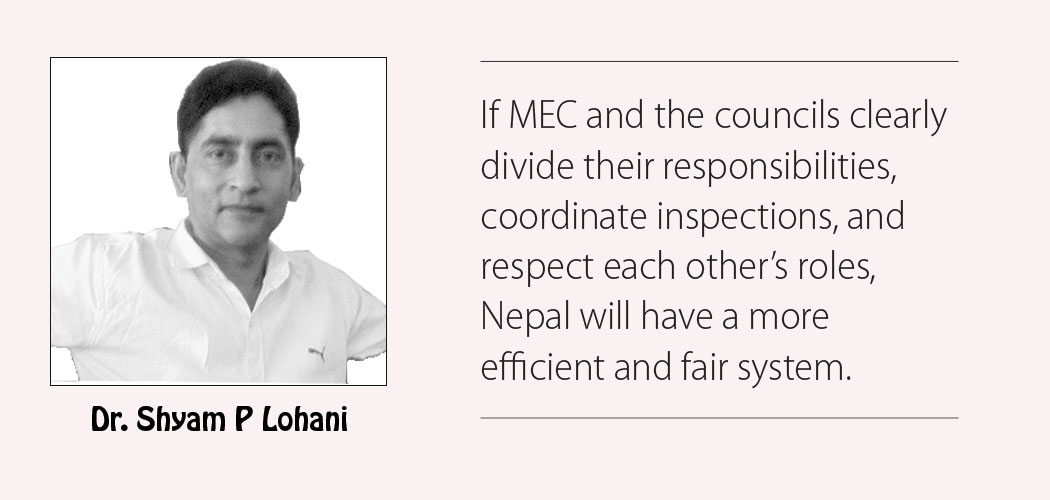
Professional councils can advise MEC on several seats to allocate in each field. The MEC and council should invest in online systems for admissions and accreditation that not only cut down costs and duplication but also make processes more transparent. The MEC has already improved admissions and created a more transparent system. But the common entrance exam has many shortcomings, such as for medicine and dentistry, a common entrance date and time on a separate day, but for other medical sciences, the date and time are on the same day, limiting students' choice to only one subject. This causes the seat to remain vacant in other medical sciences in many colleges, such as pharmacy, nursing, etc. The solution lies in collaboration, not opposition. If MEC and the councils clearly divide their responsibilities, coordinate inspections, and respect each other’s roles, Nepal will have a more efficient and fair system.
(Dr. Lohani is the executive director at the Health Concern. lohanis@gmail.com)



-square-thumb.jpg)