- Tuesday, 9 June 2026

Democracy Day Special
Nepal's Fight For True Democracy

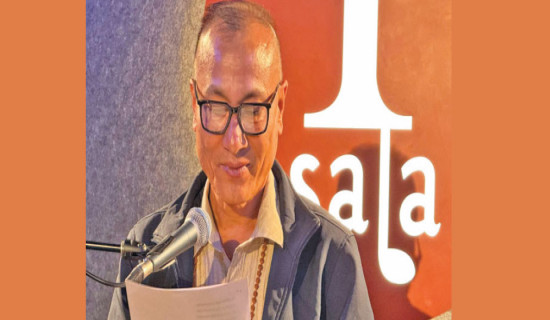
 K. B. Gurung
K. B. Gurung
K. B. Gurung
When rumours of revolution began spreading, I was a high school student in Ilam. Since Ilam is near Darjeeling, the Indian town, information about the political activities used to reach Ilam from Darjeeling. Many leaders of the Gorkha League were living in Darjeeling. Before launching the armed revolution in November 2006, Nepali Congress leader Bishweshwar Prasad (BP) Koirala reached Darjeeling to meet the Gorkha League leaders. This news spread like wildfire in Ilam. Of course, whispers of revolution were already circulating across Nepal. In Ilam, even a section of the people used to call as Kangresi (supporters of the Nepali Congress) when we gathered to play in groups.
As students, we used to frequently hear talks about the need for a new revolution to usher in democracy by overthrowing the Rana regime. The Nepali Congress was gaining prominence, and we, as young students, used to feel proud to be called ‘Kangresi.'
As the Nepali Congress began preparing for the revolution, the political atmoshpere in eastern Nepal and neighbouring Darjeeling became highly charged. BP Koirala, the pioneer of Nepal’s democratic movement, tried to form alliances with the Gorkha League in India. However, these efforts were unsuccessful due to the League’s ties with the Ranas. There was a speculation that BP Koirala had traveled to Darjeeling to discuss plans with Dharanidhar Koirala, but the Gorkha League, owing to its connections with the Rana rulers in Nepal, refused to lend their support.
One of the key factors for the downfall of the Rana regime was the internal division within them. The Ranas had created a class hierarchy among themselves, separating those born to wives married formally as Byaite and those born to women who the rulers had made their wives without performing any marriage rituals as Lyaite. The latter were stationed away from Kathmandu and sent to different regions of Nepal, while those born to legitimate wives were kept in Kathmandu.
As they were born to Lyaite wives, Mahabir Shumsher Rana was sent to Ilam and Subarna Shumsher Rana to Birgunj and Madhav Shusmher elsewhere. Later, these Ranas became instrumental in supporting the revolution of 1951. Subarna Shumsher was one of the key NC leaders during and after the revolution of 1951. The Ranas from the Lyaite wives of the Rana rulers were unhappy with the way they were treated. They had soft corners for common people, allied with BP Koirala and the Nepali Congress, helping the revolution gain momentum.
Meanwhile, in Kathmandu, King Tribhuvan, who was little more than a figurehead under the Ranas, was becoming increasingly restless. Krishna Prasad Koirala, BP’s father, sent the king dirty clothes worn by common Nepalis as a powerful reminder of the people's suffering, urging him to take a stand against the regime.
As the revolution gained pace, key Congress leaders inlcuding Ganesh Man Singh sought international support. BP Koirala had a big personality and had good relations with Indian leaders, mostly the socialist leaders like Jaya Prakash Narayan. BP himself had participated in the independent movement of India and was a reputed figure in India.
When BP was imprisoned in Kathmandu by the Ranas, they refuse to release him. In the meantime, the Ranas learned that Mahatma Gandhi was travelling to Kathmandu to secure BP Koirala's release, they decided to free him. Despite this, Rana Prime Minister Mohan Shumsher attempted to bribe BP Koirala with Rs. 100,000 to sway him. BP, however, used the money to finance the revolution instead. Mohan Shumsher told BP, "You want to be like us, but you need good fortune for that." BP replied, "No, I am just a common Nepali.".
Later, the armed struggle began from Birgunj and Biratnagar, with BP Koirala, Matrika Prasad Koirala, and other revolutionaries taking over government offices. Makeshift armored vehicles, tractors turned into tanks, became symbols of the people’s uprising. Thirbam Malla and others were at the forefront while capturing Birgunj. Later, Malla was shot to death by the Ranas. Although the situation was tense, Mohan Shumsher’s relatively liberal stance prevented mass bloodshed. It is said that Mohan Shumsher and his son Bijay Shumsher were against using forces against the people while Babar Shumher wanted to suppress the movement.
A decisive moment came when BP Koirala planned to take King Tribhuvan to Palpa to escalate the movement. Then Rudra Shumsher was the Badahakim in Palpa, and he had good relations with Koirala and other NC leaders. However, India intervened, whisking the king away to Delhi instead. This move heightened tensions among the Ranas, who, realising they had lost international support, ultimately relinquished power, and Nepali people got democracy on February 18, 1951, through a proclamation by King Tribhuvan after a tripartite—king, Congress, and Rana—agreement in Delhi, India.
Although BP Koirala envisioned a socialist Nepal free from both Rana rule and monarchy, external factors, particularly India’s geopolitical interests, ensured the continuity of monarchy. As a result, instead of transitioning to a republic, Nepal adopted a constitutional monarchy after 1951, with BP Koirala becoming the first elected Prime Minister.
The 1951 revolution set the stage for subsequent movements, including the 1990 movement to reinstate democracy snatched away in 1960 and the 2006 People’s Movement that ultimately abolished the monarchy. However, BP Koirala’s full vision was never realised. BP wanted to create a truly independent, socialist Nepal, but external factors dictated a different path.
Yet, Nepal’s sovereignty remained intact, thanks to its international recognition, membership in the United Nations, and its historical ties with Britain and India and the towering personality BP Koirala. The contribution of Nepali soldiers during World War II further cemented Nepal’s standing on the global stage.
As mentioned earlier, the 1951 revolution was just the beginning. Many other uprisings followed, shaping Nepal into the country it is today. While the system has changed numerous times, the struggle for true democracy and social justice continues.
The sacrifices made to break the chains of autocracy and the long road ahead in realising the aspirations of those who fought for freedom are undeniable. The fight for democracy did not end with the fall of the Rana regime, as successive governments have faced their own challenges in maintaining peace, stability, and prosperity.
The spirit of 1951 continues to inspire new generations to protect and uphold the hard-won freedoms of the past. Nepal’s journey remains a testament to resilience and the unyielding pursuit of justice, equality, and self-determination.
(Based on conversations Pallav Bhusal of TRN had with senior NC leader Gurung.)