- Wednesday, 6 May 2026

Manmohan Singh A Leader With Humility And Brilliance
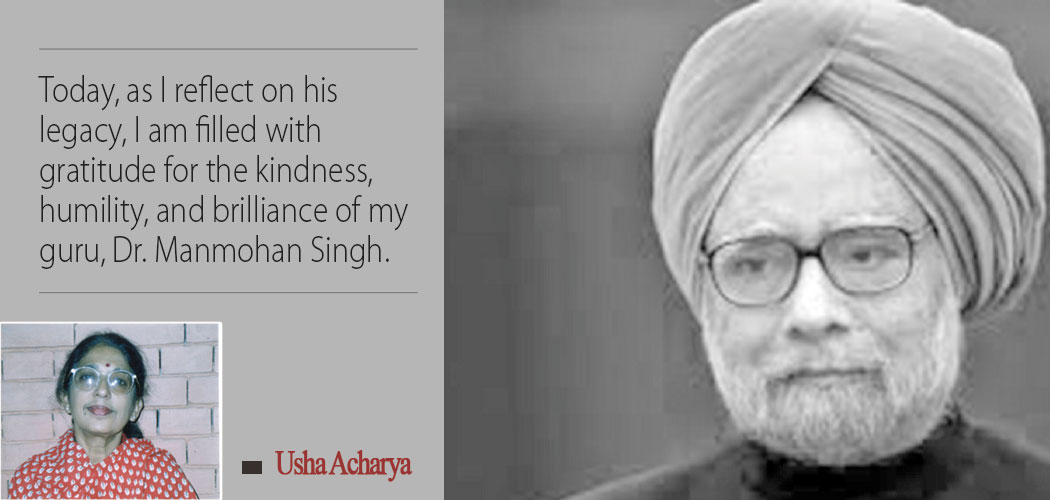

Coming from rural Nepal, I was fortunate to study monetary economics under guidance of the late Manmohan Singh, who was a professor at the Delhi School of Economics in the early 1970s. My journey to that point was anything but ordinary.
I grew up in Nepal’s central district of Tanahun and moved to Kathmandu in the late 1950s when I was around twelve years old. Despite not knowing the English alphabet, I was enrolled in the fifth grade. After completing my S.L.C., I pursued higher education and graduated with a B.A. in economics in 1968, topping the list of successful graduates from Padma Kanya College. This achievement earned me a scholarship from the Government of India to pursue an M.A. in Economics at Delhi University.
Profound impact
It was there that I had the privilege of being taught by Professor Manmohan Singh, who treated me like his own daughter. Aware of my background, he showed kindness and encouragement that profoundly impacted me. I also had the honour of studying development economics under Professor Amartya Sen, who later moved to London and became a Nobel laureate.
After completing my M.A., I pursued an M. Phil. in Economics at Jawaharlal Nehru University (JNU) and began working toward my Ph.D. However, during a summer break in Kathmandu in 1976, I was offered a position as an officer at the Agricultural Development Bank (ADB), so I left JNU without completing my PhD. After a few years in ADB, I was transferred to Nepal Rastra Bank in 1980.
In 1981, I had the opportunity to reconnect with my guru, Dr. Manmohan Singh, when he visited Kathmandu as the Governor of the Reserve Bank of India (RBI) to attend a conference of South Asian central bank governors. As his former student, I was appointed his liaison officer. The role was effortless because of his warm and fatherly demeanor. He even invited me to bring my husband to meet him, saying in Hindi, “Unko bhi le aaiye” (“Please bring him too”).
The next morning, my husband and I joined Dr. Singh for breakfast at Soaltee Hotel. He greeted us with his characteristic humility and gentleness, saying, “Please, help yourself.” My husband, like many others, was deeply impressed by Dr. Singh’s simplicity and humility. Despite being the Governor of RBI, Dr. Singh’s modest attire — his shirt cuffs were slightly frayed — only enhanced his greatness. He commanded respect through his integrity, sincerity, and intellect.
Years later, my husband, then Nepal’s ambassador to the United Nations, met Dr. Singh again in Geneva in 1993, when Dr. Singh was India’s Finance Minister. He fondly inquired about me, “Aap ne Usha ji ko kyun nahin laayaa?” (“Why didn’t you bring Usha ji with you?”). My husband explained that I was in New York with our young children.
Dr. Singh’s tenure as Finance Minister in the early 1990s marked a turning point in India’s history. Facing a severe economic crisis, he played a pivotal role in rescuing the country from the brink of default. His policies ushered in a wave of economic liberalisation that transformed India into one of the world’s fastest-growing economies.
Interesting anecdotes
An anecdote illustrates his decisive leadership during this time. In 1991, during a cabinet meeting, Prime Minister P.V. Narasimha Rao took a brief recess to consult opposition leader Atal Bihari Vajpayee about two critical measures proposed by Dr. Singh: devaluing the Indian rupee and pledging the Reserve Bank of India’s gold reserves to raise $400 million to stabilise foreign exchange reserves. After securing Vajpayee’s approval, Rao confidently told Dr. Singh, “When Vajpayee ji says ‘it is alright,’ it is alright. Don’t worry about the cabinet colleagues!”
These bold measures, along with other trade and investment reforms, became the cornerstone of India’s economic resurgence — aptly termed “Manmohanomics.”
Today, as I reflect on his legacy, I am filled with gratitude for the kindness, humility, and brilliance of my guru, Dr. Manmohan Singh. He not only shaped my academic and professional journey but also left an indelible mark on India and the world.
Singh passed away at the age of 92 on December 26. His demise has triggered an outpouring of grief and condolence messages from inside and outside of India. My deepest tribute to him.
(Acharya currently is associated with Education for Empowerment (E4E) of Nepali girls.)