- Tuesday, 9 June 2026

59thAnniversary Special Supplement
Print Media Is Here To Stay
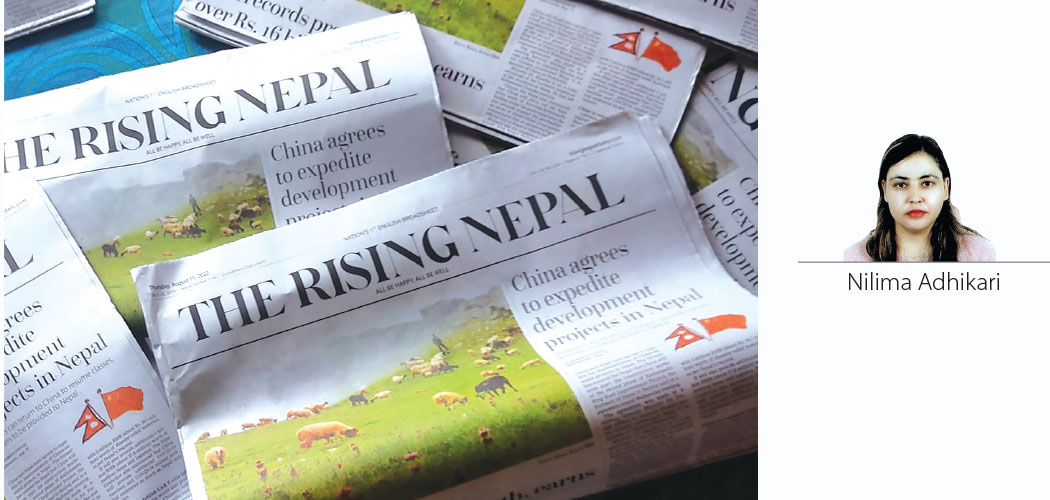
 Nilima Adhikari
Nilima Adhikari
Nilima Adhikari
Despite the proliferation of online news portals, print media is here to stay. The online news portals have grown in significant numbers, but the importance of newspapers has not diminished and probably never will. Many global researchers, including in Nepal, have shown that newspapers are still the most trusted news sources for the public. Although newspapers are struggling to adapt to the changed global scenario due to unprecedented development in the sector of information and communication technology (ICT), the factual information, trustworthiness, and quality of news and articles they produce are seldom produced by their digital competitors.
Artchil B. Fernandez, in his article, Newspaper in the Digital Age, writes, “Adaptation and innovation enabled newspapers to survive the digital age. Most newspapers also migrated to online while maintaining their printed edition. Newspapers entered the digital age with electronic copies of their own paper and created their own websites."
This digital transformation of many newspapers in Nepal allowed them not only to compete but also to endure the digital disruption. Most of the English national dailies, including The Rising Nepal, have shifted to online editions while maintaining their print editions as well. After going online, these dailies have strived to increase their subscribers.
Trustworthy
When it comes to accuracy, balance, and credibility, people rely on the print media. Journalism is guided by certain codes of conduct and ethics, and print media like The Rising Nepal, with an extended legacy, is more accountable to its readers. The national dailies are more trustworthy and accountable to people and society compared to their digital counterparts. Unlike online news portals, newspaper news goes through the rigorous process of editing and fact-checking before being published.
With the restoration of multiparty democracy in 1990, press freedom has been constitutionally guaranteed. As a result, the country has witnessed an unprecedented growth of media, both print and broadcast. Privately owned English-language newspapers, including The Kathmandu Post, The Himalayan Times, and Republica, also came into operation.
They also provided the platform for Nepalis to engage in discourse on global issues. As The Rising Nepal is celebrating its 59th anniversary, it stands at a critical juncture of challenges and opportunities. It is often predicted that print media, especially newspapers, will be taken over by online platforms.
However, people still like to start their morning tea with a newspaper that provides factual information and unbiased opinions. English newspapers will continue to have their own readers. In the age of misinformation and fake news circulated by digital and social media outlets, TRN continues to thrive because of its primary mission of disseminating factual, objective, and credible news to its readers, which it has been doing for the past 59 years.
English newspapers have fewer readers compared to their Nepali counterparts. The readers of English newspapers mostly include college teachers, media people, diplomats, expatriates, and officials at international agencies. Not all Nepalis are proficient in the English language, and they prefer reading news in the Nepali language or their regional languages. English newspapers in Nepal often have a limited distribution network, focusing on urban areas, while a large part of the population lives in rural areas where access to these newspapers is scarce.
However, we can predict that the number of readers of English newspapers is likely to increase in the coming days as most students receive education in English medium these days, be it community schools or private schools. Many times readers, like school students, read English newspapers to improve their English language. If the English dailies work to make newspapers more accessible and affordable and diversify their content to appeal to a broader audience, they can sustain and sail smoothly.
English newspapers such as The Rising Nepal, The Kathmandu Post, The Himalayan Times, Nepali Times, and The Annapurna Express survived the COVID pandemic, continuing publication, and are popular among readers. Business houses still prefer to give advertisements in print media despite people having enhanced access to digital platforms. Advertisements in digital media are often overlooked and skipped. However, the advertisements in print media are believed to have a wider impact on readers. Likewise, they are the major sources of revenue for the newspapers. A survey has shown that 82 per cent of people from the 18-23 age group prefer to read print ads over digital content. They find print ads in newspapers or magazines more authentic and credible than content on random online sites.
English-language media often faces a scarcity of journalists who are highly proficient in the English language and who want to make journalism their career. Media houses often feel a dearth of people who have the level of English proficiency that is often required in professional journalism. Sustaining those human resources is often challenging to the media houses as the pay is not as good as the quality of work is expected from the journalists. Likewise, there is always the possibility of layoffs, as most of the English-language newspapers in Nepal have downsized their pages during COVID to cut costs.
Additionally, media owners frequently fail in offering competitive salaries and benefits to journalists in English-language media. So, aspiring youth who dream of making a career in journalism either go abroad for studies or work or opt for a more stable career in INGOs or government organisations. So for media houses to thrive, they need to create an environment where journalists get a chance of professional development and a stable career. Media houses should also ensure the chances of training and workshops for the journalists to boost their professional growth.
Rich legacy
TRN has traversed a long path and has made history; its story is the story of resilience. In a crisis like COVID-19, it did not stop bringing print editions. TRN is a state-owned media outlet, but it brings forward the political and social anomalies without being biased. It has never stopped disclosing the weaknesses of ruling parties, which enhances its credibility, and it should continue to do so. English-language newspapers in Nepal have a rich legacy as carriers of informed debate and global connections.
Likewise, TRN should conduct regular surveys to understand the changing preferences of the readers. This can provide valuable insights into what content is liked most, emerging trends, and areas where improvement is needed. While the digital age presents challenges, those who innovate and adapt can not only survive but also flourish in this evolving media landscape.
(Adhikari is a journalist at TRN.)