- Saturday, 25 April 2026

A native bird of hot climate sighted in Manohara
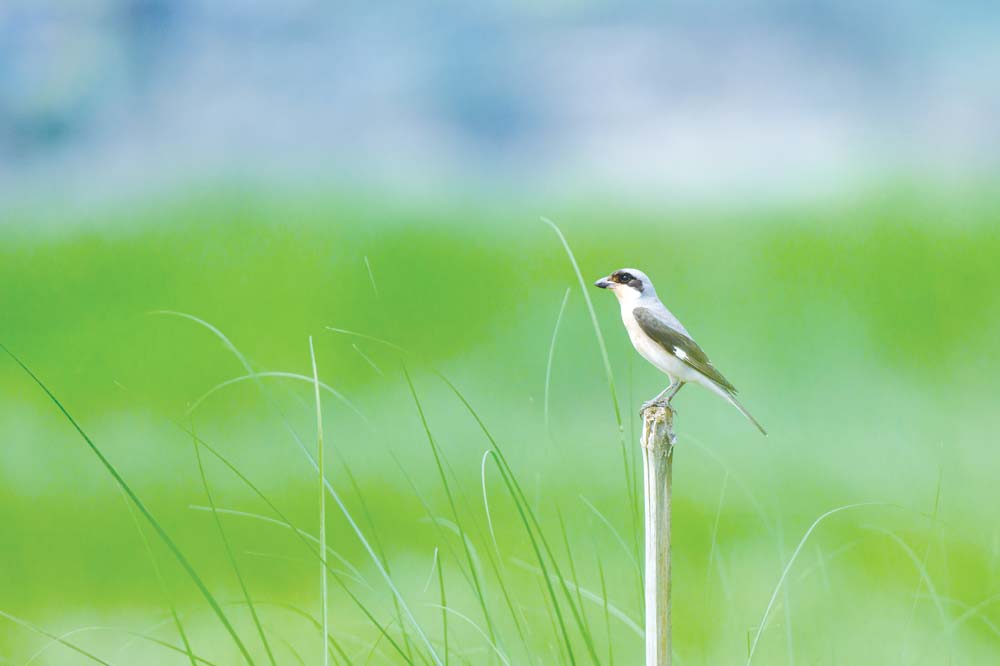
Lesser Grey Shrike

By A Staff Reporter, Kathmandu, June 21:With the rise in temperatures, birds typically found in warmer regions have started appearing in the Kathmandu Valley. Recently, the ‘Lesser Grey Shrike,’ a bird native to Europe, South, and West Asia, has been recorded in the Kathmandu Valley for the first time.
A pair of ‘Lesser Grey Shrike’ was spotted in Manohara of the Bhaktapur district recently. With this record in the Kathmandu Valley, the ‘Lesser Grey Shrike’ is also the first record for the hilly regions of Nepal. Bird guide Shankar Tiwari and wildlife photographer Sanjay Tha Shrestha found this bird in Bode, Manohara, on Saturday afternoon.
According to Shrestha, the bird was first recorded by Tiwari. When Tiwari saw the unique bird in the area, he called Shrestha, and together they confirmed that the bird was a ‘Lesser Grey Shrike,’ making it the first sighting in the Valley.
Last year, at the end of April, the ‘Lesser Grey Shrike’ was seen for the first time in Nepal in the eastern coastal area of Shuklaphanta National Park. Wildlife technician Devraj Joshi of the National Trust for Nature Conservation (NTNC) noticed the bird, and a team of national and international experts confirmed it as the first record for Nepal.
The bird was again seen in Shuklaphanta National Park this year. So, the record in Kathmandu is the third time in Nepal and the second time in the locality, said noted ornithologist Dr. Hem Sagar Baral.
According to Dr. Baral, the bird is of the Shrike species and is yet to be given a Nepali name. It looks similar to a sparrow at first glance. It has a black forehead and crown, and white in the middle of its black wings. It can fly long distances. This is a western species and is commonly found in Rajasthan, India, Pakistan, Afghanistan, and surrounding areas.
“This species of bird is native to a drier climate, and its record in the Kathmandu Valley might indicate a drier climate in Kathmandu Valley as well. It could be the effect of global warming. Due to the increase in temperature, it might have come here searching for a suitable area to nest.” He said that he has no prior record of this bird in the hilly regions of Nepal.
Baral suggests that the appearance of the ‘Lesser Grey Shrike’ in Shuklaphanta, a Tarai region at 218 meters above sea level last year, and in Bhaktapur, over 1,300 meters above sea level this year, might be due to rising temperatures. Along with the Lesser Grey Shrike, about 300 species of birds have been recorded in Manohara.
A month ago, a water bird called ‘Water Hen’ was also found in Manohara. Although rare in the Kathmandu Valley, it was not the first record. According to Shrestha, birds like the Water Hen and Lesser Grey Shrike might be seen in Manohara as they rest during their wandering due to increased heat.