- Friday, 5 June 2026

Water scarcity in Jumla headquarters
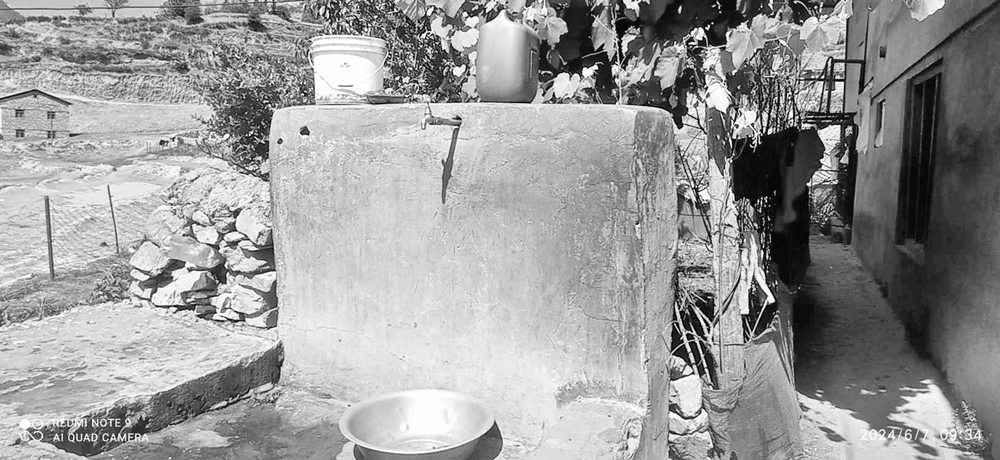

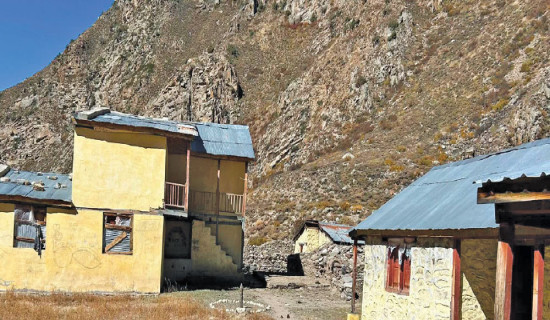
By Our Correspondent,Jumla, June 9: For the last couple of years, Namita Rawat, residing in the Khalanga, treks to Kholikot village daily, spending three hours to fetch a pail of water. In Jumla, the primary water sources have dried up, and the stream's water level has significantly reduced.
Likewise, Manisha Budha, who runs a beauty parlor in Bhartiwada, Chandannath Municipality, says there is no water in the stream and if the water in the river dries up, it would be very difficult for her to carry on her business.
Currently, the absence of water distribution in Khalanga, the main center, has left the residents feeling disheartened. For the past fortnight, there has been no water supply, necessitating a trip to another stream to fetch water.
The Water Consumer Committee of Khalanga, Jumla's main hub, has been overseeing operations for an extended period. Due to the absence of a nearby drinking water source, water supply is sourced from Badekholi in Patarasi Rural Municipality-6, Chahare River in Rini Village of Patarasi-7, and Khalagadh River in Chandanath Municipality, all located approximately 10 kilometers away
According to Arjun Baral, Assistant Technician of Khalanga Water Consumer Committee, when the water source dries up, they have to rely on other local levels for drinking water.
He stated that in 2000, a total of 150 drinking water taps were constructed, although there was a plan to construct 200 taps. Presently, there are 1,850 drinking water taps in the district. Additionally, he mentioned that in Badikholi Spring, three water sources have been combined, yielding a flow rate of only 2 liters per second. Comparatively, a decade ago, the spring used to fill at a rate of 6 liters per second
Hotels in Jumla are facing challenges due to the scarcity of drinking water. Padam Bahadur Mahat, the manager of the Dautari Hotel in Jumla, mentions that despite the construction of 40,000 ridge tanks, there is still insufficient water for complete filling. Concerns arise as soon as the water level drops, but the situation has improved with the introduction of reserve tanks, making it less worrisome.
Following the water scarcity in Khalanga, the federal government has taken a significant step by forwarding the Dhauligad Water Supply Project, which will build 8500 taps. Dipendra Bhatta, who oversees the Federal Water and Sewerage Project in Jumla, reports that the project's physical development is on track, showing a 45 per cent increase so far. Bhatta also mentioned that the Dhauligad Water Supply Project is being executed in two phases, with the initial phase focusing on tasks such as intake construction, pipeline installation and tank construction. Tanks of 100 to 600 cubic meters are being constructed in this area.
-square-thumb.jpg)