- Wednesday, 10 June 2026

Defenseless due to Disaster

It happened 44 years ago when preparations were
being made in the country for plebiscite over whether improved Panchayat is
good or multiparty system. Jay Ram Tharu was just four years old then. Jay Ram
has a dim memory about how he clung to his grandpa’s hand while they migrated
from Bhawaniyapur to Joraiya. He knew about the reasons for the migration much
later. His grandfather had moved to Joraiya field which lay two kilometers from
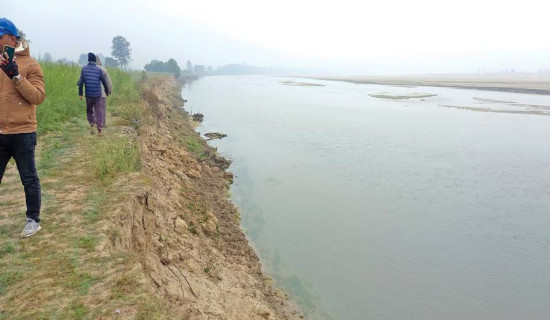
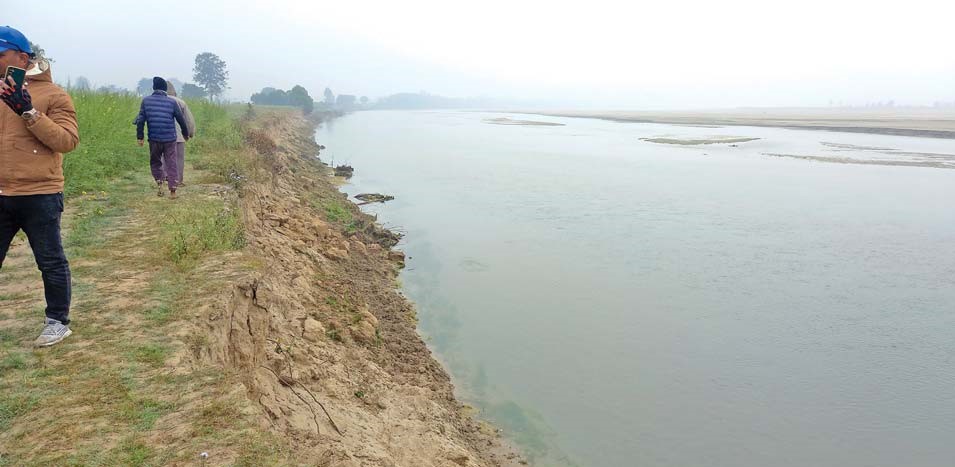
Bhawaniyapur out of fear that their shelter would be swept away by the erosion
of the Rapti River. However the same Joraiya turned out to be unsafe. Jay Ram’s
family had again to migrate from Joraiya, which now lies at Ward no 6 of Rapti
Sonari Rural Municipality in Bake district. Like his grandfather, Jay Ram
shifted some two kilometers away from Joraiya as the Rapti River started to
erode their land in 2006. But, unlike in their first migration when they had
come to their own land, this time they settled in the edge of a forest, a
public land. To save their life and properties 90 families which have no
different story from that of Jay Ram have been staying in make-shift huts for
the last 17 years at an elevated land in Mohanpur forest area.

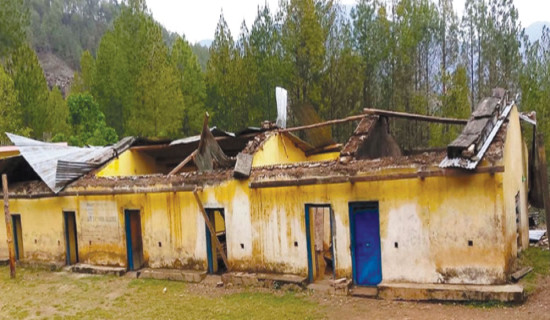
Jay Ram is more frustrated now because even after 17 years since the Rapti started eroding their land, no work has been initiated to contain the erosion and save the field. No government in this period has listened to the plight of the Joraiya farmers like Jay Ram. Due to failure to initiate measure to stop erosion, field that would be covered with swaying paddy plants have been barren sandy bank. 10 families at Sauliya Tol and eight families at Thulopurano Tol of Joraiya have so far remained safe from flood and erosion of the Rapti. But they are also at risk of flood-induced calamity.
Mohanpur jungle has become a shelter for families like that of Jay Ram who have lost their houses and farmland to flood. About 255 families have been staying here in temporary shelters they have made. With the increasing incidents of floods and landslides, number of farmers similar to those of Joraiya who lost houses and means of livelihood such as farmland has increased.
On the basis of three comprehensive
reports produced by the government and the data of farmland lost to flood,
landslides and erosion at 842 places that we collected as well as the analysis
of some 220 news reports related to flood and landslides, we can conclude 'loss
of farmland is terrible.' Agricultural
production is found to have been put in priority in the multi-year projects of
the government. Of all the three tiers of the government, federal, provincial
and local, none has taken a concrete step to protect farmland that the farmers
are losing, help farmers’ efforts to safeguard farmland, provide relief or make
farmer-oriented programme. As the farmland is thus being lost, on one hand,
agricultural production is decreasing in the country, on the other,
landlessness and poverty is increasing. A large chunk of remittance sent home
by youths working abroad has been spent on importing agricultural goods.
In 2068 BS, loss of farmland due to
flood was 54,738 hectors, in 2078 BS it was added by 15,000 hectors. This shows
that every year some 1500 hectors of farmland on average is lost to disasters
such as flood and landslide. Similarly, economic survey and the agricultural
census of the federal government confirms that a large area of farmland has
been damaged due to inundation, landslides and erosion.
People who have thus lost shelters, farmland and grains have been vote banks of the political parties. Of them, political parties and the government have kept the landless in top priority for relief. However, political action has been found motivated only by partisan interest. Although commissions have been formed in different times to solve the problems of landless and provide land to them, problems have been growing more. Fifteen different landless commission were formed in the last 30 years (2048-2078 BS). Every government formed the commission and they were blamed for distributing land to their cadres and near ones instead of the real landless. Till the date, land certificate of a plot to make house has been provided to 440 families. But that plot suffices only to build house, not for farming. Sociologist and political expert Bhashkar Gautam says at least 10 Dhur of land is needed in Terai and 1 and half bigha in the hills for farming purposes. “If cycle that keeps the increase of landless in this way, vote for the political parties will no doubt increase, but it has exposed that the government as well as the parties have done nothing to control the damage of the disaster. Indeed, government efforts to protect farmlands from disasters is very minimal. Embankment projects have stayed incomplete for years.
It is not that no project was made to erect embankment in the Rapti to protect settlement and farmland of the farmers such as Jay Ram Tharu. The planning of embankment construction at Joraiya, Rapti Sonari Rural Municipality ward -6, with aid from Asian Development Bank (ABD) was made in 2020, the contract was granted in 2022, but the work in ward 6 has not moved ahead although, as per ADB reports, works in wards 5 and 7 have moved ahead.
Leader of CPN (Maoist Center)
Maheshwor Jung Gahatraj, also former Member of Parliament (MP) from Banke Constituency-2,
said that even though the agreement was made to work in ward 6, which lies near
Nepal-India border, with grant from the government of India, no work has been
initiated yet.
He said, “Even though the agreement was made to construct embankment in Nepali side across the Laxmanpur dam, no work has been started so far. The locals of Joraiya settlement are worried that their remaining settlement and cultivable land could be flooded and swept away at any time."
Ghatajraj says that the government of
India has claimed that it has already provided the aid but the officials of
Priority River Basins Flood Risk Management Project (PRBFRMP) under Ministry of
Energy, Water Resources and Irrigation say that the aid is limited in
discussion stage only.
Director of the Project Min Raj Dhakal said that the work of embankment, in aid of loan from ADB, is underway at ward 5 and 7. No clear answer was obtained from him on topic of embankment in Joraiya. He said, “There was a discussion of gradually expanding embankment from Holiya of Banke in aid of India but no concrete decision has been made on it. There is no hurdle to start working if the investments are made available.”
Then, we looked into prior decisions of the bilateral committees between Nepal and India. A record was found about a detailed report of project (DPR) made 10 years ago with an aim to build a five-km long embankment along west Rapti in the Nepali side. The report about DPR was presented at the meeting of the eighth inspection/meeting of Nepal-India Joint Committee on Inundation and Flood Management (JCIFM) held in Janakpur in 2014.
The report published by an Indian
organization Ganga Flood Control Commission (GFCC), in 2021 mentioned about the
agreement of controlling flood in rivers including the west Rapti.
There was an agreement to build a 41-km
long strong embankment in both sides of West of Rapti River and for that, India
was to provide aid of Rs 10.44 billion, in the meeting about water resources
that was held between officials of Nepal and Nepal it Patna, India, in July
2022. But, that work is yet to start. A news report published at that time read
that Nepal government was to invest a billion rupees as per the agreement between
Department of Water Resources and Irrigation and the Department of Water
Resource, River Development and Ganga Rejuvenation. However, due to
indifference on the part of Indian side to implement the agreement, works
related to Rapti river control has not been initiated even after two years of
the pact.
There is no clear answer on the part
of Nepali government officers as to why the agreement has not been implemented.
Chief of People’s Embankment Programme Office, Lamahi, Ram Aryal said, “The budget that was to be provided by the Embassy of India is yet to be disbursed therefore, the project is yet to start. This should be initiated by the embassy but we do not have any idea on this subject.”
While enquiring on telephone about
this with Secretary of the Embassy of India in Nepal Dr Sahil Kumar, he
responded to send him the text. But, no reply was obtained even after a week of
sending a text in social media.
Locals and activists of the political
parties said that 18 families are still far from clutch of deadly flood at Joraiya
but the fatal fate does not seem too far away.
The common land property of Jaya Ram
Tharu- two bigh of land- is just 10 meters far from the main current of the Rapti
River.
“The remaining land will also be swept
away in flood. Who will protect from turning our land into the Rapti River bank,”
Jay Ram Tharu shared his worry.
Around 255 families are living by
making temporary settlement in Mohanpur Jungle. Mohanpur Jungle have been a
rescue point to all those who have lost their farmland to flood. With the
increase in incident of floods and landslides, number of those losing their
property and livelihood to calamities, such that of Joraiya, have also been on
the rise.
The local government is helpless in
the face of a disaster of such great magnitude. Ward 6 chair of Rapti Sonari
Rural Municipality, Labaraj Kharel is also a victim of the flood and erosion of
the Rapti. The hands of local government has been tied because of lack of
budget. A sum of three bighas of cultivable paddy field that he owned was swept
away by flood in 2014 July. The settlement of Tingharwa was swept away. Green
field of Gulari, Kamiya, Danda, Balamba, Sidhanwaka turned into stony river
bank. Last year, flood destroyed the farmland which was close to the
settlement. At a meeting with him on 15 January at his ward office, he pointed
out the need to relocate families under the risk of flood before the upcoming
monsoon.
He said, “Rapti River is further
expanding. It is getting difficult to protect soil. Even if we cannot protect
our lands, we need to avoid human causalities.”
According to Ward Chair 7 Ram Lakhan
Tharu, the plain cultivable land near The Rapti river bank of Joraiya,
Padanhawal, are at the risk of turning into sandy bank.
“Bisampur is at grave risk as the old
embankment is at risk of getting destroyed by tide of Rapti river, but no
budget has been allocated to repair it,” he said. Ward 6 chair Kharel added
that their appeal to federal and provincial governments for help to control
river has got no response. A kilometer long embankment was made five years ago
at Narsari area under the People's Embankment Programme. That has protected the
main settlement of the ward where some 2100 households live. Kharel said no
budget and plan is made for repair of it before the monsoon although it direly
needs repair. Local people's representatives point at the need of a 1200 meter
long embankment to save land and settlement at Sauriya and Thulopura area. Ward
6 chair Kharel says, “The government gets alert in relief distribution as
disaster strikes and human casualties happen, but it has no plan for
sustainable solution to problem."
Negligence to recover farmland
Some six thousand rivers and streams including the
Rapti River that flow in the country have in different times eroded farmland
but government agencies related to natural disaster and land have no record
about the time and amount of land swept away by the water bodies. Agriculture
contributes about 20 per cent to gross domestic product but no record of the
lost land where the food grains used to grow is kept. Water induced disaster
division under Water Resource and Irrigation Department keeps the records of
only injured, deaths, and houses damaged due to natural disaster.
There are many government agencies for relief
distribution in the wake of natural calamity but there is not a single
programme for reinstating or recovering the farmland lost to landslides and
flood or provide farmland to farmers who thus lose their field. Despite it
falling under their jurisdiction and being an issue of concern, Prime Minister
Natural Disaster Rescue Fund, National Authority on Management and Disaster
Risk Minimization, Landslide and Flood Prevention Division under Department of
Mines and Geology and Ministry of Agriculture and Livestock Development, none
of these have any proramme to reinstate the farmland that has turned into sandy
river bank. The Water Induced Disaster Control Division under Department of
Irrigation is seen to have performed some work to control rivers. Similarly,
People’s Embankment Programme, Land Recovering Programme, Irrigated land
protection programme have made efforts protection of farmland of the farmers
and river control. However, the programmes are minimal and incomplete compared
to the damage.
The department has constructed embankment measuring
1400kilometers and it is seen that some 1300 hectors of land has been
retrieved. No details of this record is to be found. At present, People’s
Embankment Programme is limited to 15 districts.
Government officials point at the danger of deepening food security and increasing poverty in future due to negligence to people's problems as flood is sweeping away farmland. Then spokesperson of the National Authority on Disaster Risk Reduction and Management Dhruba Bahadur Khadka says, “It is sad that fertile and plain farmland is becoming sandy river bank in an agricultural country and no work has been seen to retrieve the farmland lost to disaster.”Jagat Deuja, land rights activist, remarks that the government lacks reinstatement policy that matches the scale of disaster. “Although it was ok to make plans focusing on relief and reconstruction of houses when earthquake destroyed houses, flood and landslides sweep away the farmland which is the basis of future and livelihood. In such cases, talking about the people is not enough, farmers should be provided with uninhabited land and there should be a provision of land exchange,” he suggests.
This story was produced under an Earth Journalism Network (EJN) fellowship in collaboration with Centre for Data Journalism Nepal (CDJN).