- Friday, 8 May 2026

Effects of Down syndrome: Teenagers, adults in pre-primary class

By Phadindra Adhikari,Lekhnath, Mar. 23: Some of Manisha Koirala's peers are now teaching at the college level. Her brother, born in 2002, is currently working as a migrant worker in Korea. But, Manisha at 27 is still attending her pre-primary class in Pokhara.
This is how Manisha's life has unfolded since being diagnosed with Down syndrome. Alongside her, 15 others dealing with the same condition are pursuing studies at the Child Development Centre in Siddharth Chowk, Pokhara.
Bhola Prasad Koirala, a resident of Pokhara Metropolitan City-5, dedicates his days to caring for his daughters Manisha and Mahima.
Both Manisha and Mahima have Down syndrome. Down syndrome is a genetic condition characterised by the presence of an extra chromosome in the body's cells. Individuals with Down syndrome often appear child even when they reach adulthood due to physical characteristics associated with the condition. It affects both physical and mental development.
Dr. Ram Chandra Bastola, a senior paediatrician at Gandaki Regional Hospital, said that patients with Down syndrome should be provided special support and arrangements by families, society and the government. He said that many challenges associated with Down syndrome can be addressed through proper care.
Dr. Bastola highlighted that while most symptoms related to Down syndrome could be managed, the government must facilitate support systems. He also suggested that the government should issue an 'A' category red card specifically for patients with Down syndrome.
Down syndrome is not considered a disease but rather a congenital condition that develops while the child is in the womb. It is characterised by intellectual and physical disabilities that impact the child's overall well-being.
Dr. Bastola explained, “Children with Down syndrome often have distinct facial features. And they may experience complications such as infections in the intestines, heart, or skin.”
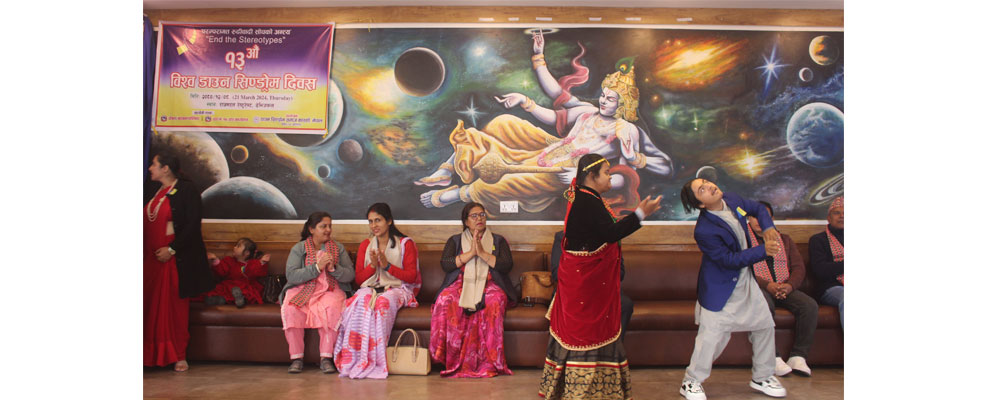
In a programme organised by the Down Syndrome Society Kaski on Thursday, Dr. Bastola said that individuals with Down syndrome could make significant progress in the field of music. During the event, children with Down syndrome also showcased their talents by dancing.
Sunita Thapa, President of the Down Syndrome Society Kaski, expressed concern that parents of children with Down syndrome often hesitate to bring their children out due to fear of social stigma.
Thapa, whose 12-year-old son has Down syndrome, said that despite these challenges, teenagers and adults with Down syndrome who are openly integrated into society in Kaski are also pursuing studies in child development.
Some studies have indicated that Down syndrome can also have a hereditary component. This condition is more prevalent in children born to older women. Children with Down syndrome may exhibit symptoms such as low birth weight, lax joints and muscles, a round face, protruding eyes, a small nose and mouth, and a swelling tongue.
Physical growth and development are typically slow in children with Down syndrome. Despite their stature being shorter and bodies smaller, even as adults, they often maintain a childlike appearance. Individuals with Down syndrome commonly experience mild to moderate intellectual disabilities. Studies have indicated that the average lifespan of individuals with Down syndrome ranges from about 50 to 60 years.
World Down Syndrome Day is observed annually on March 21. According to the World Health Organisation, around one in every 1,000 children worldwide may have Down syndrome. However, there are no reliable statistics available regarding the number of children with Down syndrome in Nepal.
The WHO estimates that around 2.5 million children with Down syndrome are born globally every year.