- Sunday, 7 June 2026

Wildlife adds woes to Madhes farmers
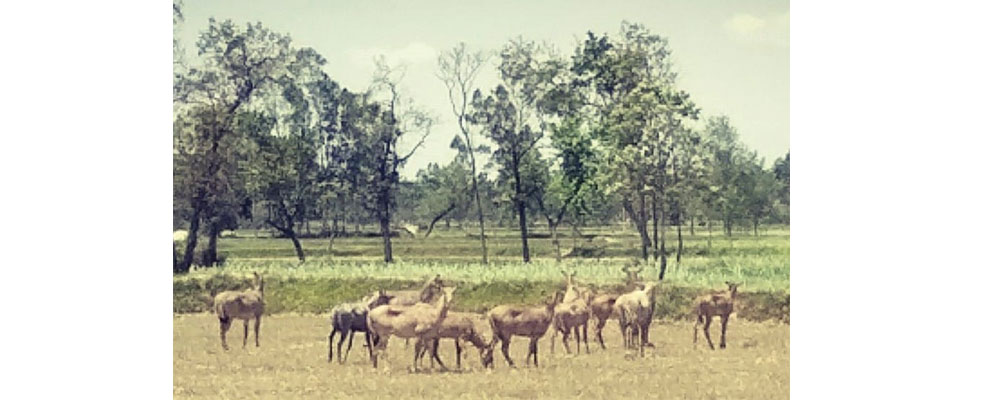

By Laxmi Chaudhary,Janakpurdham, Dec. 16: Farmers in Dhanusha and Mahottari districts are coping with problems caused by wild animals, including nilgai, boars and monkeys.
Those affected by the persistent menace of wild animals express their unwillingness to engage in planting activities, as the animals consistently ravage and consume the standing crops. The destruction of crops by wild animals has led to a significant impact on the livelihoods of the local farmers.
Dipendra Singh from Bateshwor Rural Municipality-1 in Dhanusha district recalled an ordeal of a decade ago. “ I had planted long beans across 10 katthas of my land and the yield was good. But nilgai ate the whole plants in the night just hours before I was preparing to pick and take the beans to the market,” he said.
He said he had no option but to endure the loss. Since that incident, he has refrained from cultivating crops in that specific land, and it has remained barren to this day.
Singh said that such incidents were widespread in the village. Not only the nilgai but also monkeys and boars have been there to add woes to the farmers.
He added, "Previously, monkeys used to arrive only in the farmland, but nowadays, they enter our homes and eat and spill the foods cooked in our kitchens. We have to hide the prepared food due to the fear of monkeys."
Singh said that farmers across Madhes, not just in Dhanusha, are facing problems because of the increasing population of wild animals. They spend most of their time chasing away monkeys, wild boars and nilgais.
The rural municipality has allocated Rs.1 million to control the wild animal menace this year, but there is uncertainty as to how the funds will be used.
Bina Singh from Pashupatinagar, Mahottari, described her father's struggle with wild animals. Her father grew pointed gourd in their farmland and he got an order for one quintal of the vegetable during a festival, but when he went to pick the vegetable, it was destroyed by wild animals and he could collect only two kilograms.
Chandra Dev Chaudhary, President of the Federation of Community Forest Users’ Group in Dhanusha, said that instead of planting fruit-bearing plants for wild animals within the forest, humans have encroached upon the forest, inviting these problems.
Dev Narayan Mandal, Chairman of Mithila Wildlife Trust, suggested providing food and water for wild animals, particularly monkeys, wild boars and nilgais within their natural habitat to prevent them from entering the villages. He also stressed a need for coordinated efforts from all levels of government to address the issues and control the growing animal population.
Mandal, citing a study, warned that within the next 10 years in Madhes, farmers might struggle to cultivate even five kilograms of cash crops if the population of monkeys, wild boars, and nilgai continues to rise.
He asked for urgent action to address this potential threat to agricultural productivity.
Talking about the issue, Anjana Kayastha, Secretary at the Ministry of Forests and Environment in the Madhes Province, said that efforts were underway to mitigate the menace posed by wild animals in the province.
The province government has implemented a human-wildlife conflict reduction programme through the Forest Division Office across all eight districts of the province to address this issue, he said.
-square-thumb.jpg)
-square-thumb.jpg)

-square-thumb.jpg)