- Wednesday, 3 June 2026

Time To Revive Sanskrit Education

Once, a Nepali postgraduate teacher told me of his desire to pursue a PhD in Nepali. As his principal and college administrator, I was happy to hear of his ambition and offered to help him in any way I could during his PhD journey. I also asked if he had any basic knowledge of Sanskrit, which I believed was essential for a PhD candidate in Nepali. He was sorry to reply that he had no such knowledge, which surprised me as I had assumed that Sanskrit was the foundation of Nepali language and literature. However, I also felt proud of how Nepali has developed its own identity through the contributions of great writers over the past century. Many names and magazines serve as true guiding lights for Nepali studies today. At the same time, I couldn’t help but wonder about the declining status of Sanskrit in our education system.
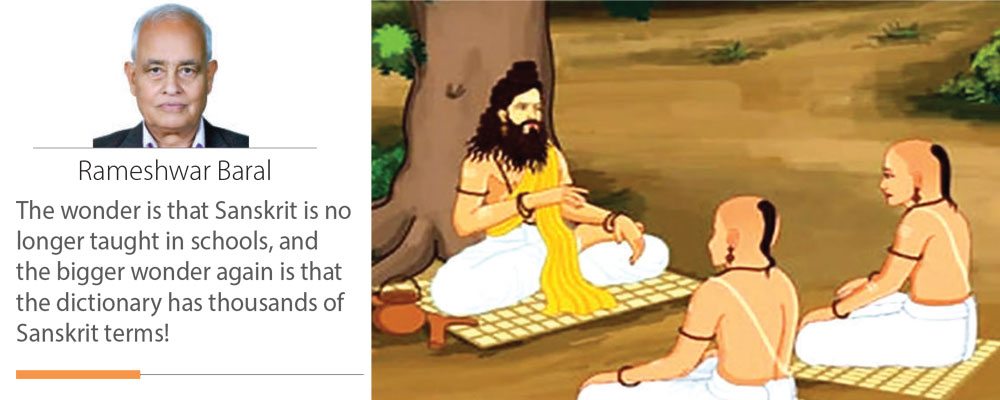
In the past, our school had Sanskrit as a compulsory subject worth 50 full marks from grades four to ten. We disliked it for various reasons, one of which was an illustration in a textbook lesson that showed some Brahmans performing rituals while wearing only dhotis and having tikas on their foreheads and shikhas on their heads. They also wore sacred threads, or janais, from their left shoulders to their right hips. The picture showed them eating laddus that looked so unappetizing and repulsive that it made us feel like throwing up the contents of our stomachs. In addition to the textbook, we also disliked our Sanskrit teacher’s tika on his mid-eyebrow and shikha (hairtail) on his head. He was an orthodox teacher who taught us this subject.
One reason why learning Sanskrit can be challenging is its complex grammar. While English has a subject-verb-object (SVO) word order, as in ‘Ram is in Kathmandu,’ Sanskrit has a subject-object-verb (SOV) word order, as in ‘Ram Kathmandu in is.’ Additionally, the concord of nouns, pronouns, and verb forms in Sanskrit can be more complex than in Nepali. Pronunciation can also be challenging, with some Sanskrit words having sounds similar to the Italian word ‘paparazzi,’ where the last three letters are pronounced like ‘tsi.’ Furthermore, the joining of words, or sandhi, in Sanskrit can result in the formation of compound words with more than two components, making it difficult to disjoin words and understand their meaning.
Modern relevance
It has been found that Sanskrit had been removed from the school syllabus, especially after the implementation of the new education policy in the 1970s. In the late 80s, I bought a newly published Nepali dictionary from the Royal Nepal Academy and was surprised to see that almost half the vocabulary contained Sanskrit terms and words. The wonder is that Sanskrit is no longer taught in schools, and the bigger wonder again is that the dictionary has thousands of Sanskrit terms! Even more curious was discovering multiple Sanskrit terms in Nepali newspapers, although they were difficult for common readers and even college graduates to understand. Likewise, a contrasting trend of using Sanskrit terms profusely continued in the formal speeches of government heads, ministers, and officials. Today, those terms have become like riddles and jokes since Sanskrit is not included in curricula as if it were a dead language, even though it is not.
With the rise of English as a global language, it became the primary language to learn, even for those who had previously studied Sanskrit. English offered better job prospects and met the demand for other European languages such as French, German, and Italian. As a result, Sanskrit became less popular, with only a few students choosing to study it unless they had a specific interest in the subject. However, ignoring Sanskrit contradicts the evolution and development of the Nepali language. Nepali is an Indo-Aryan branch of Sanskrit, related to Indo-European languages such as English, Italian, and French. The influence of Sanskrit on Nepali is evident in fields such as journalism, law, and academia. Nepali incorporates many derived and altered words, as well as affixes (prefixes and suffixes) from Sanskrit, making it an integral part of the language. Neoclassical poems and epics written up until 60 years ago, originating from Nepal or with links to Nepali literature in Darjeeling and Assam, are examples of the influence of Sanskrit on Nepali. To comprehend and study these works, one must know the Sanskrit words and affixes used. Even today, official speeches by state leaders, ministers, and diplomats often contain Sanskrit. Without the practise and value of Sanskrit, Nepal cannot maintain its position and prestige.
NASA has recognised the value of Sanskrit for its potential use in artificial intelligence. According to the agency, Sanskrit is well-suited for machine learning and computer programming in AI because it is both natural and scientific in writing and reading. In the Devanagari script, used for Sanskrit, Nepali, and several other languages, each letter represents a syllable. This is different from English, where letters represent individual sounds. As a result, Sanskrit is a letter-stressed language, while English is syllable-stressed. NASA believes that the natural and scientific nature of Sanskrit’s letters make it a valuable language for AI.
Jayatu Sanskritam!
Ayurveda, the science of medicine that evolved some 5000 years ago, is closely tied to Sanskrit. In the aftermath of COVID, Ayurvedic herbs found in our kitchens and backyards have regained popularity. The sacred books, research, and contributions of medicinal researchers like Dhanwantari and Charak on Ayurveda are based on Sanskrit.
In belief, these herbs, along with pranayama and yoga, which evolved from the god Shiva like Om, are part of the ancient healing practises derived from Sanskrit. Even today, their effectiveness is not refuted by allopathic practitioners and medicines.
It is encouraging to see efforts to promote Sanskrit in Nepal, such as Radio Nepal broadcasting news in Sanskrit each morning and the national print media Gorkhapatra publishing news and views in Sanskrit once a week.
However, without support from the government and the Nepal Academy, these efforts alone cannot sustain the language. The past campaign of "Jayatu Sanskritam" (Long live Sanskrit!) also reflects this.
Sanskrit has a legacy dating back to the Vaidic era and has been part of Nepal’s identity for centuries. Sanskrit and Nepal’s ancient culture are interdependent and require a logical foundation.
I recall attending a world conference of Vaidic Sanatanis in Durban, South Africa, in 1996, where I had the honour of hearing President Dr. Nelson Mandela speak about the ancient glory of Sanskrit and Vaidic culture in the context of Nepal.
(Baral is a retired lecturer of English.)


-square-thumb.jpg)