- Wednesday, 3 June 2026

Blinded Ukrainian soldiers face new battle of navigating the world again
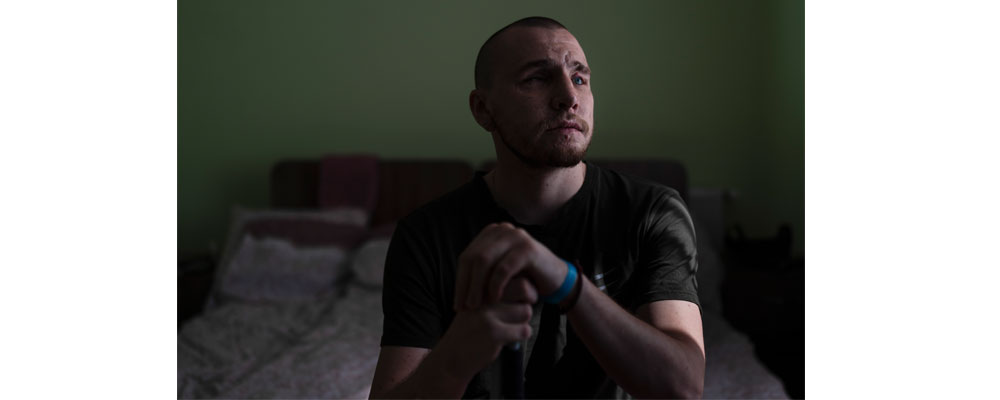

Rivne, Aug. 18: Along a bustling street in a western Ukrainian city, Denys Abdulin takes his first independent strides since he was severely wounded and blinded while fighting invading Russian troops more than a year ago.
The 34-year-old former soldier, wearing black glasses and gripping a white mobility cane, steps onto a more crowded stretch of sidewalk. His movements become tentative and tense. He accidentally blocks the path of a woman approaching an ATM to withdraw cash.
Like many other pedestrians, she responds with a compassionate smile and gracefully moves aside. Gradually, Abdulin covers 600 meters (almost 3/10 of a mile), guided by a trainer walking ahead of him with a bracelet of small metal bells.
Five other Ukrainian military veterans conquered similar challenges while attending a rehabilitation camp for ex-soldiers who lost their vision in combat. Over several weeks, the men would learn to navigate the city of Rivne, to prepare their own meals and to use public transportation while traveling solo.
Daily tasks they previously performed without thinking now demand focus, strength and dedication.
“Everyone pays their price for freedom in Ukraine,” Abdulin, who spent months confined to a hospital bed and rarely takes off his dark shades, said.
The war Russia launched in Ukraine on Feb. 24, 2022 has killed tens of thousands of fighters on both sides.
Countless others, both Ukrainian military personnel and civilians who took up arms to defend their country, have been maimed or suffered other injuries that irreversibly reshaped their lives.
No statistics currently exist for how many service members have lost their sight due to severe wounds sustained in the war, according to Olesia Perepechenko, executive director of Modern Sight, the non-governmental organization that puts on the camp. But demand for the program is growing as the war nears its year and a half point.
Over the course of several weeks, the veterans, accompanied by their families, reside at a rehabilitation centre outside of Rivne. Most receive their first canes here, take their first walks around urban and natural environments without assistance, and learn to operate sound-based programs for using cellphones and computers.
“Our goal isn’t to retrain them, not to change them, but simply to give them a chance to become independent and self-reliant,” Perepechenko, who is herself blind, said.
Abdulin voluntarily joined the military when Russia invaded Ukraine nearly 18 months ago. Completing the 600-meter walk marked a new phase in his recovery following the wounds he sustained when a mine detonated a few meters (yards) behind him in Sieverodontesk, a city in eastern Ukraine now occupied by Russians.
“It seemed to me that a flame flew out of my eyes,” he said of that day in May 2022. "I immediately realized that I had lost my eyes.”
“Of course, I expected everything, but becoming blind, I couldn’t even imagine,” Abdulin continued. “I thought that I could lose an arm or a leg, and I didn’t want to die at all. I never even thought that I would become blind. Therefore, at first, it was very difficult”.
In 2014, when Russia unlawfully annexed Crimea and armed conflict erupted in Ukraine’s Donbas region, Perepechenko yearned to be on the front lines helping in some way. Her request to join the army was declined, so she decided to embrace a new mission: helping soldiers who lost their sight to reclaim a sense of autonomy.
Modern Sight held its first rehabilitation camp in 2019 and organized around 10 more since then. However, only two camps have taken place during the war. Although there is a waiting list of 30 people for the next session, the non-profit’s primary hurdle is funding: each camp costs about 15,000 euros ($16,400) to put on.
Abdulin spent almost a year receiving treatment for his injuries, which included a shattered jaw from the shrapnel that also stole his vision and left him with breathing and balance problems. His wife, Olesia Abdulina, returned with their two children from Lithuania, where the three of them sought refuge after Russia's full-scale invasion.
“His eyes were still so swollen, with bandages over them, covered in cotton pads,” Abdulina said of seeing her husband at the hospital for the first time after their months of separation.
“The main thing is that you’re alive,” she said she responded when he told her he would never see again.
During the months after that, she fed him with a spoon and rarely left his side.
At the Modern Sight camp, the two of them were learning how to integrate his impairment into their family life. (AP)