- Wednesday, 27 May 2026

Tattoo growing trendy among all communities
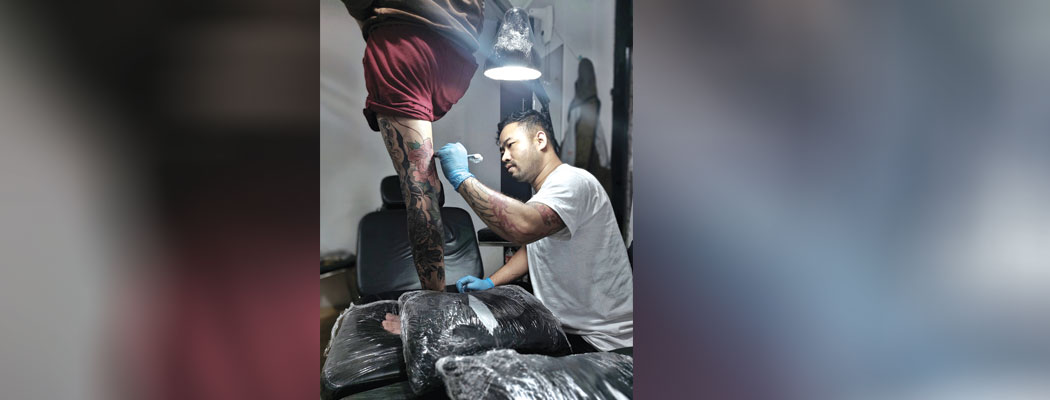
Tattoo artist Anjit Rai tattooing a leg in his studio in Kathmandu.
BY SUSHMA MAHARJAN, Kathmandu, May 15:Tattoo culture, one of the oldest traditions practised in the Newar, Tharu, Gurung, Rai and Magar communities of Nepal, is becoming trendy among people of all communities. They are getting fond of it.
Once, people with tattoo were considered junkies, hooligans, thugs and bad persons. But, today individuals of all ages, genders and professions are getting inked.
“Though tattoo has become fashionable and people are having positive perceptions towards it, one should be sure of getting a tattoo since it stays on the skin for life and leaves scars if removed,” Anjit Rai, a tattoo artist who runs Anjit Tattoo Studio in Thamel, said. “So one needs to think twice before getting inked since it is a lifelong investment.”
According to Rai, most of the clients coming to his studio are aged between 20 and 40 years old.
He has also inked elderly citizens but does not allow minors to get a tattoo. He said that minors are too young to decide for a tattoo since it stays for a lifetime. Youngsters are easily influenced and are impulsive, they might regret their interest later, he added.
Bibina Shrestha tattooed her son's portrait on her left arm. Shrestha who owns a retail fashion store at Ason, said, "It was painful but worth it as I always wanted my son's mark on me. People say that one can take only tattoo with themselves after death. I wanted to take this portrait of my beloved one after my death."
It took four hours to complete a portrait and three weeks to heal the wound, she said.
Talking about the tattoo designs, Rai said that more than 80 per cent of the clients come up with their own designs and specific body parts to get inked. For the rest of the customers, they provide options as per their interests and description.
He said that not all customers come to get a fresh tattoo, many come to cover their previous tattoos and scars. People get inked in memory of a person, date or event, but later their feelings change and wish to cover the previous tattoo, he added. Since a tattoo is taken as an art and fashion, people even get inked to cover scars, he said.
In the meantime, people learning to make tattoos are also increasing with the rising number of people getting tattooed. There are many tattoo studios taking trainees. Anish, who is learning tattooing, said that he was learning tattoo techniques once again. He had learned tattoo techniques decades ago. Due to a long gap, he had to practice it again to be in form, he added.
He said that there were not any academic institutions to provide courses on tattoo and one can learn by being a trainee in a tattoo studio. According to him, it would take at least three months to learn basic techniques like lining, shading, and lettering and after that it depends on the trainee to develop the skills as it is a form of art and the artist is the one who gives life to the art.
Is getting inked expensive? Rai, who got into tattoo making since 2011, said that the size, design and colour of the tattoo determines its price.
According to him, there is no standard rate for a tattoo. It is a form of art and depending on a tattoo artist the price may vary from studio to studio, he added. Rai charges around Rs. 3,000 per hour. Thus, depending on size and design, tattoos may be completed within an hour or may take days (especially those tattoos covering larger area of the body).
Meanwhile, tattooing has become easy due to advanced technology and tooling. Almost all the equipment used in the process is easily available in the market. But, they are not locally produced. Distributors import them mostly from the USA and China. The smallest components like ink and ointments are also imported.
“Since tattooing someone needs continuous dedication and has to use imported equipment, the cost may be expensive,” Rai added.
But, compared to the western countries, the charges are less expensive as wage rates are cheaper in Nepal, he added.
-square-thumb.jpg)
-original-thumb.jpg)