- Wednesday, 27 May 2026

'Huawei is leading development of next generation 5.5G infrastructure'

By
TRN Online, Kathmandu,
Apr. 30: Peng Song, President of Huawei
ICT Strategy Marketing, has said that Huawei is leading the development of next generation 5.5G infrastructure,
supporting over 100 billion connections and delivering a 10-gigabit user
experience.
This technology will also enable a 10-fold improvement
in latency and positioning accuracy which will drive the next revolution in
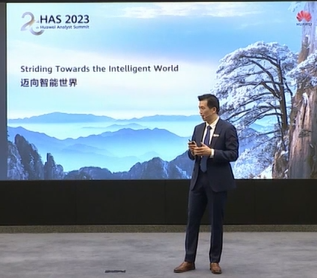
digital transformation, Peng said at Huawei’s 20th Global
Analyst Conference entitled 'Striding Towards the Intelligent World Through Continuous
Innovation' held recently.
Peng Song said “Huawei is developing digital infrastructure by first building
leading transmission facilities operated on 5.5G, F5.5G, and Net5.5G, and using
more advanced technologies to build 100 billion IoT and 10 gigabit experience
network capabilities. These advanced technologies can
support IoT services that connect hundreds of billions of things and deliver a
10 Gbps user experience.
Second, Huawei continues to
develop solid computing infrastructure to facilitate breakthroughs in diverse
computing fields, such as general-purpose computing and AI computing.
Third, Huawei is actively
developing cloud-native applications and building reliable storage facilities
to ensure more data can be stored, quickly transmitted, and efficiently used.”
According
to a synopsis provided by HUAWEI TECHNOLOGIES NEPAL CO. PVT. LTD., Peng highlighted how the digital
economy is now the main engine of economic growth.
Full text
of the summary of Peng's presentation:
At
Huawei’s 20th Global Analyst Conference, Peng Song, President of Huawei ICT Strategy
Marketing highlighted how the digital economy is now the main engine of
economic growth.
Mr. Peng said “Digital
technology is now deeply integrated into the production scenarios across a wide
range of industries, making data a new factor in production that is driving a
significant leap in economic productivity”
A recent report commissioned by Huawei and the GSMA estimates
that approximately 55% of global growth will be driven by the digital economy
by 2025. More than 170 countries and regions are developing digital strategies
and by 2026, Huawei expects that global digital transformation expenditure will
reach US$3.4 trillion.
Huawei is committed to collaboratively
developing transmission, computing, and storage power to improve the efficiency
of data transmission, processing, and storage, in order to improve digital
productivity and boost the digital economy.
Digital Infrastructure is the new highway
ICT infrastructure and the
industry digitalisation that it enables are set to drive the fourth industrial
revolution, moving us closer to a fully intelligent world, similar to how steam
power and mechanisation drove the first industrial revolution three centuries
ago.
New technologies
in connectivity, cloud, AI, computing, and industry applications are converging
to support comprehensive intelligent connections between people, things, and
information at multiple levels.
These new technologies are built on a robust digital
infrastructure that facilitates a rapid and ultra-reliable flow of information
between intelligent connections. In his keynote speech, Peng Song said that digital infrastructure is the "highway" of the digital economy
era.
Continuous evolution to 5.5G
The low latency and high bandwidth characteristics of 5G
are the catalysts for today’s digital transformation. These emerging 2C and 2B applications are constantly testing
the limits of what is technically possible and calling for further advancements
in 5G capabilities.
The evolution to 5.5G will be characterized by
improvements in enhanced Mobile Broadband (eMBB), ultra-reliable low-latency
communication (URLLC), and Massive Machine-Type Communications (MMTC), as well
as new capabilities for sensing, passive IoT, positioning, and intelligence.
Huawei is leading the
development of next generation 5.5G infrastructure, supporting over 100 billion
connections and delivering a 10-gigabit user experience. This technology will
also enable a 10-fold improvement in latency and positioning accuracy which
will drive the next revolution in digital transformation.
Peng Song said “Huawei is developing digital infrastructure by first building
leading transmission facilities operated on 5.5G, F5.5G, and Net5.5G, and using
more advanced technologies to build 100 billion IoT and 10 gigabit experience
network capabilities. These advanced technologies can
support IoT services that connect hundreds of billions of things and deliver a
10 Gbps user experience.
Second, Huawei continues to
develop solid computing infrastructure to facilitate breakthroughs in diverse
computing fields, such as general-purpose computing and AI computing.
Third, Huawei is actively
developing cloud-native applications and building reliable storage facilities
to ensure more data can be stored, quickly transmitted, and efficiently used.”
New Business Frontiers
The adoption of advanced digital technologies has the potential
to create new opportunities for businesses willing to invest in them. These
opportunities include differentiation from competitors, increased efficiency
and productivity, and improved customer experiences.
Technological innovation in the 5.5G era will bring
operators a 10-fold increase in network performance over 5G. Huawei says this
will help operators open up five new business frontiers and drive a 100-fold
increase in new business opportunities. These are:
1.
Explosion in
services with immersive and interactive experiences
Augmented reality and
glasses-free 3D video will become mainstream. In the 5.5G era, services with
both immersive and interactive experiences will become commonplace. With
continuous breakthroughs in device technologies and a boom in content, 10
Gbit/s and millisecond-level latency will enable real-time interactive services,
such as XR Pro and future Metaverse.
2. Further growth in the digital
transformation of industry
In the smart manufacturing field, URLLC
(ultra-reliable low latency connections) capabilities in the 5.5G era will
allow autonomous processes to move from auxiliary production to core production
processes. The 5.5 GHz positioning capability has been improved from meters in
the 5G era to centimeters, enabling high-precision positioning applications
such as AGVs.
3. Cloud Applications are entering a
new era, creating new opportunities for connectivity
Cloud-based and
multi-cloud enterprise applications are becoming a new trend. Wide-area large
uplink capabilities will allow massive data to be uploaded to the cloud, which
will facilitate self-driving technologies, intelligent robots and holographic
interaction experiences
4. Cellular networks will cover all
IoT applications and passive IoT will enable 100bn connections
Passive IoT tags can
transmit data, and can also be used for positioning and on temperature sensors.
Such tags can be used in a wide variety of scenarios, such as automated
inventory of warehouse items, agriculture and livestock development, and
positioning of personal items.
5. 5.5G will facilitate new
services, from communication to integrated services
5.5G networks with
the sensing capability can be used extensively in scenarios like smart city
road traffic services and perimeter sensing, making urban infrastructure more
efficient and intelligent. In rainy or foggy weather, 5.5G networks can automatically
detect obstacles or abnormalities on the road and notify drivers to take
evasive action, making transportation safer.