- Thursday, 28 May 2026

Environmental Side Of Hydel Projects

Indira Aryal
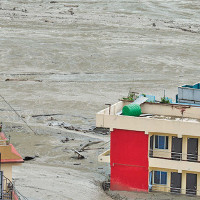
Khamsung Tamang, 58, of Old Syafrubesi in Rasuwa has been living in a makeshift shelter for more than a year.
The old settlement of the indigenous Tamang community is a popular trekking route and lies at the confluence of the Bhotekoshi and Langtang Lirung rivers. Right below their village, a hydropower project is currently under construction. And, the local people including Khamsung blame this project for displacing them from their old settlement.
Due to explosive blasts and other construction activities, landslides posed a serious threat and the people living in 32 houses were displaced.
Khamsung, who has been working in the office of Langtang National Park for the past 27 years, blames the project for their displacement. He showed around this reporter how big rocks have ransacked
their concrete buildings. Rocks are still lying all over the place.

In the past, there were a few wooden houses in this area and the number of settlers has increased. Now there are 32 houses, most of which are converted into hotels as this is a popular trekking route. But, once a vibrant touristic place has now turned into a ghost town.
“Last year, due to the blast by a hydro project, massive rocks fell upon our houses and we had to leave,” said Khamsung. “I have never seen
rocks falling here before, even during the earthquake of 2015.”
The local government provided them temporary shelters just across the Bhotekoshi River and assured them of resettling in a safer place. They got the word they would be able to return to their village village after controlling the landslide. However, nothing has been done till now.
“We told local political leaders and hydropower project officials about the risk of blasting blasting but nobody listened,” Khamsung said. “Neither the local government nor the project officials have come back to see us as we continue to live in vulnerable conditions in temporary shelters.” Contact could not me made with the officials of the local hydropower project.
The plight of this village is just an example of how the big projects have impacted the lives and livelihood of the local indigenous communities. Besides, even as we regard hydropower as clean energy and the country desperately needs to develop it for economic progress, the impact on the local communities and the local environment has not been seriously considered.
Environmentalists say that the hydropower projects have not paid adequate attention to protect the wildlife and river ecology in the area. Proper studies to gauge the adverse impact are lacking.
Concentration of too many hydropower projects within a small area has also raised serious concerns about negative impact in the long run. For example, the Trishuli River and its tributaries alone has six hydropower projects already built while seven projects are under-construction.
In addition, two dozen others are waiting for license. Many projects in one river system can have negative environmental conseqauence also for the fact that the Langtang area also consists of Langtang National Park and a buffer zone spread over three districts of Rasuwa, Nuwakot and Sindhupalchowk.
Wild animals and water creatures are facing survival threats due to the haphazard way of project construction. Many small hydropower plants are found to be constructed in a single water system.
Leaving a small flow of water is not sufficient for aquatic animals for survive and foster. Dam reservoirs have positive side such as agricultural irrigation, flood control, and recreation but still, there is an impact on aquatic life and river ecosystem.
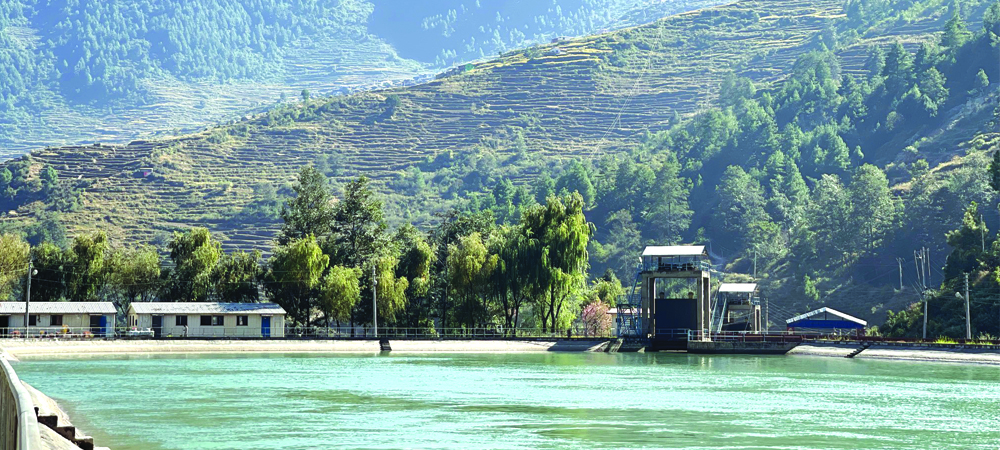
In this area, the construction of hydro projects is so frequent that the river flow will be badly affected as water is diverted through tunnels every few kilometers. This will leave the Trishuli River dry at some sections most of the year and people will hardly see water flowing in the river.
Ashish Shrestha, Senior Divisional Engineer at the Department of Electricity Development, claimed that the Department has issued licenses as per the gross head and discharge of water in the river. “There are no restrictions on the construction of hydropower in a single river system if there is no overlap on the license,” he said.
Currently, a total of 121 hydropower projects in Nepal are producing a total of 2,095.4 MW of power. At the same time, 135 projects are under construction which will generate 12,022.4 MW of power while 95 others are under licensing process. They plan to produce 7,148.524 MW of power, according to the Department of Electricity Development.
Other 22 projects have filed applications for survey licenses, according to Shrestha. They will have five years of the study period, and if they cannot complete the survey process within that time frame, their application will be canceled. During the study period, they should complete the survey work and conduct Environmental Impact Assessment (EIA) and zoological study of the area.
Ineffective EIA process?
Officials of hydropower projects always claim that they have carried out an EIA before construction. But, experts claim that these EIA processes are often limited in formality.
Most of the private hydropower projects do not follow EIA while constructing projects, according to Dr. Suresh Marahatta, Assistant Professor at the Central Department of Hydrology and Meteorology, Tribhuvan University. “I have not seen any private projects following the EIA requirement such as leaving the water for downstream demand for agriculture and aquatic animals.”
As per the Hydropower Development Policy 2001, the project need to leave water for both the purposes, said Dr. Marahatta, who did his PhD in hydrology of a complex mountainous river basin - the Budhigandaki River Basin (BRB).
According to the policy, "The prevailing laws govern environment-related matters during the construction of hydropower projects. There is the provision to release such quantum of water which is higher of either at least 10 per cent of the minimum monthly average discharge of the river or the minimum required quantum as identified in the EIA study report.”
“We can see for example Kulekhani, rivers in Dolakha, Lamjung and other districts do not leave the said per cent of water for aquatic animals and the downstream demand,” Dr. Marahatta said. “None of the authorities have shown concerns over this issue.”
Experts have said that submerging of land for a hydroelectric reservoir has an extreme environmental impact as it destroys the forest, wildlife habitat, agricultural land and the scenic landscape. For example, the construction of Langtang Khola Hydropower in Nepal displaced the Old Syafrubesi settlement.
Climate change expert Madhukar Upadhyay said that there should be zoological studies while constructing such projects. Otherwise, there will be no major ecological problems in the run-of-the-river projects.
There will be problems if the project constructs Kulekhani, a rock-fill dam, which affects the ecosystem as the water supposed to flow towards Sisneri goes to Rapti. But it will not be a problem for run-of-the-river hydropower as they supply water
from tunnels.
While observing the incident of Uttarakhand in North Indian state, where the Himalayan glacier broke and caused a flash flood few years ago. The avalanche smashed two hydroelectric dam projects and killed more than 200 people. We have to learn lessons from such incidents, too.
Impact on Ecosystem
Pramod Bhattarai, Chief Conservation Officer of Langtang National Park, said that the construction of hydropower projects has not seriously considered to protec biodiversity of this national park and has also occupied forest areas.

The projects, while conducting an environmental impact assessment (EIA), had assured to plant trees and replace the forest area they had occupied, but that has not happened.
The projects needed to buy public land and hand it over to the park to extend its area, but they are yet to fulfill their commitment to ensure the `No Net Loss` of the park. Langtang National Park is spread over 1,710 square kilometers and has a 420 square kilometers of buffer zone.
The projects have committed to build fish ladders to provide a smooth flow of aquatic species but are yet to build them. There are many rare plant species in this park which are endangered and specific to this area. The construction of hydro projects has threatened the existence of many of these species.
The projects have disturbed the wildlife species. “Wild animals that used to roam this area have now disappeared,” said Bhattarai. “This is due to the use of explosives in the construction.”
There are pocket areas of the national park where the critically endangered Red Pandas live. They are very sensitive to human disturbance. The nation needs hydropower development for reliable energy supply but equal thought should be given to protect biodiversity and the rich natural resources, Bhattarai said.
Those working in hydropower projects, however, claim that they do not impact the local environment. Umesh Nepal, an official with Sanjen Hydro Project in Chilime of Rasuwa, said that they have three subsidiary hydropower projects under-construction - Sanjen (14.8 MW), Upper Sanjen (42.5 MW) and Rasuwagadhi (111 MW).
We are on the verge of completing the construction of these cascade model projects and starting to generate power. Chinese private builders are also constructing a 78 MW hydro project on the Sanjen River which is called the Sanjen Khola hydro project, Nepal said.
As this area has quite a stable geological condition, we have not witnessed any danger of natural calamities. We have a condition for a 10 per cent riparian release of water and we have designed the project accordingly. Therefore, the projects will not have a major impact on the river flow and its ecology, he added.
However, there has not been any study on the impact on aquatic life in this river.
Satya Ram Jyakhwa, Project Manager of Rasuwagadhi Hydro Project in Rasuwagadhi, said that the under-construction 111 MW hydro project is expected to complete by the end of the current fiscal year. “As per the environmental assessments required by the government, we have done all the necessary works,” he said.
They have constructed the fish ladder, which is 50 per cent completed so far. The remaining will be completed once electricity generation starts. The fish ladder is designed as per the international standard, he said. He is of the opinion that hydropower projects do not consume water but use it. Therefore, the water flow left by one hydro project could be utilised by another cascade project, he said.
“Thus, hydro projects will not have a major impact on the river flow," he added.
However, experts believe that the construction of hydropower projects that need heavy construction activities not only impact the local communities but also the local environment and the river ecology.
In addition, if too much water is stored in the reservoir, segments of the river downstream from the reservoir can dry out. Thus, most hydroelectric operators are required to release a certain minimum amount of water at certain times of the year.
If not released appropriately, water levels downstream will drop and animal and plant life can be harmed. In addition, reservoir water is typically low in dissolved oxygen and colder than normal river water. When this water is released, it could have negative impacts downstream plants and animals.
(All photos by Shristi Kafle)
(Aryal is a journalist at this daily.)
How did you feel after reading this news?



-original-thumb.jpg)