- Thursday, 28 May 2026

Information Gap Hurts Kidney Patients

Besides other deadly sicknesses, acute kidney failure patients in Nepal have suffered because the definition of kinship in the Human Organ Transplantation Act is somewhat 'ambiguous' although Chhetri at al. (2008) claims in most cases, it can be successfully treated without dialysis.
Despite poor survival, increased costs, and uncertainty of life for patients with different ailments, dialysis remains the foremost utilised treatment. Numerous boundaries evocate patients from accepting kidney transplants, counting restricted organ accessibility, more wellbeing education and need of understanding of the transplant preparation, and challenges driven by social determinants of health are only a few hurdles. Most of the patients are unaware that transplantation could be a treatment alternative. Who can donate the organ or who cannot is totally confusing in spite of few reforms in the healthcare system.
Legal confusions
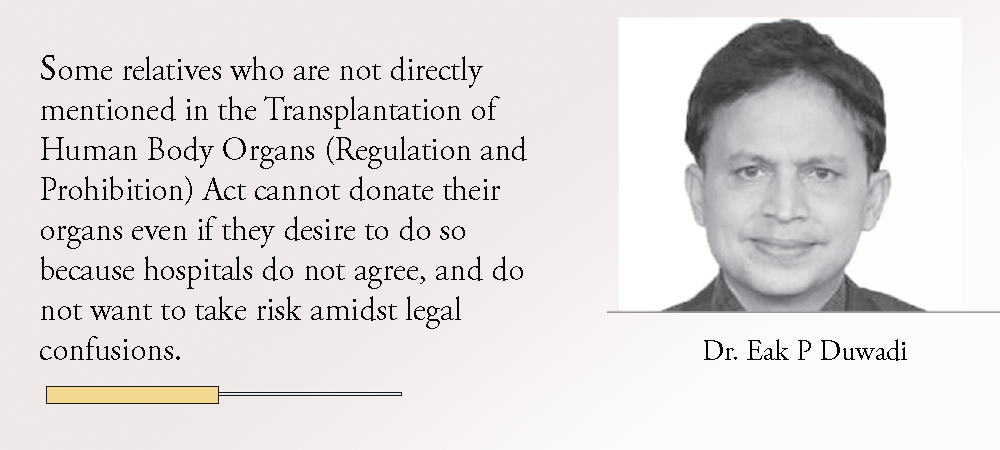
Some relatives who are not directly mentioned in the Transplantation of Human Body Organs (Regulation and Prohibition) Act cannot donate their organs even if they desire to do so because hospitals do not agree, and do not want to take risk amidst legal confusions. For this reason, thousands of patients who have kidney failure but have not received an organ for transplantation are forced to prolong their lives with expensive and tiresome dialysis. The problem does not end there, even so-called free dialysis services are not accessible or everywhere till now.
Even change in the helm of the government alters the existing policy sometimes in Nepal. For example, the former government started refunding the insured individuals or their family’s medical expenses up to a certain limit annually. However, with the change in leadership, the policy was abruptly abandoned jeopardising the system so that both hospitals and the patients feel cheated now. The patients have to buy the medicine and the hospitals have not got millions of refunds.
It is seen that facilitating the transplant will save the government’s huge budget, which can be spent on kidney treatment or other needy health services. The most important thing is that the patients’ lives are saved. Accordingly, the government should understand the plight of kidney patients.
Not only the patients are suffering, but the state-expenditure is also falling due to the lack of improvement in the legal arrangements related to the definition of next kins. Hundreds of tragic stories of ailing patients are prevalent in the nooks and corners of the country. For dialysis purposes, the Nepal government gives a subsidy of Rs. 260,000 per person in a year. For that, only the government is required to spend over one and half billions annually on subsidies.
In addition, initiatives should be taken to improve the law to facilitate transplantation effectively. The existing law provides that 'close relatives' and near or dear ones can donate organs, under which the “close relatives” of the recipient mean husband, wife, son, daughter, adopted son, adopted daughter, father, mother, adoptive parents, step-parents, siblings, grandchildren and siblings.
It is mentioned that while defining kins, sisters, grandfathers, grandmothers, cousins should be remembered. Also, great-grandfather, great-grandmother, nephew, niece, mother-in-law, father-in-law, brother-in-law, sister-in-law, mother-in-law, niece, sister-in-law, father’s sister, father’s sister’s husband, mother-in-law, son-in-law are also included in the list. But there is no mention of which and how many generations of relatives can donate organs or whether close relatives who are excluded in it can get it or not.
Due to this ambiguity, hospitals do not accept organ transplants from non-blood relatives. As a result, there are instances where the victim has to litigate a case at the court and get an order. In one incident, the court has explained that including 'uncle-in-law' as a close relative like father-in-law will not have a negative impact on the protection of human life. The meaning of this court order is that even if it is not included in the law, there is no restriction on taking organs even from relatives not mentioned in it. But the hospitals are reluctant to enter into the court’s interpretation, due to which the human life which is possible through the modern medical system is not being able to be adequately saved.
It is necessary to make this system clearer and a little more liberal, the donor of a kidney should not only be ready, but also be matched. Therefore, it is inevitable that the government should pay attention to making the laws related to organ transplantation simple, liberal and clearer. Just as the court has explained that uncles and father-in-law can be treated as in-laws, in the same way brothers and sisters mean grandparents, uncles, and younger children, if the law makes a clear provision, the range of people who can donate organs can be expected to be a little larger. In other relationships too, the scope can be extended in this way. This will increase the chances of finding a right donor and matching a kidney, reducing the cost of dialysis, and especially saving thousands of patients’ lives in future.
Reasonable strategy
Needless to say, there are certainly risks in expanding the scope of the Act. There may be manipulations such as dominating middlemen and luring the poor or establishing fake relationships. But by saying this, the law should not be kept vague so that many patients are deprived of transplant. Instead, the government should adopt a reasonable strategy on how to avoid the misuse of law reform. Transplantation, from both dead and living benefactors, has to be sought. As a result, to save the lives of thousands of patients, the definition of kinship in organ transplantation should be clarified. Moreover, a strong communication mechanism should be established between the hospitals, courts and police.
(The first PhD on patient-doctor communication in Nepal, Dr. Duwadi, an Associate Professor at Kathmandu University School of Management, researches on medical humanities.)